15 wks to JAMB

L.O.E.P · PhysicsNo. 13

Explainer · Work, energy and power · about 15 min

Why does carrying a bag of rice up the stairs tire you more than carrying it along the corridor?

Watch the lecture

Ash and Kay teach this lesson, start to finish.

⬇ Save for offline

Keeps it on this phone, so it plays with no signal and no data, at this same address.

In short

The key words in this lesson, in plain English:

Power:
How fast work is done or energy is transferred: power = work ÷ time, in watts (W). 1 W = 1 J every second.
Potential energy:
Energy something has because of its position or state. Lifted through a height h, a mass m gains mgh joules of it.
Kinetic energy:
The energy something has because it moves: ½mv². Double the speed and it has four times the energy.
Speed:
How fast something moves: distance travelled ÷ time taken, in metres per second. Speed has no direction; velocity does.

Free this month: 1 of 1 lessons. A free account gives you 3 a month.

Carry a bag of rice along a flat corridor and then up four flights of stairs. Both tire your arms, but in physics only one of them is work. Work is what a force does when it moves something; energy is what you need to do that work; and power is how fast you do it. Get the three straight and every question on this topic is one formula and a careful look at the units.

Kay:So when I sit at my desk reading for three hours, I'm doing no work at all? I'm telling my mum.
1

Play · the wheelbarrow

Work is force × distance

Push the wheelbarrow of sand so that you do exactly 600 J of work. Pick a force, set the distance, then push. Then try the wall.

Pick a force, set the distance, then push

0123456789100 m moved: 0 J
Force100 NDistance2 mWork W = Fd0 J

Work done

Where you see it: a labourer on a building site hauling a bucket of concrete up to the first floor by rope does work on it: the pull moves the bucket up through a distance. Work is done when a force moves its point of application in the direction of the force: work = force × distance moved, W = Fd. The unit is the PhysicsJouleThe unit of work and energy: the work done when a force of 1 newton moves something 1 metre. 1 kJ = 1000 J.Lifting a 100 g mango through 1 metre takes about 1 joule.Science dictionary ▶ (J): one newton pushing through one metre. 200 N through 3 m is 600 J, and so is 300 N through 2 m. Push as hard as you like against a wall that doesn't move: the distance is zero, so the PhysicsWork doneEnergy transferred when a force moves something: work = force × distance moved in the direction of the force, in joules (J).Carrying a bucket across flat ground does almost no work on it against gravity; lifting it up the stairs does.Science dictionary ▶ on the wall is zero, however tired you get.
2

Play · the suitcase

Pulling at an angle

You pull a suitcase 10 m across the bus park with a 50 N pull along its strap. Change the strap's angle. At what angle do you do exactly 250 J of work on it?

Tilt the strap

the part that moves it
Angle θ0°Along the ground F cos θ50 NWork Fd cos θ500 J

Force at an angle

Where you see it: a farmer dragging a sack of cassava by a rope over the shoulder: only the forward part of the slanting pull moves the sack along; the upward part just lightens it on the ground. Only the part of a force along the direction of movement does work. A pull F at an angle θ to the ground has a part F cos θ along the ground, so the work is W = Fd cos θ. At θ = 0 all of it counts; at 60°, cos 60° = 0.5, so half; at 90° (straight up) none of it moves the case along, so no work is done on it. The same idea explains why carrying a bag along a flat corridor does no work on the bag against PhysicsGravityThe force that pulls masses towards each other. On Earth it pulls objects down at about 9.8 m/s².The Moon's gravity causes the tides.Science dictionary ▶: your upward force is at right angles to the movement.
3

Play · loading the lorry

Potential energy: work stored by lifting

Lift a load onto the lorry so that it gains exactly 1500 J of potential energy. Pick the load, set the height, then lift. (g = 10 N kg⁻¹)

Pick a load, set the height, then lift

0 m0.5 m1 m1.5 m2 m2.5 m3 m25 kg
Mass25 kgHeight1.0 mPE = mgh0 J

Gravitational potential energy

Where you see it: the overhead tank on a stand above a house: water pumped up from the borehole stores PhysicsPotential energyEnergy something has because of its position or state. Lifted through a height h, a mass m gains mgh joules of it.A bag of cement on a lorry's bed has potential energy; push it off and the energy becomes kinetic as it falls.Science dictionary ▶, and PhysicsGravityThe force that pulls masses towards each other. On Earth it pulls objects down at about 9.8 m/s².The Moon's gravity causes the tides.Science dictionary ▶ spends it pushing the water out of the taps below. To lift a PhysicsMassThe amount of matter in something, measured in kilograms. It doesn't change from place to place.Your mass is the same on the Moon, but your weight there is about a sixth.Science dictionary ▶ m through a height h you push up with a force equal to its PhysicsWeightThe pull of gravity on a mass, measured in newtons: W = mg, about 10 N for every kilogram on Earth.A 50 kg student weighs about 500 N.Science dictionary ▶, mg, through a distance h, so the PhysicsWork doneEnergy transferred when a force moves something: work = force × distance moved in the direction of the force, in joules (J).Carrying a bucket across flat ground does almost no work on it against gravity; lifting it up the stairs does.Science dictionary ▶ is mgh. That work isn't lost: it is stored as potential energy, energy something has because of its position. PE = mgh, in PhysicsJouleThe unit of work and energy: the work done when a force of 1 newton moves something 1 metre. 1 kJ = 1000 J.Lifting a 100 g mango through 1 metre takes about 1 joule.Science dictionary ▶ (m in kg, g = 10 N kg⁻¹, h in m). A 50 kg bag of cement on a 3 m lorry bed has 1500 J; so does a 100 kg bag of rice 1.5 m up. Twice the height, twice the energy.
4

Ash's lab

Falling: potential energy becomes kinetic

A 0.2 kg mango drops from the tree. Watch the two energy bars as it falls. Drop it from 5 m, then from 20 m, and compare the speeds when it lands.

Set the height, then let go

PEKE
Height5 mPE at the top10 JSpeed at the ground–

Conservation of energy

Where you see it: a pile driver on a building site lifts a heavy hammer and lets it fall; the PhysicsPotential energyEnergy something has because of its position or state. Lifted through a height h, a mass m gains mgh joules of it.A bag of cement on a lorry's bed has potential energy; push it off and the energy becomes kinetic as it falls.Science dictionary ▶ it gained becomes PhysicsKinetic energyThe energy something has because it moves: ½mv². Double the speed and it has four times the energy.That is why a crash at 100 km/h is so much worse than one at 50 km/h.Science dictionary ▶ that drives the pile into the ground. Energy is never made or destroyed; it only changes from one form to another. That is the PhysicsConservation of energyEnergy is never created or destroyed, only changed from one form to another, so the total stays the same.A falling mango's potential energy becomes kinetic energy, then heat and sound when it lands.Science dictionary ▶. As the mango falls (ignoring air PhysicsResistanceHow strongly a component opposes current: R = V/I, measured in ohms. It rises with length and falls with thickness of a wire.The coil in an electric iron has a high resistance so it heats up.Science dictionary ▶), the potential energy it loses becomes kinetic energy: at every point PE + KE stays the same. Just before it lands, all of it is kinetic: mgh = ½mv², so v = √(2gh), whatever the PhysicsMassThe amount of matter in something, measured in kilograms. It doesn't change from place to place.Your mass is the same on the Moon, but your weight there is about a sixth.Science dictionary ▶. Four times the height gives only twice the PhysicsSpeedHow fast something moves: distance travelled ÷ time taken, in metres per second. Speed has no direction; velocity does.Science dictionary ▶. When it hits the ground the energy becomes heat and sound. A hydroelectric dam such as Kainji does the same with water: falling water's potential energy turns the turbines.
5

Play · the okada

Kinetic energy grows with speed squared

An okada and its rider (150 kg together) brake hard on the same road. Brake at 10 m s⁻¹, then at 20 m s⁻¹, and compare the skid marks.

Set the speed, then brake

0 m2 m4 m6 m8 m10 m
Speed10 m/sKE = ½mv²7500 JSkid distance–

Kinetic energy

Where you see it: a carpenter's hammer drives a nail in with its PhysicsKinetic energyThe energy something has because it moves: ½mv². Double the speed and it has four times the energy.That is why a crash at 100 km/h is so much worse than one at 50 km/h.Science dictionary ▶: swing it twice as fast and it lands with four times the energy. Kinetic energy is the energy something has because it moves: KE = ½mv². The PhysicsSpeedHow fast something moves: distance travelled ÷ time taken, in metres per second. Speed has no direction; velocity does.Science dictionary ▶ is squared, so twice the speed means four times the kinetic energy. The brakes take that energy away by doing work against it (force × distance), so with the same braking force the skid is four times as long: 2.5 m at 10 m s⁻¹, 10 m at 20 m s⁻¹. It's why a crash at highway speed is so much worse than one in town.
6

Work it out

Power: how fast the work is done

Kay (50 kg) runs up a staircase 4 m high in 5 s. Ash (60 kg) walks up the same stairs in 8 s. Who is more powerful? (g = 10 N kg⁻¹)

Step 1

    Power

    Where you see it: at the market, a grinding machine with a more powerful engine grinds the same basin of pepper in less time: the same work, done faster. PhysicsPowerHow fast work is done or energy is transferred: power = work ÷ time, in watts (W). 1 W = 1 J every second.A 2 000 W kettle boils water much faster than a 1 000 W one, because it gives the water energy twice as fast.Science dictionary ▶ is the rate of doing work: P = PhysicsWork doneEnergy transferred when a force moves something: work = force × distance moved in the direction of the force, in joules (J).Carrying a bucket across flat ground does almost no work on it against gravity; lifting it up the stairs does.Science dictionary ▶ ÷ time = E/t, in PhysicsWattThe unit of power: one joule of energy used or given out each second. 1 kW = 1000 W; 1 MW = 1 000 000 W.Science dictionary ▶ (1 W = 1 J s⁻¹). Ash does more work climbing (she's heavier), but Kay does hers faster, so Kay's power is greater. For something moving at a steady PhysicsSpeedHow fast something moves: distance travelled ÷ time taken, in metres per second. Speed has no direction; velocity does.Science dictionary ▶ v against a force F, P = Fv. The old unit, the horsepower, is about 746 W. No machine turns all its input into useful work: its PhysicsEfficiencyHow much of the energy put into a machine comes out as useful work: efficiency = useful output ÷ input × 100%. No real machine reaches 100%.A pump that takes 1250 W of electricity and lifts water at 1000 W is 80% efficient; the rest warms it up.Science dictionary ▶ is useful output ÷ input × 100%.
    7

    Play · arcade

    Work done, or no work done?

    Press Start

    Swipe left if work is done on the object, right if no work is done

    Score0Streak0Lives♥♥♥

    When is work done?

    Two things must happen together: a force acts, and the object moves in the direction of that force (or has a part of its movement along it). No movement, no work: holding a bucket still, pushing a stuck car. Movement at right angles to the force, no work by that force: carrying a load along level ground, a satellite going round in its orbit.
    8

    Exam corner

    How the exam asks it

    The pump question, every part of it. Tap each step to reveal it.

    A pump raises 500 kg of water from a well through a height of 12 m in 1 minute. Find the work it does, its useful power output, and the electrical power it takes if it is 80% efficient. (g = 10 N kg⁻¹)

    Now try the real ones

    Real JAMB, WAEC and NECO past questions on this lesson (the JAMB and WAEC ones in LOEP's words). Answer them one at a time: each is marked, with the worked answer.

    Start the 10 real questions ▶
    1. JAMB 2023How much net work must be done to speed up an 800 kg car from 10 m s⁻¹ to 20 m s⁻¹?
    2. WAEC 2005Which of these energy sources is naturally replaced and so will not run out?
    3. JAMB 1993A bulb is lit using electricity from a hydroelectric station. Which sequence shows the energy changes, starting from the water stored in the dam?
    4. WAEC 2020Two snooker balls collide and the total kinetic energy after the collision equals the total kinetic energy before it. This type of collision is described as
    5. JAMB 2023A porter carries a 4.0 kg load up a vertical climb of 150 m to the top of a tower. How much work is done against gravity? (g = 10 m s⁻²)
    6. WAEC 2020A ball is dropped from the top of a 20 m tower. Ignoring air resistance, which of its energies decreases during the fall?
    7. JAMB 2022A 1200 kg mini-bus starts from rest and reaches 20 m s⁻¹ in 10 s. What average power does its engine develop?
    8. WAEC 2019Two trolleys collide in a perfectly elastic collision. Apart from momentum, which quantity is also conserved?
    9. JAMB 2021A ball of mass 0.2 kg is thrown upwards at 5 m s⁻¹ from the top of a building 8 m high. Ignoring air resistance, what is its total energy just before it hits th
    10. JAMB 2019A stone falls freely, with air resistance neglected. Which quantity stays constant during the fall?

    Label it

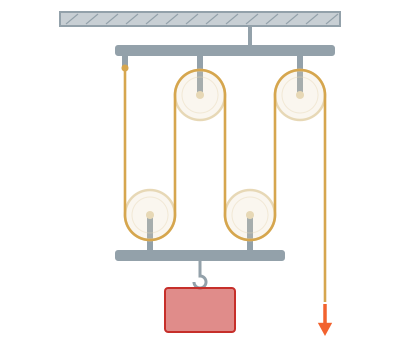
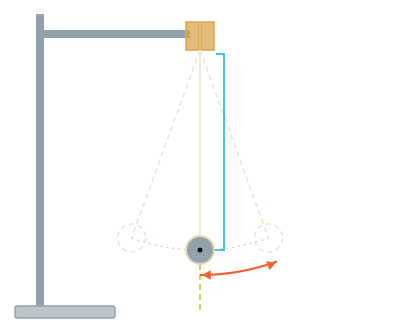
    The pendulum, where potential and kinetic energy trade places every swing, and the block and tackle, where a small effort does the same work over a longer distance, in the Label lab.
    9

    The League's test

    Pass the League's test

    Six exam-style questions from the League. Get all six right to earn your stamp. Three wrong and you resit.

    The League's badge

    League test · Work, energy and power

    You: ♥♥♥

    Press Start when you're ready.

    Remember it

    Tap a card to flip it. Say the answer before you flip.

    Ash:That's work, energy and power. Kay, sitting at your desk reading is no work on the desk, but your heart does about a joule a beat. You're never doing nothing.
    Work, energy and power: Physics explained, with games · L.O.E.P

