15 wks to JAMB

L.O.E.P · PhysicsNo. 03

Explainer · Waves · about 15 min

A Mexican wave races round the stadium. So why does nobody leave their seat?

Watch the lecture

Ash and Kay teach this lesson, start to finish.

⬇ Save for offline

Keeps it on this phone, so it plays with no signal and no data, at this same address.

In short

The key words in this lesson, in plain English:

Frequency:
How many waves pass a point each second, measured in hertz (Hz).
Wavelength:
The distance from one crest of a wave to the next, written λ. Speed = frequency × wavelength.
Speed:
How fast something moves: distance travelled ÷ time taken, in metres per second. Speed has no direction; velocity does.
Transverse wave:
A wave whose vibrations are at right angles to the direction it travels, like ripples on water and all light.

Free this month: 1 of 1 lessons. A free account gives you 3 a month.

At a full stadium, a Mexican wave races all the way round the stands in seconds. Yet nobody leaves their seat: each person just stands up and sits down. What travels round the stadium isn't people. It's a disturbance, carrying energy. That's exactly what a wave is.

Kay:I tried to run with the Mexican wave once. Ash says that's not a wave, that's a lap.
1

Play · watch it

The stadium wave

Kay is in orange. Start the wave and watch him, not the wave.

Start the wave

The wave travelled0 seatsKay moved along0 seats

What a wave is

Where you see it: a fishing canoe resting on the lagoon bobs up and down as ripples pass under it, but the ripples do not carry it to the shore. A wave is a disturbance that travels through a medium (or through space), carrying energy from one place to another without carrying the medium along with it. The PhysicsParticleA tiny piece of matter or energy, such as an atom, an electron or a photon.Light can behave like a stream of particles.Science dictionary ▶ only vibrate about where they are, just as each fan only stands and sits.
2

Play · the wave machine

Frequency, wavelength and speed

Waves on this rope always travel at 8 m/s. Change the frequency (how many waves you make each second) and watch the wavelength. Make waves of wavelength 1 m, 2 m and 4 m. (Shown in slow motion.)

Drag the frequency

0 m2 m4 m6 m8 mwavelength λamplitudecresttrough
Frequency1 HzWavelength8 mPeriod1 sTargets0 / 3

The wave words, and v = fλ

Where you see it: every FM radio station is named by its PhysicsFrequencyHow many waves pass a point each second, measured in hertz (Hz).Higher frequency sound has a higher pitch.Science dictionary ▶: tune to 101.5 and you pick up the station whose waves arrive 101.5 million times a second. PhysicsAmplitudeThe height of a wave from its middle line. Bigger amplitude means louder sound or brighter light.It doesn't change a wave's speed.Science dictionary ▶: the biggest PhysicsDisplacementDistance moved in a stated direction: the straight line from start to finish. It is a vector.Science dictionary ▶ from the rest position. PhysicsWavelengthThe distance from one crest of a wave to the next, written λ. Speed = frequency × wavelength.FM radio waves are about 3 m long; the light you see is about two-thousandths of a millimetre.Science dictionary ▶ (λ): the distance between two neighbouring crests (or any two matching points). Frequency (f): how many waves pass each second, in hertz (Hz). Period (T): the time for one wave, T = 1/f. And the wave equation: v = fλ. Double the frequency at the same PhysicsSpeedHow fast something moves: distance travelled ÷ time taken, in metres per second. Speed has no direction; velocity does.Science dictionary ▶ and the wavelength halves.
3

Play · the slinky

Transverse and longitudinal

Shake the slinky

PICK A WAY TO SHAKE IT

Two kinds of wave

Where you see it: on a phone call your voice reaches the phone as sound, a PhysicsLongitudinal waveA wave whose vibrations are along the direction it travels, as a series of compressions and rarefactions. Sound is longitudinal.Science dictionary ▶ that needs the air, and the phone sends it on to the mast as PhysicsRadio waveThe longest electromagnetic waves, from millimetres to kilometres long, used to carry sound, pictures and data.FM stations, TV, phone networks and GPS all use radio waves.Science dictionary ▶, PhysicsElectromagnetic waveA wave of changing electric and magnetic fields that needs no material and travels at 3 × 10⁸ m/s in a vacuum: radio, light, X-rays and gamma rays are all of this kind.Science dictionary ▶ that need no medium. In a PhysicsTransverse waveA wave whose vibrations are at right angles to the direction it travels, like ripples on water and all light.Science dictionary ▶ wave the PhysicsParticleA tiny piece of matter or energy, such as an atom, an electron or a photon.Light can behave like a stream of particles.Science dictionary ▶ vibrate at right angles to the direction the wave travels: crests and troughs (light, water ripples, a shaken rope). In a longitudinal wave they vibrate along the direction of travel: squashed-up PhysicsCompression and rarefactionIn a longitudinal wave, a compression is where the particles are squeezed together and a rarefaction is where they are spread apart.Science dictionary ▶ and stretched-out rarefactions (sound, a pushed slinky). Mechanical waves need a medium to travel through; electromagnetic waves (light, radio, PhysicsX-rayShort-wavelength electromagnetic waves that pass through soft tissue but are stopped by bone and metal.Airport scanners and hospital radiographs both use X-rays.Science dictionary ▶) can cross empty space.
4

Play · arcade

Transverse or longitudinal?

Press Start

Swipe left for transverse, right for longitudinal

Score0Streak0Lives♥♥♥
5

Work it out

How long is a radio wave?

An FM radio station broadcasts at 100 MHz. Radio waves travel at 3.0 × 10⁸ m/s. What is the wavelength, and the period?

Step 1

    Ash:Kilo is 10³, mega is 10⁶, giga is 10⁹. Most wrong answers on this kind of question are a prefix forgotten.
    6

    Play · the ripple tank

    Waves meet obstacles

    Two experiments. Gap: narrow the gap until the waves spread out the most. Shallow water: watch what happens to the waves as they slow down.

    Pick an experiment

    Gap ÷ wavelength–Spreading–

    Four behaviours of waves

    Where you see it: you can hear a radio playing in the next room even though you cannot see it: sound waves PhysicsDiffractionThe spreading out of waves as they pass through a gap or around an edge.It's strongest when the gap is about the size of the wavelength.Science dictionary ▶ round the doorway, while light, with its tiny PhysicsWavelengthThe distance from one crest of a wave to the next, written λ. Speed = frequency × wavelength.FM radio waves are about 3 m long; the light you see is about two-thousandths of a millimetre.Science dictionary ▶, hardly spreads at all. PhysicsReflectionWhen light (or sound) bounces off a surface. In a plane mirror, the angle it hits at equals the angle it leaves at.Angle of incidence = angle of reflection.Science dictionary ▶: bouncing off a surface (PhysicsEchoA sound reflected from a large hard surface and heard separately after the original. The sound goes there and back, so the distance to the surface is d = vt ÷ 2.It's heard separately only if the reflector is at least about 17 m away.Science dictionary ▶). PhysicsRefractionThe bending of light as it passes from one material into another, because its speed changes. The refractive index measures how much it slows.It's why a straw looks bent in a glass of water.Science dictionary ▶: a change of PhysicsSpeedHow fast something moves: distance travelled ÷ time taken, in metres per second. Speed has no direction; velocity does.Science dictionary ▶, and so of direction, entering a new medium. Into shallow water the waves slow down and their wavelength shortens, but the PhysicsFrequencyHow many waves pass a point each second, measured in hertz (Hz).Higher frequency sound has a higher pitch.Science dictionary ▶ stays the same. Diffraction: spreading out through a gap or round an edge, most when the gap is about the same size as the wavelength. PhysicsInterferenceWhat happens when two waves overlap: they add up where crest meets crest and cancel where crest meets trough, giving loud and quiet (or bright and dark) patches.Science dictionary ▶: two waves overlapping, adding up (constructive) or cancelling (destructive). And PhysicsPolarisationFiltering a transverse wave so it vibrates in only one plane. Only transverse waves can be polarised, which proves light is transverse.Science dictionary ▶, which only PhysicsTransverse waveA wave whose vibrations are at right angles to the direction it travels, like ripples on water and all light.Science dictionary ▶ waves can do.
    Kay:That's why you can hear people round a corner but can't see them. Sound waves are about a metre long, the size of a doorway, so they diffract round it. Light waves are far too small.
    7

    Play · the Doppler effect

    The passing ambulance

    An ambulance drives past Kay with its siren on. Watch the wavefronts in front of it and behind it. Turn the sound on if you like.

    Send the ambulance

    Kay hears–

    The Doppler effect and beats

    Where you see it: a car that sounds its horn as it PhysicsSpeedHow fast something moves: distance travelled ÷ time taken, in metres per second. Speed has no direction; velocity does.Science dictionary ▶ past you on the expressway drops in PhysicsPitchHow high or low a sound seems. It depends on frequency: more vibrations a second, higher pitch.Tightening a guitar string raises its pitch; a big drum gives a low one.Science dictionary ▶ the PhysicsMoment of a forceThe turning effect of a force: force × its distance from the pivot. Something balances when the clockwise and anticlockwise moments are equal.A door handle sits far from the hinges so a small push turns it. A seesaw balances a light child far out against a heavy one close in.Science dictionary ▶ it passes; a speed radar gun works out a car's speed from the same effect. When a source of waves moves towards you, its waves are squashed together: shorter PhysicsWavelengthThe distance from one crest of a wave to the next, written λ. Speed = frequency × wavelength.FM radio waves are about 3 m long; the light you see is about two-thousandths of a millimetre.Science dictionary ▶, higher PhysicsFrequencyHow many waves pass a point each second, measured in hertz (Hz).Higher frequency sound has a higher pitch.Science dictionary ▶, a higher pitch. Moving away, they're stretched: lower pitch. The siren itself never changes. Beats: two notes of slightly different frequency sounded together get PhysicsLoudnessHow strong a sound seems to the ear. It depends on the amplitude of the sound wave: the bigger the vibration, the louder the sound.Science dictionary ▶ and softer regularly; the PhysicsBeatsThe regular rise and fall in loudness heard when two notes of slightly different frequency sound together. The beat frequency is the difference of the two.Science dictionary ▶ is the difference between the two frequencies.
    8

    Exam corner

    How the exam asks it

    Tap each step to reveal it.

    A wave travels 12 m in 3.0 s. The distance between two neighbouring crests is 0.50 m. Find the speed, frequency and period of the wave.

    Now try the real ones

    Real JAMB, WAEC and NECO past questions on this lesson (the JAMB and WAEC ones in LOEP's words). Answer them one at a time: each is marked, with the worked answer.

    Start the 10 real questions ▶
    1. JAMB 2023A wave of frequency 25 Hz travels at 30 m s⁻¹. Find its angular wave number k = 2π/λ.
    2. WAEC 2020Water ripples in a deep tank have a wavelength of 4.0 cm and a speed of 20 cm s⁻¹. When they move into a shallow part of the tank, the wavelength becomes 2.5 cm
    3. JAMB 2023Which wave needs a material medium and has its particles vibrating along the direction in which the wave travels?
    4. WAEC 2019A water wave moves from deep water into shallow water. Which of these quantities stays the same?
    5. JAMB 2020The pitch of an ambulance siren seems higher as it approaches you and lower after it passes. This effect is called
    6. WAEC 2011Two tuning forks of frequencies 505 Hz and 500 Hz are sounded together. What is the time between successive beats?
    7. JAMB 2022A travelling wave is described by y = 3 mm sin(2 cm⁻¹ x - 50 s⁻¹ t). What is the wave number of the wave?
    8. WAEC 2012Which observation shows that light consists of transverse waves?
    9. JAMB 2019Which of the following statements about waves is NOT true?
    10. JAMB 2016Two tuning forks of frequencies 384 Hz and 392 Hz are struck together. How many beats are heard each second?

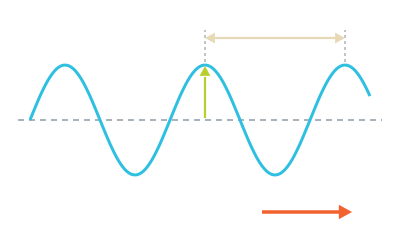
    Label it

    The parts of a transverse wave, in the Label lab.
    9

    The League's test

    Pass the League's test

    Six exam-style questions from the League. Get all six right to earn your stamp. Three wrong and you resit.

    The League's badge

    League test · Waves

    You: ♥♥♥

    Press Start when you're ready.

    Remember it

    Tap a card to flip it. Say the answer before you flip.

    Kay:That's waves. Light, sound, radio, the signal on your phone: all of them, carrying energy without carrying anything else. Next stop: sound.
    Waves: Physics explained, with games · L.O.E.P

