15 wks to JAMB

L.O.E.P · PhysicsNo. 07

Explainer · Upthrust and floating · about 15 min

How does a steel ferry full of people float, when a steel nail sinks?

Watch the lecture

Ash and Kay teach this lesson, start to finish.

⬇ Save for offline

Keeps it on this phone, so it plays with no signal and no data, at this same address.

In short

The key words in this lesson, in plain English:

Upthrust:
The upward force a fluid exerts on a body in it, equal to the weight of fluid displaced (Archimedes' principle).

Free this month: 1 of 1 lessons. A free account gives you 3 a month.

A ferry crossing from Lagos Island carries hundreds of people and is made of steel, which sinks like a stone. A bucket of water feels lighter while it's still under the surface of the well. Push an empty bottle under water and it fights back. In each case the water is pushing up. That push is upthrust, and it decides what floats.

Kay:So the water's been pushing back this whole time. Rude, but helpful.
1

Play · feel it

Push it under

Push a 1-litre ball down into the water. Watch the upthrust as more of it goes under, then push it deeper still.

Slide the ball down

Under water0%Upthrust0 NYour push0 N

Where upthrust comes from

Where you see it: push an empty plastic bottle down into a bucket of water and it shoves back up against your hand: the water presses harder on its bottom than on its top. PhysicsPressure in a liquidP = hρg: the pressure at depth h in a liquid of density ρ. It acts equally in all directions and doesn't depend on the shape of the container; add atmospheric pressure for the total.In water, every 10 m adds about one atmosphere.Science dictionary ▶ grows with depth. The bottom of a submerged object is deeper than its top, so the water pushes up on the bottom harder than it pushes down on the top. The difference is the PhysicsUpthrustThe upward force a fluid exerts on a body in it, equal to the weight of fluid displaced (Archimedes' principle).A steel ship floats because the water it displaces weighs as much as the ship.Science dictionary ▶. It grows as more of the object goes under, but once it's fully submerged, pushing it deeper doesn't change it: both pressures rise together.
2

Ash's lab

Archimedes' overflow can

Hang an object from a spring balance and lower it into a full overflow can. Catch the water that spills. Fully immerse three combinations of object and liquid, and compare the numbers.

Pick an object and a liquid, then lower it

–
Spring balance–Weight lost–Liquid caught–Recorded0 / 3

Archimedes' principle

Where you see it: a jeweller can check gold by PhysicsWeightThe pull of gravity on a mass, measured in newtons: W = mg, about 10 N for every kilogram on Earth.A 50 kg student weighs about 500 N.Science dictionary ▶ it in air and then in water: the weight it seems to lose equals the weight of water it displaces, which gives its volume and so its PhysicsDensityMass per unit volume: density = mass ÷ volume, in kg m⁻³. Water is 1000 kg m⁻³.Oil floats on water because it is less dense; a steel ship floats because its hull holds lots of air.Science dictionary ▶. When a body is wholly or partly immersed in a fluid, it experiences an PhysicsUpthrustThe upward force a fluid exerts on a body in it, equal to the weight of fluid displaced (Archimedes' principle).A steel ship floats because the water it displaces weighs as much as the ship.Science dictionary ▶ equal to the weight of the fluid it displaces. So the weight a body seems to lose in a liquid is exactly the weight of liquid it pushes aside. A denser liquid gives more upthrust for the same volume. Apparent weight = real weight − upthrust.
3

Play · load it

Load the canoe

A fishing canoe on the river. Load sacks of yam one by one. How many can it carry before the water comes over the side? Then take it out to sea.

Load the sacks

Canoe + load200 NWater displaced200 NHow deep17%

The law of flotation

Where you see it: a canoe at the waterside sits lower in the water with every bag of yams or sand loaded into it, as it displaces more water to match the extra PhysicsWeightThe pull of gravity on a mass, measured in newtons: W = mg, about 10 N for every kilogram on Earth.A 50 kg student weighs about 500 N.Science dictionary ▶. A floating body displaces its own weight of the fluid it floats in. Add load and it sinks deeper, displacing more, until the PhysicsUpthrustThe upward force a fluid exerts on a body in it, equal to the weight of fluid displaced (Archimedes' principle).A steel ship floats because the water it displaces weighs as much as the ship.Science dictionary ▶ matches the new weight. If even a full-depth PhysicsDisplacementDistance moved in a stated direction: the straight line from start to finish. It is a vector.Science dictionary ▶ can't match the weight, it sinks. Sea water is denser than river water, so a boat needs to displace less of it: it floats higher in the sea. Ships carry PhysicsPlimsoll lineMarks on a ship's side showing how deep it may safely be loaded in different waters; it may sit deeper in fresh water than in denser sea water.Science dictionary ▶ showing the safe loading depth in different waters.
4

Play · shape it

Make steel float

A 1 kg lump of steel sinks straight to the bottom. Hammer it into a bowl: the steel stays 1 kg, but the shape takes up more space. Make it float, then make it carry a 500 g load as well.

Hammer it out

Space it takes up127 cm³Max upthrust1.3 NWeight10 N

Why ships float

Where you see it: an empty, sealed ChemistrySteel and cast ironIron with a little carbon. Pig or cast iron (about 4% C) is hard but brittle; mild steel (about 0.1–0.3% C) is tough and malleable; high-carbon steel (about 0.6–1.5% C) is very hard.Steel is made by blowing oxygen through molten pig iron to burn off most of the carbon.Science dictionary ▶ drum floats high on water, which is why fishermen and builders lash old oil drums together to make rafts and floating platforms. A ship is made of steel, about 8 times denser than water, but it's hollow. Its shape encloses a great volume of air as well as steel, so its average PhysicsDensityMass per unit volume: density = mass ÷ volume, in kg m⁻³. Water is 1000 kg m⁻³.Oil floats on water because it is less dense; a steel ship floats because its hull holds lots of air.Science dictionary ▶ is less than water's, and it can displace its own PhysicsWeightThe pull of gravity on a mass, measured in newtons: W = mg, about 10 N for every kilogram on Earth.A 50 kg student weighs about 500 N.Science dictionary ▶ of water before it's fully under. That's why a steel ship floats while a steel nail sinks. Holes in the hull let water into that space, and the ship's average density climbs.
5

Play · hover it

Hover the submarine

Flood the ballast tanks to sink; blow them out with air to rise. Bring the submarine to hover in the green zone, neither rising nor sinking, for 2 seconds.

Flood or blow the tanks

Tanks full0%Doingfloating

Submarines and fish

Where you see it: a tilapia in a fish pond can hang still in mid-water without swimming, by controlling the amount of gas in its BiologySwim bladderA gas-filled sac in many fish. Changing the gas in it changes the fish's average density, so it can hover at any depth.Science dictionary ▶. A submarine's volume doesn't change, so its PhysicsUpthrustThe upward force a fluid exerts on a body in it, equal to the weight of fluid displaced (Archimedes' principle).A steel ship floats because the water it displaces weighs as much as the ship.Science dictionary ▶ underwater is fixed. It changes its PhysicsWeightThe pull of gravity on a mass, measured in newtons: W = mg, about 10 N for every kilogram on Earth.A 50 kg student weighs about 500 N.Science dictionary ▶ instead: flooding the ballast tanks makes it heavier than the water it displaces, so it sinks; blowing water out with compressed air makes it lighter, so it rises. With exactly the right amount it hovers. Many fish do the same with a gas-filled swim bladder.
6

Play · fly it

The hot-air balloon

Air is a fluid too, so it gives upthrust. Hold the burner to heat the air in the envelope. Climb above the palm trees, then bring the balloon back down to land.

Hold the burner

palm tops, 40 m
Air inside27 °CHeight0 m

Floating in air

Where you see it: smoke and hot air from a cooking fire or from bush burning in the harmattan rise because the hot gases are less dense than the cool air around them. Air gives an PhysicsUpthrustThe upward force a fluid exerts on a body in it, equal to the weight of fluid displaced (Archimedes' principle).A steel ship floats because the water it displaces weighs as much as the ship.Science dictionary ▶ equal to the PhysicsWeightThe pull of gravity on a mass, measured in newtons: W = mg, about 10 N for every kilogram on Earth.A 50 kg student weighs about 500 N.Science dictionary ▶ of air displaced, as Archimedes says for any fluid. Heating the air in the envelope makes it PhysicsThermal expansionMost materials get bigger when heated, because their particles vibrate more and push further apart.Railway lines have gaps, bridges sit on rollers and electric wires hang loosely, all to leave room to expand.Science dictionary ▶ and become less dense, so the balloon and its hot air weigh less than the cool air they push aside: it rises. As the air cools it sinks again. Helium and hydrogen balloons rise because those gases are much less dense than air.
7

Play · arcade

Rise or sink?

Press Start

Swipe left if upthrust wins and it rises, right if weight wins and it sinks

Score0Streak0Lives♥♥♥
8

Exam corner

How the exam asks it

The floating block. Tap each step to reveal it.

A block of wood of volume 500 cm³ and density 0.60 g/cm³ floats in water (1.0 g/cm³). What fraction of it is under water, and what extra mass placed on top would just submerge it?

Now try the real ones

Real JAMB, WAEC and NECO past questions on this lesson (the JAMB and WAEC ones in LOEP's words). Answer them one at a time: each is marked, with the worked answer.

Start the 10 real questions ▶
  1. JAMB 2020A hydrometer is used to find the relative density of a liquid. It works by
  2. WAEC 2017A stone weighs 12 N in air. When it is partly immersed in water, 150 g of water is displaced. Calculate the upthrust on the stone. [g = 10 m s⁻²]
  3. JAMB 2017A stone of volume 80 cm³ is completely immersed in a liquid of density 1200 kg m⁻³. What is the upthrust on it? [g = 10 m s⁻²]
  4. WAEC 2016Which of these, when added to clean water, lowers its surface tension?
  5. JAMB 2016A block weighing 60 N in air displaces 4.2 kg of water when it is partly immersed. What is the upthrust on the block? [g = 10 m s⁻²]
  6. WAEC 2016A solid of volume 600 cm³ and density 2.0 g cm⁻³ hangs from a spring balance with one-third of its volume in water. Find the balance reading. (Density of water
  7. JAMB 2015According to the law of flotation, a body floats at rest when the fluid it displaces has a
  8. WAEC 2015A floating body displaces a quantity of fluid that has the same ___ as the body.
  9. JAMB 2013A block of wood of density 0.40 × 10³ kg m⁻³ floats in a liquid of density 1.60 × 10³ kg m⁻³. What fraction of its volume is below the liquid surface?
  10. JAMB 2011A stone has a scale reading of 4.5 kg in air and 3.7 kg when fully dipped in water. What is the upthrust on the stone? [g = 10 m s⁻²]

Label it

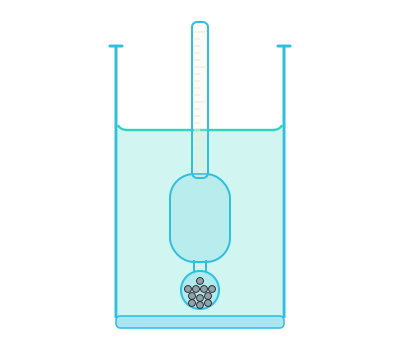
The hydrometer, a float that reads density by how deep it sinks, in the Label lab.
9

The League's test

Pass the League's test

Six exam-style questions from the League. Get all six right to earn your stamp. Three wrong and you resit.

The League's badge

League test · Upthrust and floating

You: ♥♥♥

Press Start when you're ready.

Remember it

Tap a card to flip it. Say the answer before you flip.

Kay:That's upthrust. Next time you're on the ferry, thank Archimedes. Quietly. People are already looking at you.
Upthrust and floating: Physics explained, with games · L.O.E.P

