15 wks to JAMB

L.O.E.P · PhysicsNo. 19

Explainer · Thermal expansion · about 15 min

The electricity wires sag in the afternoon sun and pull tight on a cold harmattan morning. Nobody touched them. What happened?


Watch the lecture

Ash and Kay teach this lesson, start to finish.

⬇ Save for offline

Keeps it on this phone, so it plays with no signal and no data, at this same address.

In short

The key words in this lesson, in plain English:

Thermal expansion:
Most materials get bigger when heated, because their particles vibrate more and push further apart.
Bimetallic strip:
Two metals bonded together that expand by different amounts, so the strip bends when heated. Used to switch heaters on and off.
Real and apparent expansion:
When a liquid is heated in a container, the expansion you see (apparent) is less than the liquid's real expansion, because the container expands too. Real = apparent + the container's expansion.
Anomalous expansion of water:
Water shrinks as it warms from 0 °C to 4 °C, then expands like other liquids. It is densest at 4 °C.

Free this month: 1 of 1 lessons. A free account gives you 3 a month.

Look up at the wires between the electricity poles. In the hot afternoon they hang in long, lazy curves; early on a cold harmattan morning they're pulled noticeably tighter. Nobody touched them. Almost everything gets a little bigger when it's heated and a little smaller when it cools: that's thermal expansion. It's why engineers leave gaps in railway lines and bridges, how an electric iron knows when to switch itself off, and why a pond freezes from the top down, so the fish underneath survive.

Kay:So the wires are actually longer in the afternoon? By how much?
1

Ash's lab

The ball and ring

A brass ball just fits through a brass ring. Heat the ball and try again. Then heat the ring too.

Try the ball through the ring

Does it pass?–

Why things expand

Where you see it: a mechanic heats a gear or bearing so its hole grows a little, slides it over the shaft, and it grips tight as it cools. Heating makes the PhysicsParticleA tiny piece of matter or energy, such as an atom, an electron or a photon.Light can behave like a stream of particles.Science dictionary ▶ of a solid vibrate more strongly, so on average they push each other slightly further apart: the whole solid grows a little in every direction. The particles themselves don't get bigger. The hot ball is too wide for the cold ring; heat the ring as well and its hole grows too (a hole PhysicsThermal expansionMost materials get bigger when heated, because their particles vibrate more and push further apart.Railway lines have gaps, bridges sit on rollers and electric wires hang loosely, all to leave room to expand.Science dictionary ▶ just as if it were made of the same metal), so the ball passes again. Cooling reverses it: things contract. Liquids expand more than solids, and gases much more than liquids.
2

Play · the electric iron

The bimetallic strip and the thermostat

Inside an electric iron, a strip of brass and iron riveted together touches a contact and lets current reach the heater. Turn up the heat and watch what the strip does.

Raise the temperature

heateriron (top)brass (underneath)
Strip30 °CHeateron

Bimetallic strips

Where you see it: many electric kettles switch themselves off with a bimetallic disc: when steam heats it, it snaps into a new shape and pushes the switch off. A PhysicsBimetallic stripTwo metals bonded together that expand by different amounts, so the strip bends when heated. Used to switch heaters on and off.Electric irons, kettles and fire alarms use one.Science dictionary ▶ is two different metals, such as brass and iron (or invar), joined along their length. When heated, brass PhysicsThermal expansionMost materials get bigger when heated, because their particles vibrate more and push further apart.Railway lines have gaps, bridges sit on rollers and electric wires hang loosely, all to leave room to expand.Science dictionary ▶ more than iron, so the strip bends, with the metal that expands more (brass) on the outside of the curve. In a thermostat the bending strip breaks a contact at the set temperature and switches the heater off; as it cools it straightens and switches back on, holding the temperature steady. The same idea runs electric irons, fire alarms, flashing ChemistryIndicatorA dye whose colour shows whether a solution is acidic or alkaline. Litmus turns red in acid and blue in alkali; universal indicator shows the whole pH scale.Science dictionary ▶ lamps and the thermometers in some ovens.
3

Play · quick rounds

Sagging wires, stuck lids, cracked glass: problems and uses

Press Next

Five right to pass.

Right0 / 5

Living with expansion

PhysicsThermal expansionMost materials get bigger when heated, because their particles vibrate more and push further apart.Railway lines have gaps, bridges sit on rollers and electric wires hang loosely, all to leave room to expand.Science dictionary ▶ causes problems unless it's allowed for: railway lines and bridges are built with gaps or rollers, concrete roads with expansion joints, and overhead electricity and telegraph cables are hung with some sag so they don't snap when they contract on cold nights. Thick glass cracks if hot water is poured in, because the inside expands before the outside; heat-resistant (Pyrex) glass expands very little. A PhysicsPendulumA weight on a string or rod that swings from a fixed point. Its period is T = 2π√(l/g): a longer pendulum swings more slowly.Old wall clocks use one to keep time; on a hot day the rod lengthens and the clock runs slow.Science dictionary ▶ clock loses time in hot weather because its pendulum gets longer. But expansion is also useful: a stuck metal lid comes off a glass jar under hot water (the metal expands more than the glass), ChemistrySteel and cast ironIron with a little carbon. Pig or cast iron (about 4% C) is hard but brittle; mild steel (about 0.1–0.3% C) is tough and malleable; high-carbon steel (about 0.6–1.5% C) is very hard.Steel is made by blowing oxygen through molten pig iron to burn off most of the carbon.Science dictionary ▶ tyres are fitted onto wheels hot and shrink tight, rivets are hammered in hot and grip as they cool, and thermometers and PhysicsBimetallic stripTwo metals bonded together that expand by different amounts, so the strip bends when heated. Used to switch heaters on and off.Electric irons, kettles and fire alarms use one.Science dictionary ▶ work by it.
4

Play · the railway gap

How big a gap between the rails?

Steel rails, each 20 m long, are laid on a cool harmattan morning at 15 °C. In the afternoon sun a rail can reach 50 °C. Steel's linear expansivity is 1.2 × 10⁻⁵ K⁻¹. Choose the smallest safe gap, to the nearest millimetre.

Set the gap

Gap4 mmResult–

Linear expansivity

Where you see it: metal roofing sheets creak and tick on a hot afternoon as they PhysicsThermal expansionMost materials get bigger when heated, because their particles vibrate more and push further apart.Railway lines have gaps, bridges sit on rollers and electric wires hang loosely, all to leave room to expand.Science dictionary ▶ against their nails, and the longer the sheet, the more it grows. How much a solid expands depends on its original length, the temperature rise and the material. The PhysicsLinear expansivityThe fractional increase in length of a solid per kelvin rise in temperature: α = ΔL ÷ (L × Δθ), in K⁻¹. A solid's area expansivity is about 2α and its cubic expansivity about 3α.Steel's is about 1.2 × 10⁻⁵ K⁻¹: a 20 m rail warming by 35 K grows 8.4 mm.Science dictionary ▶ α is the fractional increase in length per PhysicsKelvinThe SI unit of temperature. 0 K is absolute zero (−273 °C), the coldest possible; T(K) = θ(°C) + 273.Scientists use kelvin so temperatures never go negative in the gas laws.Science dictionary ▶ rise: α = ΔL ÷ (L × Δθ), so ΔL = αLΔθ. For ChemistrySteel and cast ironIron with a little carbon. Pig or cast iron (about 4% C) is hard but brittle; mild steel (about 0.1–0.3% C) is tough and malleable; high-carbon steel (about 0.6–1.5% C) is very hard.Steel is made by blowing oxygen through molten pig iron to burn off most of the carbon.Science dictionary ▶ α ≈ 1.2 × 10⁻⁵ K⁻¹; brass ≈ 1.9 × 10⁻⁵; aluminium ≈ 2.3 × 10⁻⁵; invar, an ChemistryAlloyA mixture of a metal with other elements, usually metals, made to be harder, stronger or more corrosion-resistant. Brass is copper and zinc.Stainless steel pots are an alloy of iron with chromium and nickel.Science dictionary ▶ made for clocks and measuring tapes, about 1 × 10⁻⁶. A 20 m rail warming by 35 K grows 1.2 × 10⁻⁵ × 20 × 35 = 0.0084 m: 8.4 mm. Without a gap it would buckle the line.
5

Work it out

A bridge in the sun

A steel bridge is 50 m long at 20 °C (α = 1.2 × 10⁻⁵ K⁻¹). How much longer is it at 45 °C, and what are steel's area and cubic expansivities?

Step 1

    Area and volume

    Where you see it: tilers leave narrow grout joints between floor tiles, and a gap at the walls, partly so each tile has room to grow in area when it warms. A rise of 1 °C is a rise of 1 K, so a temperature difference is the same in both. Solids PhysicsThermal expansionMost materials get bigger when heated, because their particles vibrate more and push further apart.Railway lines have gaps, bridges sit on rollers and electric wires hang loosely, all to leave room to expand.Science dictionary ▶ in every direction: the area (superficial) expansivity β ≈ 2α, and the cubic (volume) expansivity γ ≈ 3α. So ΔA = βAΔθ and ΔV = γVΔθ. That's why a bridge sits on rollers at one end: it can grow 15 mm on a hot day without ChemistryCrackingBreaking long-chain hydrocarbons into shorter, more useful ones with heat and a catalyst, making petrol and alkenes such as ethene.Science dictionary ▶ its supports.
    6

    Ash's lab

    Real and apparent expansion of a liquid

    A flask full of coloured water with a narrow tube in its stopper. Put it into a bowl of hot water and watch the level in the tube from the very first second.

    Heat the flask

    start mark
    Level in the tubemark

    Real and apparent expansion

    Where you see it: a liquid-in-glass thermometer at the clinic shows only the PhysicsReal and apparent expansionWhen a liquid is heated in a container, the expansion you see (apparent) is less than the liquid's real expansion, because the container expands too. Real = apparent + the container's expansion.Heat a flask of water and the level first drops, as the glass warms and expands before the water.Science dictionary ▶ of its liquid, because the glass bulb holding it PhysicsThermal expansionMost materials get bigger when heated, because their particles vibrate more and push further apart.Railway lines have gaps, bridges sit on rollers and electric wires hang loosely, all to leave room to expand.Science dictionary ▶ too. At first the level drops: the heat reaches the glass flask before the water, and the flask expands, so it holds more. Then the water warms and, expanding far more than the glass, rises up the tube. The rise you see is the apparent expansion; the water's real expansion is bigger, because some of it only filled the extra space made by the flask expanding. Real expansion = apparent expansion + expansion of the container, and the same goes for expansivities: real PhysicsLinear expansivityThe fractional increase in length of a solid per kelvin rise in temperature: α = ΔL ÷ (L × Δθ), in K⁻¹. A solid's area expansivity is about 2α and its cubic expansivity about 3α.Steel's is about 1.2 × 10⁻⁵ K⁻¹: a 20 m rail warming by 35 K grows 8.4 mm.Science dictionary ▶ = apparent + the container's cubic expansivity.
    7

    Play · the pond in winter

    Water's odd behaviour: anomalous expansion

    A pond in a cold country. Cool its surface from 10 °C down to freezing and watch where the coldest water goes. Find the temperature at which water is densest.

    Cool the surface

    volume of 1 g0 … 10 °C
    Top10 °CBottom10 °CDensity–

    Anomalous expansion of water

    Where you see it: a glass bottle of water left too long in the freezer can crack, because water PhysicsThermal expansionMost materials get bigger when heated, because their particles vibrate more and push further apart.Railway lines have gaps, bridges sit on rollers and electric wires hang loosely, all to leave room to expand.Science dictionary ▶ as it freezes. Most liquids contract steadily as they cool. Water contracts down to 4 °C, but from 4 °C to 0 °C it expands, and it expands even more (by about 9%) when it freezes. So water is densest at 4 °C. In a pond, water cooled to 4 °C sinks to the bottom and stays there; colder water, being lighter, stays on top and freezes. The ice floats and insulates the water below, so the bottom stays at 4 °C and fish and plants survive the winter. The same expansion bursts frozen water pipes and splits rocks when water freezes in their cracks.
    8

    Exam corner

    How the exam asks it

    The expansivity question, every part of it. Tap each step to reveal it.

    A brass rod 1.5 m long at 30 °C is heated to 80 °C and its length increases by 1.425 mm. Calculate (a) the linear expansivity of brass, and (b) its cubic expansivity.

    Now try the real ones

    Real JAMB, WAEC and NECO past questions on this lesson (the JAMB and WAEC ones in LOEP's words). Answer them one at a time: each is marked, with the worked answer.

    Start the 10 real questions ▶
    1. JAMB 2022Why is water unsuitable as the liquid in a thermometer meant to work near 0 °C?
    2. WAEC 2021An iron ball is heated from 25 °C to 150 °C without any change of state. What happens to the ball?
    3. JAMB 2009At what temperature does pure water have its greatest density?
    4. WAEC 2019A pond is cooled slowly from 10 °C down to 0 °C. At what temperature is the water densest?
    5. JAMB 2019A 4 m steel rod heated through 25 °C expands by 2 mm. How much will a 2 m rod of the same steel expand when heated through 10 °C?
    6. WAEC 2020An iron rod is 200 cm long at 25 °C. At what temperature will its length have increased by 0.024%? [Linear expansivity of iron = 1.2 × 10⁻⁵ K⁻¹]
    7. JAMB 2018The linear expansivity of brass is 2 x 10⁻⁵ K⁻¹. A brass block has a volume of 40.00 cm³ at 0 °C. What is its volume at 50 °C?
    8. NECO 2009Which of the following statements about water is NOT correct?
    9. JAMB 2017In which of these is the thermal expansion of a solid used to advantage?
    10. JAMB 2004A sealed bottle full of water cracks when left in a freezer because

    Label it

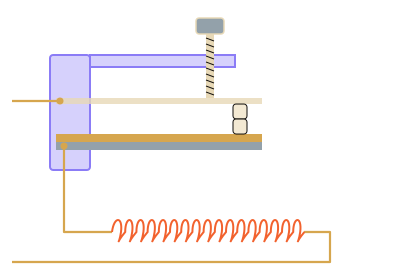
    The bimetallic thermostat, with its strip, contacts and adjusting screw, in the Label lab.
    9

    The League's test

    Pass the League's test

    Six exam-style questions from the League. Get all six right to earn your stamp. Three wrong and you resit.

    The League's badge

    League test · Thermal expansion

    You: ♥♥♥

    Press Start when you're ready.

    Remember it

    Tap a card to flip it. Say the answer before you flip.

    Ash:That's thermal expansion. Kay: a 50 m span of aluminium cable warming by 25 K grows by about 3 cm. Hung tight on a cold morning it would be fine; hung tight on a hot afternoon, it would snap the first cold night.
    Thermal expansion: Physics explained, with games · L.O.E.P
