L.O.E.P · PhysicsNo. 11
Explainer · Characteristics of sound · about 15 min
One talking drum can say a high note, a low note, a soft one and a loud one. How?



Watch the lecture
Ash and Kay teach this lesson, start to finish.
▶ In 2 minutesThe key ideas, quickly
⬇ Save for offline
Keeps it on this phone, so it plays with no signal and no data, at this same address.
- 🔒 Full lessonSign in to save the full lesson
- 2-minute summary
In short
The key words in this lesson, in plain English:
- Pitch:
- How high or low a sound seems. It depends on frequency: more vibrations a second, higher pitch.
- Loudness:
- How strong a sound seems to the ear. It depends on the amplitude of the sound wave: the bigger the vibration, the louder the sound.
- Sonometer:
- A wire stretched over a hollow box, used to study how a string's note depends on its length, tension and mass per metre.
- Resonance:
- A big vibration that builds up when something is pushed at its own natural frequency.
Free this month: 1 of 1 lessons. A free account gives you 3 a month.
A Yoruba talking drum, the gangan, can "speak": the drummer squeezes the cords under one arm and the note slides up and down like the tones of the words. One drum, one skin, and yet it can say a high note, a low note, a soft one and a loud one. Every sound you hear differs in just three ways: pitch, loudness and quality. Here's what each one is, in the wave.

Play · the talking drum
Pitch and loudness
The dashed trace is Kay's call on the drum. Squeeze the cords and choose how hard to strike until your note matches it.
Squeeze, choose the strike, then hit the drum
Pitch and loudness
Play · the oscilloscope
Same note, different instruments
Three instruments play the same note, as loud as each other. Tap each to see and hear its wave. Then press Mystery note and name the instrument from its wave alone. Get three right.
Tap an instrument
Quality (timbre) and overtones
Play · the hearing test
What the ear can hear
Slide through the frequencies and play each one. Visit all three ranges: too low, audible and too high for a human ear.
Choose a frequency, then play it
The audible range
Ash's lab
Tune the sonometer
A sonometer is a wire stretched over two bridges. Change its length, its tension and its thickness until it sounds 250 Hz. There's more than one way.
Set the wire, then pluck
The laws of a vibrating string
Ash's lab
The resonance tube
A 384 Hz tuning fork is held over a tube standing in water. Move the tube to change the length of the air column. Find the first two lengths where the sound is loudest, and mark each one.
Move the tube, listen, mark the loud spots
Resonance in air columns
Play · arcade
String or air column?
Press Start
Swipe left for a vibrating string, right for a vibrating column of air
Musical instruments
Play · resonance
Break the glass
A glass rings at its own natural frequency when you tap it. Sing a loud note at the glass. Find the note that shatters it.
Choose a note, then sing
Forced vibration and resonance
Exam corner
How the exam asks it
A pipe question, every part of it. Tap each step to reveal it.
A pipe 0.40 m long is closed at one end. The speed of sound in air is 340 m s⁻¹. Find the wavelength and frequency of its fundamental, the frequency of its first overtone, and its fundamental if it is opened at both ends. (Ignore end corrections.)
Now try the real ones
Real JAMB, WAEC and NECO past questions on this lesson (the JAMB and WAEC ones in LOEP's words). Answer them one at a time: each is marked, with the worked answer.
Start the 10 real questions ▶- JAMB 2023A guitar string is 0.60 m long, has a mass of 6.0 g and is stretched with a tension of 900 N. What is the frequency of its second overtone?
- WAEC 2021A stationary wave on a stretched string has a wavelength of 80 cm. What is the distance between a node and the next antinode?
- JAMB 2018The pitch of a musical note is raised when its
- WAEC 2018Which of these actions does NOT change the pitch of a note from a guitar string?
- JAMB 2009A flute and a trumpet play the same note at the same loudness, yet a listener can tell which is which. This is because they differ in
- WAEC 2020Which three quantities determine the frequency of the note from a plucked sonometer wire?
- JAMB 2004The pitch of a musical note depends on its
- WAEC 2014A guitar and a flute play the same note at the same loudness, yet they sound different. This difference is due to the
- JAMB 2013A sonometer wire has a fundamental frequency of 120 Hz. What is the frequency of its third overtone?
- JAMB 2003If the distance from a small source of sound is tripled, the intensity of the sound is multiplied by
Label it
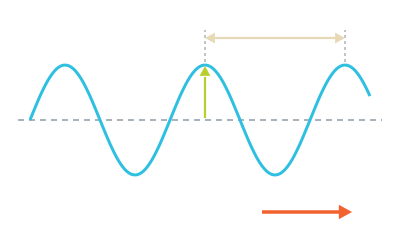
The parts of a wave (crest, trough, amplitude, wavelength), the words every harmonic is built from, in the Label lab.
The League's test
Pass the League's test
Six exam-style questions from the League. Get all six right to earn your stamp. Three wrong and you resit.

League test · Characteristics of sound
You: ♥♥♥
Press Start when you're ready.
Remember it
Tap a card to flip it. Say the answer before you flip.
