15 wks to JAMB

L.O.E.P · PhysicsNo. 21

Explainer · Simple machines · about 15 min

At Ladipo market a mechanic lifts a whole car with a jack he turns with one hand. Where does that strength come from?


Watch the lecture

Ash and Kay teach this lesson, start to finish.

⬇ Save for offline

Keeps it on this phone, so it plays with no signal and no data, at this same address.

In short

The key words in this lesson, in plain English:

Lever:
A rigid bar that turns about a pivot (the fulcrum). First class: fulcrum in the middle (scissors, crowbar). Second class: load in the middle (wheelbarrow). Third class: effort in the middle (forearm, tongs).
Moment of a force:
The turning effect of a force: force × its distance from the pivot. Something balances when the clockwise and anticlockwise moments are equal.
Pulley and block and tackle:
A wheel with a grooved rim for a rope. A single fixed pulley changes the direction of the force (VR 1); in a block and tackle the VR equals the number of rope strands supporting the moving block.
Inclined plane:
A sloping surface that lets a load be raised with a smaller force over a longer distance. Its VR = length of the slope ÷ height.

Free this month: 1 of 1 lessons. A free account gives you 3 a month.

At Ladipo market a mechanic slides a jack under a car, turns the handle with one hand, and the whole car, more than a tonne, rises off the ground. Down the road, one labourer with an iron rod shifts a boulder that four men couldn't lift, and another wheels three bags of cement in a wheelbarrow. None of them is unusually strong. They're using machines: devices that let a small force (the effort) overcome a big one (the load). There's a catch, and it's the whole of this topic: the effort always has to move further than the load.

Kay:So a machine gives you free strength?
1

Play · the crowbar

The lever and the law of moments

A 1.5 m crowbar under a 600 N stone. You can push down with 150 N. Slide the pivot (fulcrum) until you can lift it.

Move the fulcrum

Fulcrum to stone0.7 mEffort needed–MA–

Levers

Where you see it: the long handle on a borehole hand pump is a PhysicsLeverA rigid bar that turns about a pivot (the fulcrum). First class: fulcrum in the middle (scissors, crowbar). Second class: load in the middle (wheelbarrow). Third class: effort in the middle (forearm, tongs).It balances when effort × its distance from the fulcrum = load × its distance.Science dictionary ▶: its PhysicsMoment of a forceThe turning effect of a force: force × its distance from the pivot. Something balances when the clockwise and anticlockwise moments are equal.A door handle sits far from the hinges so a small push turns it. A seesaw balances a light child far out against a heavy one close in.Science dictionary ▶ sits close to the pump rod, so a gentle push down on the far end lifts the heavy column of water. A lever is a rigid bar that turns about a pivot, the fulcrum. It balances when the moments are equal: effort × its distance from the fulcrum = load × its distance from the fulcrum. Put the fulcrum close to the load and a small effort far away can lift a big load. The price: the effort moves much further than the load. Here the effort moves 4 times as far as the stone rises: that ratio is the PhysicsVelocity ratioDistance moved by the effort ÷ distance moved by the load. It depends only on the machine's shape.A pulley system with four ropes holding the load has a velocity ratio of 4.Science dictionary ▶, and in a perfect lever it equals the PhysicsMechanical advantageHow many times a machine multiplies your force: MA = load ÷ effort. Friction always makes it less than the velocity ratio.A car jack has a big MA: a small push on the handle lifts a whole car.Science dictionary ▶.
2

Play · quick rounds

First, second or third class lever?

Press Next

Five right to pass.

Right0 / 5

Three classes of lever

Where you see it: at the kitchen table, a spoon prising the lid off a tin of milk powder is a PhysicsLeverA rigid bar that turns about a pivot (the fulcrum). First class: fulcrum in the middle (scissors, crowbar). Second class: load in the middle (wheelbarrow). Third class: effort in the middle (forearm, tongs).It balances when effort × its distance from the fulcrum = load × its distance.Science dictionary ▶, and your jaw is third class: the chewing muscle pulls between the hinge and the teeth. Levers are classified by what's in the middle. First class: the PhysicsMoment of a forceThe turning effect of a force: force × its distance from the pivot. Something balances when the clockwise and anticlockwise moments are equal.A door handle sits far from the hinges so a small push turns it. A seesaw balances a light child far out against a heavy one close in.Science dictionary ▶ is between the load and the effort (see-saw, crowbar, scissors, pliers, claw hammer pulling a nail). Second class: the load is in the middle (wheelbarrow, nutcracker, bottle opener): the effort arm is always longer, so MA is greater than 1. Third class: the effort is in the middle (your forearm lifting with the BiologyAntagonistic musclesMuscles that work in pairs, pulling a bone in opposite directions, because a muscle can only contract and pull. The biceps bends the arm (flexor); the triceps straightens it (extensor).When one contracts, the other relaxes.Science dictionary ▶, tongs, tweezers, a fishing rod, a broom): MA is less than 1, but the load moves further and faster than the effort.
3

Play · the building site

Pulleys and the block and tackle

Lift a 400 N bag of cement to the first floor. You can pull with no more than 120 N. Choose how many rope strands hold up the moving block.

Choose the strands

400 N
VR–MA–Effort–Efficiency–

Pulleys

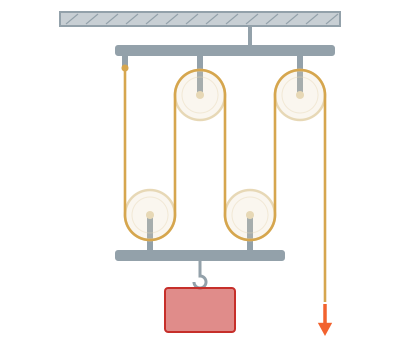
Where you see it: a bucket drawn from a hand-dug well over one PhysicsPulley and block and tackleA wheel with a grooved rim for a rope. A single fixed pulley changes the direction of the force (VR 1); in a block and tackle the VR equals the number of rope strands supporting the moving block.Its MA is a little less than its VR, because of friction and the weight of the moving block.Science dictionary ▶ lets you pull down instead of lifting up; a building-site crane hangs its hook on a block held by several strands of cable. A single fixed pulley only changes the direction of the force: VR = 1. A block and tackle has a fixed block and a moving block; the PhysicsVelocity ratioDistance moved by the effort ÷ distance moved by the load. It depends only on the machine's shape.A pulley system with four ropes holding the load has a velocity ratio of 4.Science dictionary ▶ equals the number of rope strands supporting the moving block, because to raise the load 1 m you must shorten every one of those strands by 1 m. The effort would be load ÷ VR if nothing were wasted, but some effort goes into lifting the moving block itself and overcoming PhysicsFrictionA force that opposes the sliding of surfaces in contact. It lets us walk and brake, but wastes energy as heat in machines.Worn tyres on a wet road have too little friction to stop safely.Science dictionary ▶ in the pulleys, so the MA is a little less than the VR and the PhysicsEfficiencyHow much of the energy put into a machine comes out as useful work: efficiency = useful output ÷ input × 100%. No real machine reaches 100%.A pump that takes 1250 W of electricity and lifts water at 1000 W is 80% efficient; the rest warms it up.Science dictionary ▶ is less than 100%. Adding more pulleys raises the VR but also the wasted work, so efficiency falls slowly.
4

Play · loading the truck

The inclined plane

Roll a 900 N drum of palm oil up a plank onto a truck 1.2 m high. You can push with 300 N at most. Choose a long enough plank.

Choose the plank

1.2 m up
Plank2.4 mVR–Push needed–Efficiency–

Inclined planes, screws and wedges

Where you see it: loaders lay a plank from a lorry to the ground so a drum of palm oil can be rolled up the slope instead of lifted, and the road to the Obudu plateau zigzags for the same reason. An PhysicsInclined planeA sloping surface that lets a load be raised with a smaller force over a longer distance. Its VR = length of the slope ÷ height.A screw is an inclined plane wrapped round a rod; a wedge is a moving one.Science dictionary ▶ (a ramp) lets you raise a load by pushing it a long way along a gentle slope instead of lifting it straight up. Its PhysicsVelocity ratioDistance moved by the effort ÷ distance moved by the load. It depends only on the machine's shape.A pulley system with four ropes holding the load has a velocity ratio of 4.Science dictionary ▶ = length of the slope ÷ height: a longer, gentler plank means a smaller push over a longer distance. PhysicsFrictionA force that opposes the sliding of surfaces in contact. It lets us walk and brake, but wastes energy as heat in machines.Worn tyres on a wet road have too little friction to stop safely.Science dictionary ▶ makes the real push bigger than the ideal W × h ÷ L. A screw is an inclined plane wrapped round a rod: a screw jack lifts a car a tiny distance for each long turn of its handle, so its VR is huge. A wedge (an axe head, a knife, a nail point) is a moving inclined plane.
5

Work it out

Calculating a machine's MA, VR and efficiency: the wheel and axle

A well's winch is a wheel of radius 40 cm turning an axle of radius 8 cm, which winds up the bucket rope. An effort of 50 N on the wheel raises a 200 N bucket of water.

Step 1

    The three numbers

    PhysicsMechanical advantageHow many times a machine multiplies your force: MA = load ÷ effort. Friction always makes it less than the velocity ratio.A car jack has a big MA: a small push on the handle lifts a whole car.Science dictionary ▶ MA = load ÷ effort (how much the force is multiplied). PhysicsVelocity ratioDistance moved by the effort ÷ distance moved by the load. It depends only on the machine's shape.A pulley system with four ropes holding the load has a velocity ratio of 4.Science dictionary ▶ VR = distance moved by the effort ÷ distance moved by the load (fixed by the machine's shape, PhysicsFrictionA force that opposes the sliding of surfaces in contact. It lets us walk and brake, but wastes energy as heat in machines.Worn tyres on a wet road have too little friction to stop safely.Science dictionary ▶ or not). PhysicsEfficiencyHow much of the energy put into a machine comes out as useful work: efficiency = useful output ÷ input × 100%. No real machine reaches 100%.A pump that takes 1250 W of electricity and lifts water at 1000 W is 80% efficient; the rest warms it up.Science dictionary ▶ = (work output ÷ work input) × 100% = (MA ÷ VR) × 100%. So MA = efficiency × VR. For a PhysicsWheel and axleA large wheel fixed to a smaller axle, turning together, so a small effort on the wheel overcomes a large load on the axle. VR = wheel radius ÷ axle radius.Steering wheels, screwdrivers, door handles and well winches all use it.Science dictionary ▶, VR = radius of the wheel ÷ radius of the axle; the same idea runs a car's steering wheel, a screwdriver and a door handle.
    6

    Play · the bicycle

    Gears: when a machine trades force for speed

    Choose a front chainring and a back sprocket. Find the easiest gear for climbing the hill, then the fastest gear for the flat road.

    Choose two gears

    FrontBackWheel turns per pedal turn–Pedalling–

    Speed multipliers

    Where you see it: a tailor's treadle sewing machine: the big wheel under the table drives a much smaller wheel on the machine through a belt, so each slow press of the foot runs the needle through many stitches. Not every machine multiplies force. On a bicycle, one turn of the pedals turns the back wheel (front teeth ÷ back teeth) times, so the wheel's rim moves much further and faster than your feet: the bicycle is a distance (PhysicsSpeedHow fast something moves: distance travelled ÷ time taken, in metres per second. Speed has no direction; velocity does.Science dictionary ▶) PhysicsMultiplierA high resistance connected in series with a galvanometer to turn it into a voltmeter.Science dictionary ▶, and its MA is less than 1: the force at the road is smaller than your push on the pedals. A small front gear and a big back gear make the ratio smallest, so each pedal stroke needs least force: the gear for climbing. A PhysicsLeverA rigid bar that turns about a pivot (the fulcrum). First class: fulcrum in the middle (scissors, crowbar). Second class: load in the middle (wheelbarrow). Third class: effort in the middle (forearm, tongs).It balances when effort × its distance from the fulcrum = load × its distance.Science dictionary ▶ like your forearm, and a fishing rod, trade force for speed the same way.
    7

    Play · quick rounds

    Why no machine is 100% efficient

    Press Next

    Five right to pass.

    Right0 / 5

    No free lunch

    Where you see it: a mechanic oils the chain of an okada so less of the engine's work is lost to PhysicsFrictionA force that opposes the sliding of surfaces in contact. It lets us walk and brake, but wastes energy as heat in machines.Worn tyres on a wet road have too little friction to stop safely.Science dictionary ▶; even a freshly oiled chain wastes a little, so no machine ever reaches 100 per cent. A machine never gives out more work than is put in: work output = load × distance the load moves; work input = effort × distance the effort moves. In a perfect (ideal) machine they'd be equal, MA = VR, and PhysicsEfficiencyHow much of the energy put into a machine comes out as useful work: efficiency = useful output ÷ input × 100%. No real machine reaches 100%.A pump that takes 1250 W of electricity and lifts water at 1000 W is 80% efficient; the rest warms it up.Science dictionary ▶ 100%. In every real machine some input is wasted overcoming friction and lifting moving parts (the bottom PhysicsPulley and block and tackleA wheel with a grooved rim for a rope. A single fixed pulley changes the direction of the force (VR 1); in a block and tackle the VR equals the number of rope strands supporting the moving block.Its MA is a little less than its VR, because of friction and the weight of the moving block.Science dictionary ▶ block, the PhysicsLeverA rigid bar that turns about a pivot (the fulcrum). First class: fulcrum in the middle (scissors, crowbar). Second class: load in the middle (wheelbarrow). Third class: effort in the middle (forearm, tongs).It balances when effort × its distance from the fulcrum = load × its distance.Science dictionary ▶ itself), so work output is less than input, MA is less than VR, and efficiency is less than 100%. Oiling a machine reduces friction and raises its efficiency, but never to 100%.
    8

    Exam corner

    How the exam asks it

    The block and tackle question, every part of it. Tap each step to reveal it.

    A block and tackle has a velocity ratio of 5. An effort of 200 N raises a load of 800 N through 2 m. Calculate (a) the mechanical advantage, (b) the efficiency, (c) the work wasted.

    Now try the real ones

    Real JAMB, WAEC and NECO past questions on this lesson (the JAMB and WAEC ones in LOEP's words). Answer them one at a time: each is marked, with the worked answer.

    Start the 10 real questions ▶
    1. JAMB 2022Which of these is a first-class lever?
    2. WAEC 2020Which of these is NOT an application of the lever principle?
    3. JAMB 2019A screw jack has a pitch of 0.5 cm and a tommy bar 50 cm long. If its efficiency is (60/π)%, calculate its mechanical advantage.
    4. WAEC 2014A screw jack has a pitch h and a handle of length L. Its velocity ratio is
    5. JAMB 2018A 30 kg load is pulled up a smooth-looking slope inclined at 30° to the horizontal, but the plane is only 60% efficient. What force along the slope is needed to
    6. WAEC 2013A drum is rolled up a ramp 5 m long to a platform 2 m high. What is the velocity ratio of the ramp?
    7. JAMB 2018A lever-type machine is 75% efficient and its effort arm is four times as long as its load arm. What effort is needed to raise a load of 360 N?
    8. WAEC 2011Which of these best describes a simple machine?
    9. JAMB 2018A block and tackle system has a velocity ratio of 6 and an efficiency of 65%. What is its mechanical advantage?
    10. JAMB 2017A block and tackle with 4 pulleys lifts a load of 150 N with an effort of 50 N. What is its efficiency?

    Label it

    The block and tackle, with its fixed and moving blocks, in the Label lab.
    9

    The League's test

    Pass the League's test

    Six exam-style questions from the League. Get all six right to earn your stamp. Three wrong and you resit.

    The League's badge

    League test · Simple machines

    You: ♥♥♥

    Press Start when you're ready.

    Remember it

    Tap a card to flip it. Say the answer before you flip.

    Ash:That's simple machines. Kay, no free strength: the mechanic's hand travels metres of handle-turns for every centimetre the car rises. Smaller force, longer distance, and a bit lost to friction on the way.
    Simple machines: Physics explained, with games · L.O.E.P
