L.O.E.P · PhysicsNo. 05
Explainer · Refraction of light · about 15 min
Why does a pencil look broken in a glass of water?



Watch the lecture
Ash and Kay teach this lesson, start to finish.
▶ In 2 minutesThe key ideas, quickly
⬇ Save for offline
Keeps it on this phone, so it plays with no signal and no data, at this same address.
- 🔒 Full lessonSign in to save the full lesson
- 2-minute summary
In short
The key words in this lesson, in plain English:
- Refraction:
- The bending of light as it passes from one material into another, because its speed changes. The refractive index measures how much it slows.
- Snell's law:
- When light passes from one material into another, sin i ÷ sin r stays the same for every angle: that constant is the refractive index.
- Total internal reflection:
- When light inside glass or water hits the surface at more than the critical angle, none escapes: it all reflects back inside.
- Lens:
- A curved piece of glass or plastic that bends light to focus it, as in glasses, cameras and your eye.
Free this month: 1 of 1 lessons. A free account gives you 3 a month.
Stand a pencil in a glass of water and it looks broken at the surface. Look down into a clear stream and it seems shallower than it really is. Nothing bent the pencil and nothing lifted the riverbed. Light changed speed as it crossed from water into air, and changed direction with it. That's refraction.

Play · the ray box
Snell's law
Shine a ray into the block. Change the angle and record three readings: what stays the same?
Drag the angle, then record
Refraction and Snell's law
Play · watch it
Why it bends
A row of marchers crosses from a road (fast) into mud (slow) at an angle. Watch the row.
Press March

Play · spear the fish
Apparent depth
You see the fish where its light seems to come from. Tap where to throw the spear. Spear three fish.
Tap the water to throw
Real and apparent depth
Play · find it
Total internal reflection
Now the light starts inside the block and heads out into air. Increase the angle. Find the exact angle where the ray just skims along the surface.
Drag the angle
The critical angle and total internal reflection
Play · the prism
Splitting white light
Shine white light at the prism
Quick fire: which colour is bent the most?
Prisms and dispersion
Play · the lens bench
Lenses and images
A converging lens with focal length 10 cm. Slide the object and watch the image. Make an image the same size as the object, then make a magnifying glass.
Slide the object
Lenses
Play · arcade
Converging or diverging?
Press Start
Swipe left for converging, right for diverging
Exam corner
How the exam asks it
Snell's law and the critical angle. Tap each step to reveal it.
A ray in air strikes glass (n = 1.5) at an angle of incidence of 60°. Find the angle of refraction, and the critical angle of the glass.
Now try the real ones
Real JAMB, WAEC and NECO past questions on this lesson (the JAMB and WAEC ones in LOEP's words). Answer them one at a time: each is marked, with the worked answer.
Start the 10 real questions ▶- JAMB 2023A ray of light travelling in water meets a glass block that is submerged in the water. The ray makes an angle of 45° with the normal. Find the angle of refracti
- WAEC 2020Which statement is true of an image that is formed on a screen by a single lens?
- JAMB 2022In a fibre-optic connector, which small cylindrical part holds the bare end of the fibre and keeps it accurately aligned?
- WAEC 2011A ray of light passing through an equilateral glass prism has a minimum deviation of 30°. What is the refractive index of the glass?
- JAMB 2022A coin at the bottom of a bucket of clear water looks closer to the surface than it really is. Which light effect causes this?
- WAEC 2020A ray of light moves from air into a glass block at an angle to the surface. Which statement about the ray is correct?
- JAMB 2017A glass prism has a refracting angle of 60° and a refractive index of 1.73 (that is, the square root of 3). What is the angle of minimum deviation?
- WAEC 2019Which of these light paths can never produce total internal reflection?
- JAMB 2021Light travels at 3.0 × 10⁸ m s⁻¹ in air and at 2.5 × 10⁸ m s⁻¹ in a liquid. If the angle of refraction in the liquid is 30°, what is the sine of the angle of in
- JAMB 2020Which pair of conditions must be met for total internal reflection at the boundary between two transparent media?
Label it
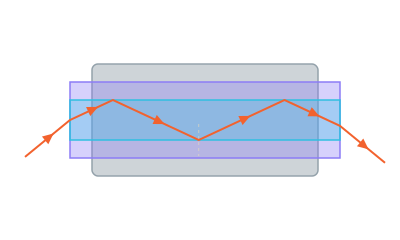
The optical fibre, in the Label lab.
The League's test
Pass the League's test
Six exam-style questions from the League. Get all six right to earn your stamp. Three wrong and you resit.

League test · Refraction
You: ♥♥♥
Press Start when you're ready.
Remember it
Tap a card to flip it. Say the answer before you flip.