L.O.E.P · PhysicsNo. 08
Explainer · Reflection of light · about 15 min
Why is AMBULANCE written back to front on the front of the vehicle?



Watch the lecture
Ash and Kay teach this lesson, start to finish.
▶ In 2 minutesThe key ideas, quickly
⬇ Save for offline
Keeps it on this phone, so it plays with no signal and no data, at this same address.
- 🔒 Full lessonSign in to save the full lesson
- 2-minute summary
In short
The key words in this lesson, in plain English:
- Reflection:
- When light (or sound) bounces off a surface. In a plane mirror, the angle it hits at equals the angle it leaves at.
- Laser:
- A device that makes a narrow, strong beam of light of one colour, with all its waves in step.
- Periscope:
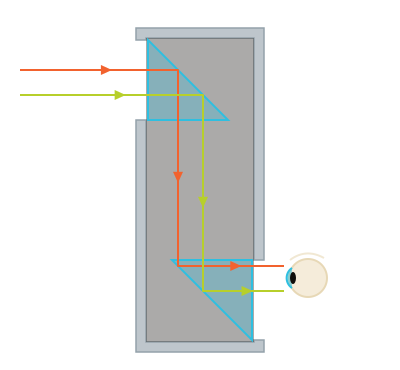
- A tube with two parallel mirrors (or prisms) at 45° that lets you see over a wall or out of a submarine.
- Concave mirror:
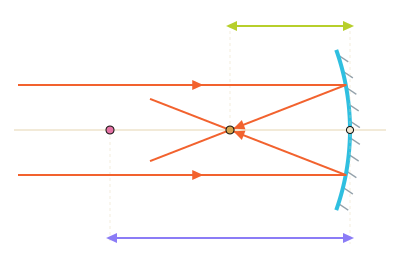
- A mirror curved inwards like a cave. It brings parallel light to a focus; used in torches, headlamps, shaving mirrors and solar cookers.
Free this month: 1 of 1 lessons. A free account gives you 3 a month.
Look at the front of an ambulance: the word is painted back to front. It looks wrong to you, but it's written for the driver ahead, who sees it in a rear-view mirror, where it reads perfectly. Mirrors don't just bounce light; they flip it in a very particular way. That's reflection.

Play · aim it
Bounce the laser
Aim the laser at the mirror so the reflected beam hits the star. Watch the two angles. Hit 3 stars.
Aim the laser
The laws of reflection
Play · find it
Where is the image?
A lamp stands in front of a plane mirror. Tap where its image appears to be, behind the glass. Find 3.
Tap behind the mirror where the image is
The image in a plane mirror
Play · quick rounds
Mirror writing
Which of these is the word as it appears in a plane mirror? Get 4 right.
Press Start
The word
–

Play · two mirrors
Mirrors at an angle
Stand a coin between two mirrors hinged together, and close them: the images multiply. Set the angle to give exactly 3 images, then exactly 7.
Choose the angle between the mirrors
Inclined mirrors
Play · build it
Build a periscope
You're behind a wall and want to see the football match on the other side. Turn the two mirrors in the tube until light from the pitch reaches your eye.
Turn the mirrors
The periscope
Play · focus it
The torch reflector
First let sunlight fall on a concave mirror and see where it gathers. Then slide a torch bulb along the axis until the beam comes out parallel.
Try sunlight first
Curved mirrors
Play · hunt the image
Concave mirror images
A concave mirror with focal length 12 cm. Move the object and watch the image. Find a position for each kind of image.
Move the object
- ☐ Real, inverted and magnified
- ☐ Real, inverted and the same size
- ☐ Virtual, upright and magnified
The mirror formula
Exam corner
How the exam asks it
The mirror formula, worked. Tap each step to reveal it.
An object 4 cm tall stands 20 cm from a concave mirror of focal length 15 cm. Find the position, size and nature of the image.
Now try the real ones
Real JAMB, WAEC and NECO past questions on this lesson (the JAMB and WAEC ones in LOEP's words). Answer them one at a time: each is marked, with the worked answer.
Start the 10 real questions ▶- JAMB 2023A convex mirror has a focal length of magnitude 15 cm. An object is placed 45 cm from it. Where is the image formed?
- WAEC 2009A ray of light strikes a plane mirror with an angle of incidence of 20°. What angle does the reflected ray make with the surface of the mirror?
- JAMB 2019A boy walks towards a large plane mirror at 1.5 m s⁻¹. At what rate does the distance between the boy and his image decrease?
- WAEC 2017Two plane mirrors are placed at an angle of 40° to each other. How many images of an object between them are formed?
- JAMB 2021The inside surface of part of a hollow metal sphere of diameter 30 cm is polished. This portion acts as a
- WAEC 2008At noon we can still see objects in the shade of a mango tree mainly because of
- JAMB 2020Why is a convex mirror used as a driving mirror?
- WAEC 2005A ray of light strikes a plane mirror with an angle of incidence of 20°. The incident ray is kept fixed and the mirror is turned through 10°. Through what angle
- JAMB 2017Two plane mirrors are set at 60° to each other. How many images of an object placed between them are formed?
- JAMB 2019A ray travelling along a line through the centre of curvature of a concave mirror hits the mirror. What is the angle of reflection?
Label it
The concave mirror's ray diagram and the prism periscope, in the Label lab.
The League's test
Pass the League's test
Six exam-style questions from the League. Get all six right to earn your stamp. Three wrong and you resit.

League test · Reflection
You: ♥♥♥
Press Start when you're ready.
Remember it
Tap a card to flip it. Say the answer before you flip.