15 wks to JAMB

L.O.E.P · PhysicsNo. 09

Explainer · Atoms and radioactivity · about 15 min

How do archaeologists know the Igbo-Ukwu site is over a thousand years old?

Watch the lecture

Ash and Kay teach this lesson, start to finish.

⬇ Save for offline

Keeps it on this phone, so it plays with no signal and no data, at this same address.

In short

The key words in this lesson, in plain English:

Chain reaction:
In fission, the neutrons released by one split nucleus go on to split others, and so on. Controlled in a reactor; uncontrolled in a bomb.

Free this month: 1 of 1 lessons. A free account gives you 3 a month.

Archaeologists dug up bronzes and burial goods at Igbo-Ukwu and dated the site to over a thousand years ago. No one wrote the date down. The clock was inside the material itself: a few atoms that, very slowly and at a perfectly steady rate, break apart. That's radioactivity, and to understand it you have to go inside the atom, to the nucleus.

Kay:Ash says everything is slightly radioactive, including bananas and including him. I've asked him to stand a little further away.
1

Ash's lab

Rutherford's gold foil

In 1909 everyone thought the atom was a "plum pudding": positive charge spread through it, electrons dotted in. Fire alpha particles at a thin sheet of gold and watch where they go. Then decide what the atom is really like.

Fire some alpha particles

α source
Straight through0Deflected0Bounced back0

The nuclear atom

Where you see it: the table you lean on is made of atoms that are almost entirely empty space; it feels solid because the PhysicsElectronA tiny negatively charged particle that moves around the nucleus of an atom. Moving electrons are an electric current.Rubbing a balloon on your hair moves electrons onto the balloon.Science dictionary ▶ of its atoms push back on the electrons of yours. Almost all the PhysicsAlpha particleA helium nucleus, ⁴₂He (2 protons + 2 neutrons), thrown out of a big unstable nucleus. Stopped by a sheet of paper.Smoke alarms use a tiny alpha source: smoke blocks the particles and sets off the alarm.Science dictionary ▶ went straight through, so the atom is mostly empty space. A few were deflected and about 1 in 8 000 bounced straight back: they had hit something tiny, very dense and positively charged. Rutherford called it the BiologyNucleusA centre. In an atom, the tiny dense core of protons and neutrons that holds nearly all its mass. In a cell, the part that holds the chromosomes and controls the cell.Science dictionary ▶: nearly all the atom's PhysicsMassThe amount of matter in something, measured in kilograms. It doesn't change from place to place.Your mass is the same on the Moon, but your weight there is about a sixth.Science dictionary ▶ in about 1/100 000 of its width. Electrons move around it. Later, Bohr showed the electrons sit in fixed ChemistryEnergy level (shell)One of the fixed distances (energies) at which electrons can orbit a nucleus: 2 in the first shell, then up to 8 in the next for the first 20 elements.Science dictionary ▶ (shells).
2

Play · build it

Build the atom

Add protons, neutrons and electrons to build each atom you're asked for. Get 4.

Build it, then check

–
Nuclide–Charge0Built0 / 4

Nuclides and isotopes

Where you see it: hospitals treat an overactive BiologyThyroxine and the thyroidThe thyroid gland in the neck makes thyroxine, which sets the rate of metabolism and growth. It needs iodine; without enough, the gland swells into a goitre.Science dictionary ▶ with iodine-131; the body takes it up just as it takes up ordinary iodine-127, because both have 53 ChemistryProtonA positively charged particle in the nucleus of every atom. The number of protons is the atomic number and decides the element.Every carbon atom has 6 protons; every gold atom has 79.Science dictionary ▶ and behave the same chemically. A BiologyNucleusA centre. In an atom, the tiny dense core of protons and neutrons that holds nearly all its mass. In a cell, the part that holds the chromosomes and controls the cell.Science dictionary ▶ is written ᴬZX: Z, the proton (atomic) number, decides which ChemistryElementA substance made of only one kind of atom, which cannot be split into simpler substances by chemical means, such as iron, oxygen or carbon.The iron in a cooking pot and the oxygen you breathe are elements.Science dictionary ▶ it is; A, the nucleon (PhysicsMassThe amount of matter in something, measured in kilograms. It doesn't change from place to place.Your mass is the same on the Moon, but your weight there is about a sixth.Science dictionary ▶) number, counts protons plus PhysicsNeutronAn uncharged particle in the nucleus, with about the same mass as a proton.In a nuclear power station, neutrons split uranium nuclei and keep the chain reaction going.Science dictionary ▶. So neutrons N = A − Z. A neutral atom has as many PhysicsElectronA tiny negatively charged particle that moves around the nucleus of an atom. Moving electrons are an electric current.Rubbing a balloon on your hair moves electrons onto the balloon.Science dictionary ▶ as protons. ChemistryIsotopeAtoms of the same element with the same number of protons but different numbers of neutrons, such as carbon-12 and carbon-14.Carbon-14, a radioactive isotope, is used to date ancient wood and bone.Science dictionary ▶ are atoms of the same element (same Z) with different numbers of neutrons: carbon-12 and PhysicsCarbon datingFinding the age of something that was once alive from how much of its carbon-14 is left: half decays every 5 700 years or so after it dies.Science dictionary ▶, both with 6 protons.
3

Ash's lab

Stop the radiation

Three mystery sources, each giving off one kind of radiation. Put different absorbers in front of the Geiger counter and watch the count. Then name each source's radiation.

Pick a source

no source0
Counts per second–Named0 / 3

Alpha, beta and gamma

Where you see it: hospital and factory staff who work near radioactive sources wear a small badge that records how much radiation they have received. Alpha (α): a helium BiologyNucleusA centre. In an atom, the tiny dense core of protons and neutrons that holds nearly all its mass. In a cell, the part that holds the chromosomes and controls the cell.Science dictionary ▶, ⁴₂He: 2 ChemistryProtonA positively charged particle in the nucleus of every atom. The number of protons is the atomic number and decides the element.Every carbon atom has 6 protons; every gold atom has 79.Science dictionary ▶ and 2 PhysicsNeutronAn uncharged particle in the nucleus, with about the same mass as a proton.In a nuclear power station, neutrons split uranium nuclei and keep the chain reaction going.Science dictionary ▶. Heavily ionising, so it loses its energy fast: stopped by paper or a few cm of air. Beta (β): a fast PhysicsElectronA tiny negatively charged particle that moves around the nucleus of an atom. Moving electrons are an electric current.Rubbing a balloon on your hair moves electrons onto the balloon.Science dictionary ▶, ⁰₋₁e, made when a neutron in the nucleus turns into a proton. Stopped by a few mm of aluminium. Gamma (γ): an PhysicsElectromagnetic waveA wave of changing electric and magnetic fields that needs no material and travels at 3 × 10⁸ m/s in a vacuum: radio, light, X-rays and gamma rays are all of this kind.Science dictionary ▶, no charge, no PhysicsMassThe amount of matter in something, measured in kilograms. It doesn't change from place to place.Your mass is the same on the Moon, but your weight there is about a sixth.Science dictionary ▶. Weakly ionising and very penetrating: ChemistryOxidation and reduction (redox)Oxidation is loss of electrons (or gain of oxygen); reduction is gain of electrons (or loss of oxygen). They always happen together.Rusting oxidises iron; a blast furnace reduces iron ore back to iron.Science dictionary ▶, not stopped, by thick lead or concrete. In a magnetic or PhysicsElectric fieldThe region round a charge in which another charge feels a force. Its strength is the force per unit positive charge, E = F/q, in N C⁻¹ (or V m⁻¹).Field lines run from positive to negative charge, never cross, and are closest where the field is strongest.Science dictionary ▶ α and β bend in opposite directions (β more, being lighter); γ goes straight. Radiation is detected with a Geiger–Müller tube, a cloud chamber or photographic film.
4

Play · balance it

Decay equations

When a nucleus decays, the numbers must balance: nucleon numbers on top, proton numbers below. Set the daughter nucleus for each decay. Get 4 right.

Set A and Z for the new nucleus

–

Balanced0 / 4

What decay does to a nucleus

Where you see it: radon, a radioactive gas that seeps out of some rocks and soils, is made by the alpha decay of radium: radium (ChemistryElementA substance made of only one kind of atom, which cannot be split into simpler substances by chemical means, such as iron, oxygen or carbon.The iron in a cooking pot and the oxygen you breathe are elements.Science dictionary ▶ 88) becomes radon (element 86). Alpha decay: A falls by 4 and Z falls by 2 (it loses ⁴₂He): a new element two places back. PhysicsBeta particleA fast electron thrown out of a nucleus when a neutron turns into a proton. Stopped by a few millimetres of aluminium.Paper mills use beta sources to check the thickness of paper as it is made.Science dictionary ▶: A stays the same and Z rises by 1 (a PhysicsNeutronAn uncharged particle in the nucleus, with about the same mass as a proton.In a nuclear power station, neutrons split uranium nuclei and keep the chain reaction going.Science dictionary ▶ became a ChemistryProtonA positively charged particle in the nucleus of every atom. The number of protons is the atomic number and decides the element.Every carbon atom has 6 protons; every gold atom has 79.Science dictionary ▶). Gamma emission: A and Z don't change; the BiologyNucleusA centre. In an atom, the tiny dense core of protons and neutrons that holds nearly all its mass. In a cell, the part that holds the chromosomes and controls the cell.Science dictionary ▶ just loses energy. In every equation the top numbers add up on both sides, and so do the bottom numbers.
5

Play · watch it

Half-life

100 radioactive atoms. Each one has a 50 : 50 chance of decaying in every half-life, and nobody can say which will go next. Wait four half-lives and watch the pattern.

Wait one half-life

half-lives100
Half-lives0Undecayed100

Half-life

Where you see it: hospitals use technetium-99m for body scans because its ChemistryHalf-lifeThe time for half the nuclei in a radioactive sample to decay. It is fixed for each isotope.Carbon-14's half-life of about 5,730 years makes it useful for dating.Science dictionary ▶ is about 6 hours: long enough to take the pictures, short enough that little activity stays in the body. Radioactive decay is random (you can't predict which BiologyNucleusA centre. In an atom, the tiny dense core of protons and neutrons that holds nearly all its mass. In a cell, the part that holds the chromosomes and controls the cell.Science dictionary ▶ goes next) and spontaneous (heat, PhysicsPressureHow hard a force presses on each square metre of a surface: pressure = force ÷ area, measured in pascals (Pa).A sharp knife cuts because its thin edge puts the force on a tiny area. Tractors and camels have wide tyres or feet so they don't sink.Science dictionary ▶ and chemistry don't change it). But with huge numbers, the pattern is exact: the half-life is the time for half of the radioactive nuclei in a sample to decay, or for its activity to halve. After n half-lives, (½)ⁿ is left: ½, ¼, ⅛, 1/16… The curve never quite reaches zero.
6

Work it out

Find the half-life

A Geiger counter near a source reads 800 counts per minute (after the background is taken off). Thirty days later it reads 100 counts per minute.

Step 1

    Using half-life

    Count the halvings: 800 → 400 → 200 → 100 is three ChemistryHalf-lifeThe time for half the nuclei in a radioactive sample to decay. It is fixed for each isotope.Carbon-14's half-life of about 5,730 years makes it useful for dating.Science dictionary ▶. PhysicsCarbon datingFinding the age of something that was once alive from how much of its carbon-14 is left: half decays every 5 700 years or so after it dies.Science dictionary ▶ uses the same idea: living things keep a steady level of carbon-14 (half-life about 5 700 years); once they die it isn't replaced, so the fraction left gives the age, which is how sites like Igbo-Ukwu are dated. Other uses: PhysicsGamma rayThe shortest, most energetic electromagnetic waves, given out by radioactive nuclei. Thick lead or concrete stops them.Hospitals use gamma rays to kill cancer cells and to sterilise syringes.Science dictionary ▶ to kill cancer cells and sterilise medical equipment, tracers to find leaks in pipes, beta sources to control the thickness of paper and plastic sheets, smoke detectors (alpha).
    7

    Play · start a chain

    The chain reaction

    Fire one neutron into a block of uranium-235. Each nucleus it hits splits and throws out more neutrons. Run it with the control rods out, then again with them in.

    Choose the rods, then fire

    Nuclei split0

    Fission and fusion

    Where you see it: Nigeria's research reactor at Ahmadu Bello University, Zaria, runs on uranium PhysicsNuclear fissionThe splitting of a heavy nucleus such as uranium-235 into two smaller nuclei after it absorbs a neutron, releasing energy and two or three more neutrons.Science dictionary ▶; it is used for research and training, not to make electricity. In nuclear fission a heavy BiologyNucleusA centre. In an atom, the tiny dense core of protons and neutrons that holds nearly all its mass. In a cell, the part that holds the chromosomes and controls the cell.Science dictionary ▶ such as uranium-235 absorbs a PhysicsNeutronAn uncharged particle in the nucleus, with about the same mass as a proton.In a nuclear power station, neutrons split uranium nuclei and keep the chain reaction going.Science dictionary ▶ and splits into two smaller nuclei, releasing 2 or 3 neutrons and a lot of energy. Those neutrons can split more nuclei: a PhysicsChain reactionIn fission, the neutrons released by one split nucleus go on to split others, and so on. Controlled in a reactor; uncontrolled in a bomb.Science dictionary ▶. In a reactor, a PhysicsControl rodBoron or cadmium rods that absorb neutrons to keep a reactor's chain reaction steady. The moderator (graphite or water) slows neutrons so they split nuclei more easily.Science dictionary ▶ (ChemistryAllotropyThe existence of an element in different forms in the same physical state, such as diamond and graphite (carbon), or oxygen and ozone.Pencil 'lead' (graphite) and a diamond ring are both pure carbon.Science dictionary ▶ or water) slows the neutrons so they are captured more easily, and control rods (boron or cadmium) absorb spare neutrons to keep the reaction steady. In PhysicsNuclear fusionThe joining of light nuclei, such as hydrogen, to make heavier ones like helium, releasing huge energy. It powers the sun.Science dictionary ▶, light nuclei such as hydrogen join to make helium: it powers the sun. In both, the products have slightly less PhysicsMassThe amount of matter in something, measured in kilograms. It doesn't change from place to place.Your mass is the same on the Moon, but your weight there is about a sixth.Science dictionary ▶ than what went in, and the missing mass becomes energy: ChemistryMass defectThe mass lost when nuclei split (fission) or join (fusion). It is released as energy by Einstein's E = mc², so a tiny mass gives an enormous energy.That's where the energy of nuclear power stations and the Sun comes from.Science dictionary ▶.
    8

    Exam corner

    How the exam asks it

    A decay series. Tap each step to reveal it.

    ²³⁸₉₂U emits one alpha particle and then two beta particles. Find the nucleon number and proton number of the final nucleus, and say how it is related to the uranium you started with.

    Now try the real ones

    Real JAMB, WAEC and NECO past questions on this lesson (the JAMB and WAEC ones in LOEP's words). Answer them one at a time: each is marked, with the worked answer.

    Start the 10 real questions ▶
    1. JAMB 2023A radioactive isotope has a half-life of 8 days. What is its decay constant?
    2. WAEC 2020In a nuclear reactor, which substance is used as a moderator to slow down fast neutrons?
    3. JAMB 2023Which scientist proposed that electrons move around the nucleus only in certain fixed energy levels?
    4. WAEC 2019A neutral atom of an element has a nucleon number of 235 and contains 92 electrons. How many neutrons does it have?
    5. JAMB 2023The sun gets its energy mainly from
    6. WAEC 2016The process that powers the Sun, in which hydrogen nuclei join to form helium with the release of energy, is called
    7. JAMB 2022A radioactive sample has an activity of 160 Bq. After 12 days the activity has fallen to 10 Bq. What is the half-life?
    8. WAEC 2018Which of the following lists contains only radiations emitted by naturally radioactive substances?
    9. JAMB 2020Which particle has a mass nearly equal to that of a proton?
    10. JAMB 2021Which radiation from a radioactive source is NOT deflected by electric or magnetic fields?

    Label it

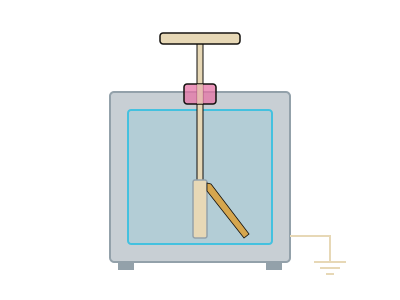
    The gold-leaf electroscope: radiation ionises the air around it, so a charged electroscope collapses near a radioactive source.
    9

    The League's test

    Pass the League's test

    Six exam-style questions from the League. Get all six right to earn your stamp. Three wrong and you resit.

    The League's badge

    League test · Atoms and radioactivity

    You: ♥♥♥

    Press Start when you're ready.

    Remember it

    Tap a card to flip it. Say the answer before you flip.

    Kay:That's radioactivity. Bananas are fine, by the way. You'd need to eat millions at once. Please don't.
    Atoms and radioactivity: Physics explained, with games · L.O.E.P

