L.O.E.P · PhysicsNo. 14
Explainer · Quantity of heat · about 15 min
Why does the sand at Bar Beach burn your feet at noon while the sea is still cool?



Watch the lecture
Ash and Kay teach this lesson, start to finish.
▶ In 2 minutesThe key ideas, quickly
⬇ Save for offline
Keeps it on this phone, so it plays with no signal and no data, at this same address.
- 🔒 Full lessonSign in to save the full lesson
- 2-minute summary
In short
The key words in this lesson, in plain English:
- Heat capacity:
- The heat needed to raise the temperature of a whole body by 1 K: C = mc, in J K⁻¹. It belongs to an object; specific heat capacity belongs to a material.
- Method of mixtures:
- Finding a specific heat capacity by mixing a hot body with a cold one: heat lost by the hot = heat gained by the cold, if none escapes.
- Newton's law of cooling:
- The rate at which a body loses heat is proportional to how much hotter it is than its surroundings (its excess temperature).
- Specific heat capacity:
- The heat needed to warm 1 kg of a substance by 1 K, in J kg⁻¹ K⁻¹. Water's is 4200, unusually high.
Free this month: 1 of 1 lessons. A free account gives you 3 a month.
At Bar Beach at noon the sand burns your feet, yet the sea is still cool, though the same sun has been on both all morning. A pot of soup stays hot long after the pot's handle has cooled. A red-hot nail hisses in a bowl of water and barely warms it. All of these come down to one question: how much heat does it take to warm something, and how much does it give back when it cools?

Play · on the ice
Heat is not the same as temperature
Put each hot thing on a big block of ice and let it cool to 0 °C. Which melts the most ice? Try the red-hot nail and the pot of hot water.
Pick something hot and put it on the ice
Heat and temperature
Play · the beach
Same sun, different warming: beach sand and sea
The sun gives 42 000 J to 1 kg of each material, starting at 25 °C. Which warms the least? Try the sea water and the sand.
Pick a material, then let the sun shine
Specific heat capacity
Play · bath water
Q = mcΔθ
Heat water for a bath so that it takes in exactly 168 000 J. Pick the mass, set the temperature rise, then heat. (c of water = 4200 J kg⁻¹ K⁻¹)
Pick the mass, set the rise, then heat
The heat equation
Work it out
Heat capacity: the pot and its water
A 2 kg iron pot (c = 450 J kg⁻¹ K⁻¹) holds 3 kg of water (c = 4200 J kg⁻¹ K⁻¹). How much heat warms the pot and the water together by 60 K?
Step 1
Heat capacity
Play · the bucket
The method of mixtures
You have 3 kg of cold water at 20 °C in a bucket and a kettle of water at 80 °C. How much hot water do you pour in for a bath at exactly 40 °C? (No heat lost to the bucket or the air.)
Choose how much hot water to pour
Heat lost = heat gained
Ash's lab
Name the mystery metal
A 0.5 kg block of an unknown metal is heated to 100 °C in boiling water and dropped into 0.5 kg of water at 20 °C. Read the final temperature, then work out its specific heat capacity to name the metal.
Drop the block in
Finding c by the method of mixtures
Play · the cup of tea
Newton's law of cooling
A cup of tea cools in a room at 25 °C. Start it at 85 °C, then at 45 °C, and compare how much it drops in the first 5 minutes.
Pick a starting temperature
Newton's law of cooling
Play · arcade
High or low specific heat capacity?
Press Start
Swipe left if it works because of a high specific heat capacity, right for a low one
Using specific heat capacity
Exam corner
How the exam asks it
The electrical method, every part of it. Tap each step to reveal it.
A 50 W immersion heater warms 0.4 kg of a liquid in a lagged container from 20 °C to 45 °C in 5 minutes. Ignoring the heat taken by the container, find the energy supplied and the specific heat capacity of the liquid.
Now try the real ones
Real JAMB, WAEC and NECO past questions on this lesson (the JAMB and WAEC ones in LOEP's words). Answer them one at a time: each is marked, with the worked answer.
Start the 10 real questions ▶- JAMB 2023Which statement about the heat capacity of a body is correct?
- WAEC 2015The joule per kelvin (J K⁻¹) is the SI unit of
- JAMB 2021A piece of copper of mass 1.5 kg is lifted out of boiling water and at once placed on a block of ice at 0 °C. Assuming no heat is lost, what mass of ice melts?
- WAEC 2018The rate at which a hot body loses heat per unit area to its surroundings depends on which of the following? I. The nature of its surface II. The excess tempera
- JAMB 2021A piece of aluminium of specific heat capacity 900 J kg⁻¹ K⁻¹ falls from rest through 45 m and hits the ground. If all its energy becomes heat in the piece, wha
- WAEC 2015Hot water at 90 °C is poured into 300 g of water at 20 °C, and the mixture reaches 40 °C. What mass of hot water was added? [Specific heat capacity of water = 4
- JAMB 2019In a method of mixtures experiment, which step helps most to make the heat lost by the hot body almost equal to the heat gained by the cold one?
- WAEC 2013Ice of mass 20 g at -10 °C is warmed and completely melted to water at 0 °C. Find the heat needed. [Specific heat capacity of ice = 2.1 J g⁻¹ K⁻¹; specific late
- JAMB 2020A heater of power 50 W warms 2.0 × 10⁻² kg of a liquid for 40 s and the temperature of the liquid rises by 10 °C. What is the specific heat capacity of the liqu
- JAMB 2018200 g of water at 80 °C is poured into 100 g of water at 20 °C and stirred. Ignoring heat losses, what is the final temperature?
Label it
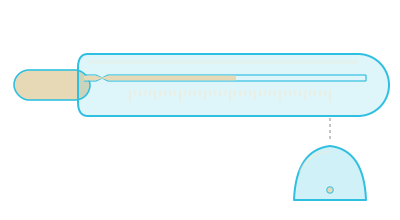
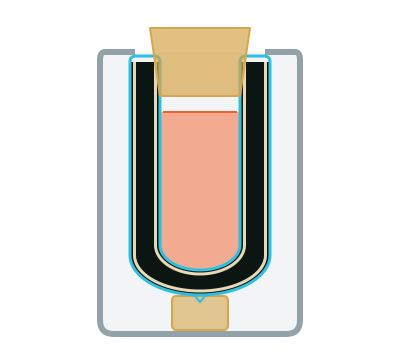
The vacuum flask, built to stop heat escaping (just what a calorimeter needs), and the clinical thermometer, in the Label lab.
The League's test
Pass the League's test
Six exam-style questions from the League. Get all six right to earn your stamp. Three wrong and you resit.

League test · Quantity of heat
You: ♥♥♥
Press Start when you're ready.
Remember it
Tap a card to flip it. Say the answer before you flip.
