L.O.E.P · PhysicsNo. 20
Explainer · Optical instruments · about 15 min
Your phone camera, the church-hall projector and the school microscope all use one trick with curved glass. What is it?



Watch the lecture
Ash and Kay teach this lesson, start to finish.
▶ In 2 minutesThe key ideas, quickly
⬇ Save for offline
Keeps it on this phone, so it plays with no signal and no data, at this same address.
- 🔒 Full lessonSign in to save the full lesson
- 2-minute summary
In short
The key words in this lesson, in plain English:
- Camera:
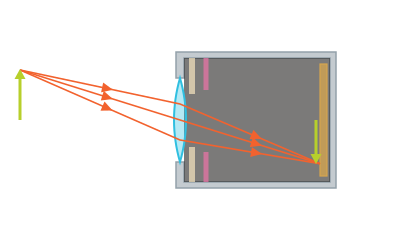
- A light-tight box in which a converging lens forms a real, inverted, diminished image on a film or sensor. It focuses by moving the lens; the aperture and shutter control the light.
- Projector:
- An instrument that throws a real, inverted, magnified image of a slide onto a screen, with the slide between F and 2F of its lens.
- Magnifying glass:
- A converging lens with the object closer than its focal length, giving a virtual, upright, magnified image. With the image at the near point (25 cm), m = 1 + 25/f.
- Compound microscope:
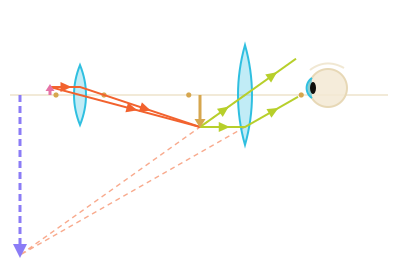
- A microscope with two short-focus converging lenses: the objective forms a real, magnified image, and the eyepiece magnifies that again. Total magnification = objective's × eyepiece's.
Free this month: 1 of 1 lessons. A free account gives you 3 a month.
Your phone's camera, the projector in the church hall, the microscope in the school lab, the telescope that shows the craters on the Moon, and your grandmother's reading glasses all run on the same trick: a curved piece of glass bending light to make an image. What changes is where the object sits compared with the lens's focal length, and how lenses are combined. Put the object far away and you get a small, real image (a camera). Put it just outside the focus and you get a big real one (a projector). Put it inside the focus and you get a magnified virtual one (a magnifying glass).

Play · focus it
The camera, and how it focuses
The camera's lens has a focal length of 5 cm. Move the lens in and out until each object is sharp on the sensor: a tree far away, a friend 1 m away, and a flower 25 cm away.
Choose what to photograph
The camera and the eye
Play · the church hall
The projector
A projector with a 10 cm lens, and a wall 2.1 m away. Slide the lens to make the picture sharp. Then make sure the picture is the right way up.
Slide the lens
The projector
Play · read the small print
The magnifying glass
A magnifying glass with focal length 5 cm, over the small print on a medicine label. Move the lens until the image sits at your near point, 25 cm from your eye: the most it can usefully magnify.
Move the lens
The simple microscope
Work it out
The compound microscope
In the school microscope the objective has f = 1.0 cm and the slide sits 1.2 cm from it. The eyepiece then magnifies that first image 10 times.
Step 1
Two lenses, two magnifications
Play · the Moon
The astronomical telescope
Build a telescope that makes the Moon look 20 times bigger, in normal adjustment (the final image at infinity, so your eye is relaxed). Choose two lenses and set the distance between them.
Choose the lenses
The astronomical telescope
Work it out
Lens power in dioptres
A student can't see clearly beyond 2 m (her far point). Her grandfather can't read anything closer than 50 cm (his near point) but wants to read at 25 cm. Work out each lens.
Step 1
Power in dioptres
Play · quick rounds
Which instrument, which image?
Press Next
Five right to pass.
The images, side by side
Exam corner
How the exam asks it
The telescope question, every part of it. Tap each step to reveal it.
An astronomical telescope has an objective of focal length 90 cm and an eyepiece of focal length 3 cm. It is used in normal adjustment. Find (a) the distance between the lenses, (b) the magnifying power. (c) Describe the final image.
Now try the real ones
Real JAMB, WAEC and NECO past questions on this lesson (the JAMB and WAEC ones in LOEP's words). Answer them one at a time: each is marked, with the worked answer.
Start the 10 real questions ▶- JAMB 2021When an astronomical telescope is in normal adjustment, the final image is formed
- WAEC 2016An astronomical telescope has an objective of focal length 2.4 m and an eye-piece of focal length 6 cm. What is its magnifying power in normal adjustment?
- JAMB 2020A short-sighted person can be helped to see distant objects clearly by wearing spectacles with
- WAEC 2008A pupil reads her textbook comfortably but cannot read the writing on the board from the back of the class. Her eyeball is longer than normal. This defect of vi
- JAMB 2019In a camera, which part does the same job as the retina of the human eye?
- WAEC 1999Which of the following is true of a short-sighted (myopic) eye?
- JAMB 2016A short-sighted student cannot see the board clearly. Which lens corrects this defect?
- WAEC 2013Which of the following is NOT a feature of the Galilean telescope?
- JAMB 2018A camera lens has a focal length of 15 cm. How far from the film must the lens be set to form a sharp image of an object 90 cm away?
- JAMB 2011Many people over fifty need reading glasses because the lens of the eye stiffens and loses much of its power of accommodation. This defect is called
Label it
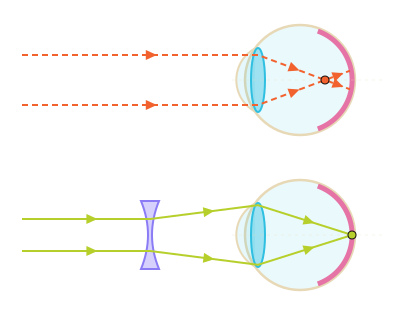
The compound microscope's ray diagram, the lens camera, and short sight with its correcting lens, in the Label lab.
The League's test
Pass the League's test
Six exam-style questions from the League. Get all six right to earn your stamp. Three wrong and you resit.

League test · Optical instruments
You: ♥♥♥
Press Start when you're ready.
Remember it
Tap a card to flip it. Say the answer before you flip.
