15 wks to JAMB

L.O.E.P · PhysicsNo. 04

Explainer · Forces and Newton's laws · about 15 min

Why do danfo passengers lurch forward when it brakes?

Watch the lecture

Ash and Kay teach this lesson, start to finish.

⬇ Save for offline

Keeps it on this phone, so it plays with no signal and no data, at this same address.

In short

The key words in this lesson, in plain English:

Newton's third law:
When one body pushes on another, the second pushes back with an equal force in the opposite direction.
Momentum:
Mass × velocity, a vector in kg m/s. In a collision with no outside force, total momentum is conserved.
Simple harmonic motion:
To-and-fro motion where the pull back to the middle grows with the distance from it, so every swing takes the same time.

Free this month: 1 of 1 lessons. A free account gives you 3 a month.

The danfo brakes hard and everyone standing lurches forward. Nobody pushed them. Their bodies were simply carrying on moving, the way they already were, while the bus stopped underneath them. That's Newton's first law, and it's the start of understanding every push, pull, crash and swing.

Kay:I once fell into a woman's basket of tomatoes on Third Mainland Bridge. Ash says I should blame inertia, not the driver.
1

Play · the danfo

Newton's first law

Drive, then brake

→ direction of travel

Newton's first law (inertia)

Where you see it: beat a dusty mat or rug with a stick and the mat jerks away while the dust, by its PhysicsInertiaThe reluctance of a body to change its state of rest or motion. The more mass, the more inertia.Passengers lurch forward when a bus brakes suddenly: that is inertia.Science dictionary ▶, stays where it was and falls out. A body stays at rest, or keeps moving at a steady PhysicsSpeedHow fast something moves: distance travelled ÷ time taken, in metres per second. Speed has no direction; velocity does.Science dictionary ▶ in a straight line, unless a PhysicsResultantThe single force (or velocity) that has the same effect as two or more acting together.Two people pulling a stuck car with ropes at an angle give a resultant pull along the middle.Science dictionary ▶ acts on it. The tendency to keep doing what it's already doing is inertia, and the more PhysicsMassThe amount of matter in something, measured in kilograms. It doesn't change from place to place.Your mass is the same on the Moon, but your weight there is about a sixth.Science dictionary ▶, the more inertia. Seatbelts exist because your body keeps going when the car stops.
2

Play · push it

Newton's second law: F = ma

A wheelbarrow on smooth ground. Choose its load, set your push, and watch the acceleration. Hit both targets.

Choose a load and a push

Acceleration–Targets0 / 2Targets: 50 kg at 2 m/s² · then the same push on 100 kg

Newton's second law

Where you see it: push an empty wheelbarrow and it moves off easily; load it with blocks on a building site and the same push gets it moving far more slowly. The rate of change of PhysicsMomentumMass × velocity, a vector in kg m/s. In a collision with no outside force, total momentum is conserved.A loaded lorry is far harder to stop than a car at the same speed.Science dictionary ▶ is proportional to the PhysicsResultantThe single force (or velocity) that has the same effect as two or more acting together.Two people pulling a stuck car with ropes at an angle give a resultant pull along the middle.Science dictionary ▶, and in its direction. For a fixed PhysicsMassThe amount of matter in something, measured in kilograms. It doesn't change from place to place.Your mass is the same on the Moon, but your weight there is about a sixth.Science dictionary ▶: F = ma (force in newtons, mass in kg, PhysicsAccelerationHow fast velocity changes: change in velocity ÷ time, in m s⁻². Slowing down is a negative acceleration.A danfo pulling away from a bus stop accelerates; you feel pushed back into your seat.Science dictionary ▶ in m s⁻²). One newton gives 1 kg an acceleration of 1 m s⁻². Same force, twice the mass: half the acceleration.
3

Play · match it

Newton's third law

Every force comes with a partner. Drag each action to its reaction.

Drag each action to its reaction (or tap one, then the other)

  • The water pushes the swimmer forwards
  • The mango pulls the earth up
  • The gas pushes the rocket up
  • The bullet pushes the gun back (recoil)
  • The wall pushes back on Kay

Newton's third law

Where you see it: a canoe paddler on the lagoon pushes water backwards with each stroke, and the water pushes the canoe forwards; a swimmer moves the same way. To every action there is an equal and opposite reaction. The two forces are equal in size, opposite in direction, and act on different bodies, which is why they don't cancel out. Jets and rockets work this way: they push gas backwards, and the gas pushes them forwards.
4

Play · crash it

Momentum

Two trolleys stick together when they collide. Set their masses and speeds (negative means moving left). Can you make them stop dead after the crash?

Set them up, then crash

AB
Momentum before–Momentum after–Velocity after–

Momentum and its conservation

Where you see it: a hunter's dane gun kicks back against the shoulder as the shot flies forward: the gun's backward PhysicsMomentumMass × velocity, a vector in kg m/s. In a collision with no outside force, total momentum is conserved.A loaded lorry is far harder to stop than a car at the same speed.Science dictionary ▶ balances the forward momentum of the shot and gases. Momentum = PhysicsMassThe amount of matter in something, measured in kilograms. It doesn't change from place to place.Your mass is the same on the Moon, but your weight there is about a sixth.Science dictionary ▶ × PhysicsVelocitySpeed in a stated direction, in metres per second (m/s). It is a vector.Two cars at 60 km/h going opposite ways have the same speed but opposite velocities.Science dictionary ▶ (kg m s⁻¹), a PhysicsVectorIn physics, a quantity with both size and direction, such as velocity or force. In biology, an animal that carries a disease to people, like a mosquito.Speed is not a vector; velocity is.Science dictionary ▶. When bodies collide or push apart, and no outside force acts, the total momentum before equals the total momentum after. Stuck together: m₁u₁ + m₂u₂ = (m₁ + m₂)v.
5

Play · drop it

Impulse: the egg drop

The same egg, dropped from the same 2 m, lands on three different surfaces. Same change of momentum every time, so what decides whether it breaks?

Pick a surface, then drop

Stopping time–Force on the egg–

Impulse

Where you see it: eggs are sold in moulded trays and glassware is packed in foam or paper, so that a knock is spread over a longer time and the force on each item is smaller. Impulse = force × time = change in PhysicsMomentumMass × velocity, a vector in kg m/s. In a collision with no outside force, total momentum is conserved.A loaded lorry is far harder to stop than a car at the same speed.Science dictionary ▶: FΔt = mv − mu. The change of momentum is fixed by the fall, so stretching out the stopping time shrinks the force. That's why cars have crumple zones and airbags, why you bend your knees when you land, and why goalkeepers draw their hands back as they catch.
6

Play · the sling

Circular motion

Kay whirls a stone on a string, seen from above. Let go at the right moment to hit the mango.

Tap Whirl, then Let go

Throws0

Circular motion

Where you see it: when a keke takes a sharp bend, PhysicsFrictionA force that opposes the sliding of surfaces in contact. It lets us walk and brake, but wastes energy as heat in machines.Worn tyres on a wet road have too little friction to stop safely.Science dictionary ▶ between the tyres and the road supplies the PhysicsCentripetal forceThe force towards the centre that keeps a body moving in a circle: F = mv²/r. Let go of a sling and the stone flies off along the tangent.Science dictionary ▶; on a wet or oily road there is less friction and it can skid off along the tangent. Moving in a circle, the direction keeps changing, so the PhysicsVelocitySpeed in a stated direction, in metres per second (m/s). It is a vector.Two cars at 60 km/h going opposite ways have the same speed but opposite velocities.Science dictionary ▶ keeps changing: the body is PhysicsAccelerationHow fast velocity changes: change in velocity ÷ time, in m s⁻². Slowing down is a negative acceleration.A danfo pulling away from a bus stop accelerates; you feel pushed back into your seat.Science dictionary ▶ towards the centre, even at a steady PhysicsSpeedHow fast something moves: distance travelled ÷ time taken, in metres per second. Speed has no direction; velocity does.Science dictionary ▶. The force that does it, the centripetal force, points to the centre: F = mv²/r (here the string's tension). Let go and that force vanishes, so the stone flies off along the tangent, not outwards.
7

Play · the pendulum lab

Simple harmonic motion

Change the length and the mass, then time ten swings. Make a pendulum with a period of exactly 2.0 s.

Set it up, then time it

10 swings–Period–

Simple harmonic motion

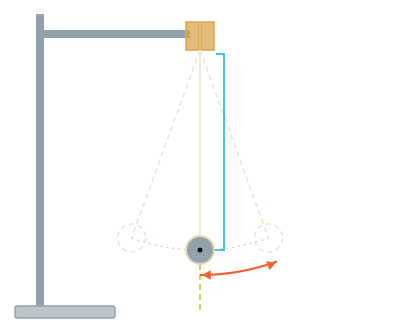
Where you see it: a PhysicsPendulumA weight on a string or rod that swings from a fixed point. Its period is T = 2π√(l/g): a longer pendulum swings more slowly.Old wall clocks use one to keep time; on a hot day the rod lengthens and the clock runs slow.Science dictionary ▶ wall clock keeps time because the period depends on the length, not the PhysicsMassThe amount of matter in something, measured in kilograms. It doesn't change from place to place.Your mass is the same on the Moon, but your weight there is about a sixth.Science dictionary ▶, so the clock is adjusted by moving the bob up or down its rod. A body moves with PhysicsSimple harmonic motionTo-and-fro motion where the pull back to the middle grows with the distance from it, so every swing takes the same time.A small swing of a pendulum, a mass bouncing on a spring and a vibrating guitar string all move this way.Science dictionary ▶ when its PhysicsAccelerationHow fast velocity changes: change in velocity ÷ time, in m s⁻². Slowing down is a negative acceleration.A danfo pulling away from a bus stop accelerates; you feel pushed back into your seat.Science dictionary ▶ is always directed towards a PhysicsFixed pointsThe two temperatures used to mark a thermometer's scale: pure melting ice (0 °C) and steam from pure water boiling at standard pressure (100 °C). The gap between them is divided into 100 degrees.The steam point is marked in a hypsometer, with the bulb in the steam, not the water.Science dictionary ▶ and proportional to its distance from it: a pendulum, a mass on a spring. PhysicsAmplitudeThe height of a wave from its middle line. Bigger amplitude means louder sound or brighter light.It doesn't change a wave's speed.Science dictionary ▶: the biggest PhysicsDisplacementDistance moved in a stated direction: the straight line from start to finish. It is a vector.Science dictionary ▶. Period: the time for one complete swing; PhysicsFrequencyHow many waves pass a point each second, measured in hertz (Hz).Higher frequency sound has a higher pitch.Science dictionary ▶ = 1/period. For a simple pendulum, T = 2π√(l/g): it depends on the length and g, not on the mass.
Ash:Galileo noticed this in a cathedral, timing a swinging lamp against his pulse. He didn't have a stopwatch, so he used his heartbeat.
8

Exam corner

How the exam asks it

Force, acceleration and impulse in one question. Tap each step to reveal it.

A car of mass 1200 kg moving at 20 m s⁻¹ brakes uniformly to rest in 5.0 s. Find its deceleration, the braking force and the impulse.

Now try the real ones

Real JAMB, WAEC and NECO past questions on this lesson (the JAMB and WAEC ones in LOEP's words). Answer them one at a time: each is marked, with the worked answer.

Start the 10 real questions ▶
  1. JAMB 2023A simple pendulum has a period of 3.0 s. When its length is reduced by 1.8 m, the period becomes 2.4 s. What is the new length?
  2. WAEC 2021Which of the following is NOT a force?
  3. JAMB 2023A boy whirls a 1.5 kg stone in a horizontal circle on a string 0.8 m long at 90 revolutions per minute. Find the tension in the string. (π² = 9.87)
  4. WAEC 2021A stone tied to a string is whirled in a horizontal circle at a steady speed. In which direction is its acceleration at any instant?
  5. JAMB 2021Which of the following statements describes simple harmonic motion?
  6. WAEC 2020The product of the mass of a body and its velocity is called its
  7. JAMB 2021A small stone of mass 2 × 10⁻² kg is fixed to the tip of a rotating blade of radius 0.3 m. If the blade turns with an angular velocity of 50 rad s⁻¹, what is th
  8. WAEC 2019A mass hanging on a spring is pulled down slightly and released, so it bobs up and down. Which force always pulls the mass back towards its rest position?
  9. JAMB 2021A 2 kg trolley moving at 6 m s⁻¹ runs into a 1 kg trolley standing still on a smooth track. The two stick together and move off as one. What is their common spe
  10. JAMB 2019A body performs simple harmonic motion along a straight line between two points 26 m apart, with an angular speed of 4 rad s⁻¹. What is its speed when it is 5 m

Label it

The simple pendulum, in the Label lab.
9

The League's test

Pass the League's test

Six exam-style questions from the League. Get all six right to earn your stamp. Three wrong and you resit.

The League's badge

League test · Forces

You: ♥♥♥

Press Start when you're ready.

Remember it

Tap a card to flip it. Say the answer before you flip.

Kay:That's Newton. Three laws, and they explain every danfo, rocket and football in the world. Ash wants a fourth law: "Kay always lands in the tomatoes."
Forces and Newton's laws: Physics explained, with games · L.O.E.P


