15 wks to JAMB

L.O.E.P · PhysicsNo. 16

Explainer · Electrostatics · about 15 min

Why does the car door bite your finger with a spark all through harmattan, and hardly ever in the rains?


Watch the lecture

Ash and Kay teach this lesson, start to finish.

⬇ Save for offline

Keeps it on this phone, so it plays with no signal and no data, at this same address.

In short

The key words in this lesson, in plain English:

Electroscope:
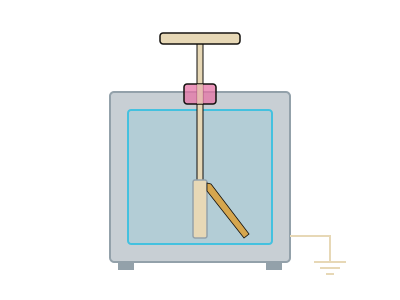
A metal cap and rod with two thin gold leaves inside a case. Charged leaves repel and spread apart.
Charging by induction:
Charging a conductor without touching it: bring a charged rod near, earth the conductor, remove the earth, then the rod. The conductor is left with the opposite charge to the rod's.
Coulomb's law:
The force between two point charges is proportional to the product of the charges and inversely proportional to the square of the distance between them: F = kq₁q₂/r², with k ≈ 9 × 10⁹ N m² C⁻² in air.
Electric field:
The region round a charge in which another charge feels a force. Its strength is the force per unit positive charge, E = F/q, in N C⁻¹ (or V m⁻¹).

Free this month: 1 of 1 lessons. A free account gives you 3 a month.

Harmattan. The air is dry and dusty, you slide out of the car seat, touch the door and snap: a little spark bites your finger. Pull off a nylon top and your hair stands up and crackles. Nothing is plugged in. This is static electricity: charge that has been rubbed onto you and sits there until it finds a way out. The same physics makes lightning, and it's why fuel tankers and aircraft are earthed before they're filled.

Kay:So the car door is shocking me because I'm the one carrying the charge?
1

Play · rub it

Charging by rubbing: the harmattan shock

Rub a polythene rod with wool, then a perspex rod with silk. Watch which way the electrons move, and the charge each one is left with.

Choose a pair to rub

rodcloth
Rod–Cloth–

Charging by friction

Where you see it: rub a balloon on your hair at a birthday party and your hair rises towards it: PhysicsElectronA tiny negatively charged particle that moves around the nucleus of an atom. Moving electrons are an electric current.Rubbing a balloon on your hair moves electrons onto the balloon.Science dictionary ▶ have moved from your hair to the rubber, leaving the two oppositely charged. Every material is made of atoms with positive ChemistryProtonA positively charged particle in the nucleus of every atom. The number of protons is the atomic number and decides the element.Every carbon atom has 6 protons; every gold atom has 79.Science dictionary ▶ locked in the BiologyNucleusA centre. In an atom, the tiny dense core of protons and neutrons that holds nearly all its mass. In a cell, the part that holds the chromosomes and controls the cell.Science dictionary ▶ and negative electrons around it. Rubbing two insulators together moves electrons from one onto the other; protons never move. The one that gains electrons becomes negative, the one that loses them is left positive, by exactly the same amount. Polythene takes electrons from wool (polythene −, wool +); perspex gives electrons to silk (perspex +, silk −). In harmattan the dry air doesn't carry the charge away, so it builds up on you until you touch metal, like the car door, and it jumps across as a spark: the shock you feel. Damp air leaks it away, which is why the rainy season has fewer shocks.
2

Play · quick rounds

Attract or repel?

Press Next

Five right to pass.

Right0 / 5

The law of charges

Where you see it: in electrostatic spray painting, used on car bodies and metal gates, every paint drop gets the same charge, so the drops repel into a fine, even mist and are pulled onto the metal. Like charges repel; unlike charges attract. A charged body also attracts an uncharged one: a charged comb pulls on bits of paper because it pushes the paper's PhysicsElectronA tiny negatively charged particle that moves around the nucleus of an atom. Moving electrons are an electric current.Rubbing a balloon on your hair moves electrons onto the balloon.Science dictionary ▶ to the far side (or pulls them to the near side), so the near side has the opposite charge and is closer. That's PhysicsCharging by inductionCharging a conductor without touching it: bring a charged rod near, earth the conductor, remove the earth, then the rod. The conductor is left with the opposite charge to the rod's.Remove the rod before the earth and the charge flows straight back.Science dictionary ▶. So attraction doesn't prove the other body is charged; only repulsion does.
3

Ash's lab

The gold-leaf electroscope: find each rod's charge

Three rods: one negative, one positive, one uncharged. Bring each near the cap and watch the leaf. You can charge the electroscope negative or positive. Name all three rods.

Charge the electroscope, then bring a rod near

A
Leaf–Named0 / 3

Testing for charge

Where you see it: the pocket dosimeters once clipped to the coats of PhysicsX-rayShort-wavelength electromagnetic waves that pass through soft tissue but are stopped by bone and metal.Airport scanners and hospital radiographs both use X-rays.Science dictionary ▶ and nuclear workers were tiny PhysicsElectroscopeA metal cap and rod with two thin gold leaves inside a case. Charged leaves repel and spread apart.Scientists once used electroscopes to discover that air is ionized by radiation from space.Science dictionary ▶: radiation let their charge leak away, and the fibre inside fell. A charged gold-leaf electroscope's leaf stands out from its metal plate because both carry the same charge and repel. Bring a rod near the cap: if the leaf rises further, the rod has the same charge as the electroscope. If it falls, the rod has the opposite charge or no charge at all, so a fall can't tell you. An increase in divergence is the only sure test of a charge's sign. A rod that makes the leaf fall whether the electroscope is − or + is uncharged. Bring a strongly charged opposite rod very close and the leaf can fall all the way and then rise again with the rod's charge.
4

Play · in the right order

Charging by induction

Make the metal sphere positive using a negative rod, without the rod ever touching it. The steps have to go in the right order.

Start with the rod

+ −+ −+ −+ −− − − −to earth
Sphereneutral

Induction and earthing

Where you see it: electronics repairers wear a wrist strap joined to earth, so any charge on their body flows to the ground instead of into a delicate circuit board. To charge a conductor by induction: bring a charged rod near (a − rod pushes the sphere's free PhysicsElectronA tiny negatively charged particle that moves around the nucleus of an atom. Moving electrons are an electric current.Rubbing a balloon on your hair moves electrons onto the balloon.Science dictionary ▶ to the far side), earth the sphere by touching it (the repelled electrons escape to earth), remove the earth first, then remove the rod. The sphere is left with the charge opposite to the rod's, and the rod keeps all of its own. Take the rod away while still earthed and the electrons simply flow back: no charge. Earthing lets charge flow safely to or from the ground, which is why a fuel tanker is joined to earth with a wire before it pumps: a spark near petrol vapour can start a fire.
5

Play · where the charge sits

Charge crowds at the points

Give the same charge to a sphere, a pear-shaped conductor and a hollow metal can. Where does the charge sit on each?

Choose a shape

+++++++++++++++++++++++++++++++++++inside: none
Most charge–

Charge distribution and the lightning conductor

Where you see it: the tall telecom masts beside the road each carry a pointed rod at the very top, joined by a thick conductor down to the earth. Charge on a conductor sits only on its outside surface: like charges push each other as far apart as they can, so none stays inside a hollow can and the field inside is zero. It's spread evenly over a sphere, but on other shapes the surface charge PhysicsDensityMass per unit volume: density = mass ÷ volume, in kg m⁻³. Water is 1000 kg m⁻³.Oil floats on water because it is less dense; a steel ship floats because its hull holds lots of air.Science dictionary ▶ is greatest where the surface curves most sharply: at points. There the air is ionised and charge leaks away. A PhysicsLightning conductorA metal rod with sharp points on top of a tall building, joined by a thick copper strip to a plate buried in the ground. Its points leak charge away, and it gives lightning an easy path to earth so the current doesn't pass through the building.It works because charge crowds at sharp points of a conductor.Science dictionary ▶ uses both ideas: its sharp spikes on top of a tall building leak charge into the air, and a thick copper strip joined to a plate buried in the ground gives lightning an easy path to earth, so the PhysicsElectric currentThe rate of flow of electric charge, measured in amperes (1 A = 1 coulomb per second).A phone charger supplies a current of about 1 to 2 A.Science dictionary ▶ doesn't go through the building. A metal car is a ChemistryFaraday's lawsThe mass deposited in electrolysis is proportional to the charge passed (Q = It). One faraday, 96 500 C, is one mole of electrons.Science dictionary ▶ cage: in a lightning storm the charge stays on its outside, so you're safe inside. The rubber tyres have nothing to do with it.
6

Play · two ways

Coulomb's law: the inverse square

The two charged balls push apart with 10 N. Make it 40 N twice: once by changing only the distance, once by changing only the charges.

Move a slider

++10 N
Charges1 µC, 1 µCDistance4 cmForce10 N

Coulomb's law

Where you see it: the ChemistrySalt (in chemistry)The compound formed when the hydrogen of an acid is replaced by a metal or ammonium ion, as when an acid neutralises a base: sodium chloride, copper(II) sulfate.Science dictionary ▶ on your table is held together by this force: positive sodium ChemistryIonAn atom or group of atoms with an electric charge, formed by losing electrons (positive cation) or gaining them (negative anion).Sports drinks replace sodium and potassium ions lost in sweat.Science dictionary ▶ and negative chloride ions pulling on each other, more strongly the closer they sit. PhysicsCoulomb's lawThe force between two point charges is proportional to the product of the charges and inversely proportional to the square of the distance between them: F = kq₁q₂/r², with k ≈ 9 × 10⁹ N m² C⁻² in air.Halve the distance and the force is four times as big. Like charges repel, unlike charges attract.Science dictionary ▶: the force between two point charges is proportional to the product of the charges and inversely proportional to the square of the distance between them: F = kq₁q₂/r², with k = 1/(4πε₀) ≈ 9 × 10⁹ N m² C⁻² in air or a vacuum. Double one charge and F doubles; double both and it's 4×. Halve the distance and F is 4× as big; double it and F is a quarter. Charge is measured in coulombs (C); rubbing gives tiny charges, so exam questions use µC (10⁻⁶ C). Like charges give a repulsion, unlike an attraction: the same 1/r² rule as PhysicsGravityThe force that pulls masses towards each other. On Earth it pulls objects down at about 9.8 m/s².The Moon's gravity causes the tides.Science dictionary ▶, but gravity only ever attracts.
7

Work it out

The force and the field strength

Two small charged balls, +2 µC and +3 µC, are 30 cm apart in air. Take k = 9 × 10⁹ N m² C⁻².

Step 1

    Electric field and potential

    Where you see it: a rechargeable mosquito bat keeps a high PhysicsPotential difference (voltage)The energy transferred per coulomb of charge between two points in a circuit, measured in volts.Mains sockets in Nigeria supply about 230 V.Science dictionary ▶ between its metal grids; the field across the narrow gap is strong, and a mosquito touching both lets a PhysicsElectric currentThe rate of flow of electric charge, measured in amperes (1 A = 1 coulomb per second).A phone charger supplies a current of about 1 to 2 A.Science dictionary ▶ flow through it. An PhysicsElectric fieldThe region round a charge in which another charge feels a force. Its strength is the force per unit positive charge, E = F/q, in N C⁻¹ (or V m⁻¹).Field lines run from positive to negative charge, never cross, and are closest where the field is strongest.Science dictionary ▶ is the region round a charge where another charge feels a force. Its field strength is the force per unit positive charge: E = F/q, in N C⁻¹ (the same as V m⁻¹); round a point charge, E = kQ/r². Field lines run from positive to negative, never cross, and are closest where the field is strongest; between two parallel plates they're straight and evenly spaced, with E = V/d. The PhysicsElectric potentialThe work done in bringing a unit positive charge from infinity to a point, in volts: V = kQ/r round a point charge.It's a scalar; the field strength is a vector. Between parallel plates, E = V/d.Science dictionary ▶ at a point is the PhysicsWork doneEnergy transferred when a force moves something: work = force × distance moved in the direction of the force, in joules (J).Carrying a bucket across flat ground does almost no work on it against gravity; lifting it up the stairs does.Science dictionary ▶ bringing a unit positive charge there from infinity: V = kQ/r, in volts. Field strength is a PhysicsVectorIn physics, a quantity with both size and direction, such as velocity or force. In biology, an animal that carries a disease to people, like a mosquito.Speed is not a vector; velocity is.Science dictionary ▶; potential is a PhysicsScalarA quantity with size only and no direction, such as mass, distance, speed, time and energy.Science dictionary ▶.
    8

    Exam corner

    How the exam asks it

    The Coulomb's law question, every part of it. Tap each step to reveal it.

    Two point charges of +4 µC and −6 µC are 0.2 m apart in air. Calculate the force between them and state whether it is attractive or repulsive. (k = 9 × 10⁹ N m² C⁻²)

    Now try the real ones

    Real JAMB, WAEC and NECO past questions on this lesson (the JAMB and WAEC ones in LOEP's words). Answer them one at a time: each is marked, with the worked answer.

    Start the 10 real questions ▶
    1. JAMB 2023A negatively charged rod is brought near an insulated metal sphere. The sphere is touched to the ground, then the earth connection is removed, and only after th
    2. WAEC 2020A charge of 3.0 × 10⁻⁷ C is placed in a uniform electric field of strength 2.0 × 10⁴ N C⁻¹. What is the magnitude of the force on it?
    3. JAMB 2018A sodium atom loses one electron. The particle that results is
    4. WAEC 2019A student wants to compare the amounts of charge on two charged plastic rods. Which instrument is suitable?
    5. JAMB 2017A p.d. of 9.0 V is applied across two parallel metal plates 25 cm apart. What is the electric field strength between the plates?
    6. WAEC 2020Two small positively charged beads repel each other. Which change would make the force between them greater?
    7. JAMB 2013A charge is allowed to move through a circuit in the same direction as the electric force acting on it. What happens to its energy?
    8. WAEC 2017The electric field strength at a point is defined as the force acting on
    9. JAMB 2010A negatively charged electroscope has its leaves spread apart. A negatively charged rod is brought slowly close to its cap without touching it. The leaves will
    10. JAMB 2009A gold-leaf electroscope carries a negative charge and its leaves are spread apart. A positively charged rod is slowly brought near the cap without touching it.

    Label it

    The gold-leaf electroscope, with its cap, rod, leaf and earthed case, in the Label lab.
    9

    The League's test

    Pass the League's test

    Six exam-style questions from the League. Get all six right to earn your stamp. Three wrong and you resit.

    The League's badge

    League test · Electrostatics

    You: ♥♥♥

    Press Start when you're ready.

    Remember it

    Tap a card to flip it. Say the answer before you flip.

    Ash:That's electrostatics. Kay, yes: sliding across the seat rubs charge onto you, and the dry harmattan air won't carry it away. Touch the door with your car key first and the spark jumps from the key, not your finger.
    Electrostatics: Physics explained, with games · L.O.E.P
