15 wks to JAMB

L.O.E.P · PhysicsNo. 15

Explainer · Electromagnetic induction · about 15 min

How does a generator turn petrol into the electricity that runs your TV when the light goes?

Watch the lecture

Ash and Kay teach this lesson, start to finish.

⬇ Save for offline

Keeps it on this phone, so it plays with no signal and no data, at this same address.

In short

The key words in this lesson, in plain English:

Electromagnetic induction:
Making a voltage by changing the magnetic field through a coil. More turns, a stronger magnet or faster movement give a bigger emf.
Electric current:
The rate of flow of electric charge, measured in amperes (1 A = 1 coulomb per second).
Electromotive force (e.m.f.):
The energy a cell or generator gives each coulomb of charge it drives round a whole circuit, in volts.
Lenz's law:
The induced current always flows in the direction that opposes the change causing it.

Free this month: 1 of 1 lessons. A free account gives you 3 a month.

When the light goes, someone pulls the cord and the generator roars. Petrol turns an engine, the engine spins a coil of wire inside magnets, and out comes the electricity for the fan and the TV. No battery, no chemicals: just a magnet and a coil moving past each other. That is electromagnetic induction, discovered by Michael Faraday in 1831, and every power station, every transformer on the pole outside your house, and every phone charger depends on it.

Kay:So when we say NEPA took light, somewhere a giant magnet stopped spinning?
1

Play · the coil and the meter

A moving magnet makes a current

The coil is joined to a sensitive meter (a galvanometer). Push the magnet in, hold it still inside, then pull it out. Watch the needle each time.

Move the magnet

0SN
Current0

Electromagnetic induction

Where you see it: hold a contactless bank card or staff ID card near its reader and the reader's changing PhysicsMagnetic fieldThe region around a magnet or a current where a magnet, a magnetic material or a moving charge feels a force. Its lines run from N to S outside a magnet and never cross.Science dictionary ▶ induces a PhysicsElectric currentThe rate of flow of electric charge, measured in amperes (1 A = 1 coulomb per second).A phone charger supplies a current of about 1 to 2 A.Science dictionary ▶ in a coil inside the card, which powers its chip. When the magnetic field through a coil changes, an PhysicsElectromotive force (e.m.f.)The energy a cell or generator gives each coulomb of charge it drives round a whole circuit, in volts.Science dictionary ▶ (a PhysicsPotential difference (voltage)The energy transferred per coulomb of charge between two points in a circuit, measured in volts.Mains sockets in Nigeria supply about 230 V.Science dictionary ▶) is induced in it, and if the circuit is complete a current flows. That is PhysicsElectromagnetic inductionMaking a voltage by changing the magnetic field through a coil. More turns, a stronger magnet or faster movement give a bigger emf.Power-station generators and bicycle dynamos work this way, and so does wireless phone charging.Science dictionary ▶. It only happens while something changes: push the magnet in and the needle kicks one way, pull it out and it kicks the other way, hold it still and nothing happens, however strong the magnet. Moving the coil instead of the magnet works just as well: it's the relative movement that counts.
2

Play · the red zone

Faraday's law: what makes a bigger e.m.f.

Push the magnet in. Get the needle into the red zone. Change the speed, the number of turns and the magnet until it gets there.

Set it up, then push the magnet in

0N
Speed×1Turns50e.m.f.–

Faraday's law

Where you see it: a bicycle PhysicsGenerator (dynamo)A machine that turns mechanical energy into electrical energy by turning a coil in a magnetic field (or a magnet near a coil). Slip rings give a.c.; a split-ring commutator gives d.c.The petrol generator outside a shop in a blackout, and the huge turbines at Kainji, work the same way.Science dictionary ▶ lamp glows brighter the faster you pedal: the magnet inside spins faster, the flux through the coil changes faster, and the PhysicsElectromotive force (e.m.f.)The energy a cell or generator gives each coulomb of charge it drives round a whole circuit, in volts.Science dictionary ▶ is bigger. ChemistryFaraday's lawsThe mass deposited in electrolysis is proportional to the charge passed (Q = It). One faraday, 96 500 C, is one mole of electrons.Science dictionary ▶: the induced e.m.f. is proportional to the rate of change of PhysicsMagnetic fluxA measure of the magnetic field passing through an area: field strength × area, in webers (Wb). Changing it through a coil induces an e.m.f.Turning a coil in a magnetic field keeps changing the flux through it, which is how a generator works.Science dictionary ▶ linking the coil. So the e.m.f. is bigger with a faster movement, more turns on the coil, a stronger magnet, a bigger coil area, or a soft-iron core inside the coil. Thicker wire is a trap: it lowers the coil's PhysicsResistanceHow strongly a component opposes current: R = V/I, measured in ohms. It rises with length and falls with thickness of a wire.The coil in an electric iron has a high resistance so it heats up.Science dictionary ▶, so the same e.m.f. drives more PhysicsElectric currentThe rate of flow of electric charge, measured in amperes (1 A = 1 coulomb per second).A phone charger supplies a current of about 1 to 2 A.Science dictionary ▶, but the e.m.f. itself doesn't change.
3

Play · quick rounds

Lenz's law: the coil fights back

The induced current makes the coil's end into a magnetic pole. Which pole, in each case? Get four in a row.

Press Next

?SN
In a row0 / 4

Lenz's law

Where you see it: the older electricity meters with a spinning aluminium disc: a magnet beside the disc induces currents in it that oppose its turning, so it turns steadily instead of racing. PhysicsLenz's lawThe induced current always flows in the direction that opposes the change causing it.Push a magnet's north pole into a coil and the coil's near end becomes a north pole, pushing back: you must do work, and that work becomes electrical energy.Science dictionary ▶: the PhysicsElectromagnetic inductionMaking a voltage by changing the magnetic field through a coil. More turns, a stronger magnet or faster movement give a bigger emf.Power-station generators and bicycle dynamos work this way, and so does wireless phone charging.Science dictionary ▶ always flows in the direction that opposes the change that caused it. Push a north pole in and the coil's near end becomes a north pole, pushing back. Pull it away and that end becomes a south pole, pulling it back. You always have to do work to move the magnet, and that work is where the electrical energy comes from: Lenz's law is the PhysicsConservation of energyEnergy is never created or destroyed, only changed from one form to another, so the total stays the same.A falling mango's potential energy becomes kinetic energy, then heat and sound when it lands.Science dictionary ▶ at work.
4

Play · the generator

Spinning a coil: a.c. and d.c. generators

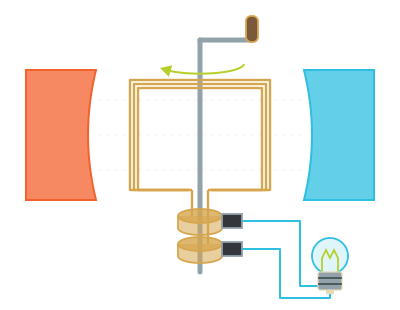
Turn the coil between the magnets and watch its output on the screen. Try it with slip rings, then with a split ring.

Choose the rings and the speed

NSoutput voltage against time
Output–Peak e.m.f.–

Generators

Where you see it: under the bonnet of a danfo, the engine's belt turns an PhysicsGenerator (dynamo)A machine that turns mechanical energy into electrical energy by turning a coil in a magnetic field (or a magnet near a coil). Slip rings give a.c.; a split-ring commutator gives d.c.The petrol generator outside a shop in a blackout, and the huge turbines at Kainji, work the same way.Science dictionary ▶, a small a.c. generator, which charges the battery while the engine runs. In a generator a coil turns in a PhysicsMagnetic fieldThe region around a magnet or a current where a magnet, a magnetic material or a moving charge feels a force. Its lines run from N to S outside a magnet and never cross.Science dictionary ▶, so the flux through it keeps changing and an PhysicsElectromotive force (e.m.f.)The energy a cell or generator gives each coulomb of charge it drives round a whole circuit, in volts.Science dictionary ▶ is induced: mechanical energy becomes electrical energy. As the coil turns, the e.m.f. rises, falls and reverses every half turn, so slip rings give PhysicsAlternating currentCurrent that keeps reversing direction. Nigeria's mains supply reverses 50 times a second (50 Hz) at about 230 V rms.Transformers only work with a.c., which is why it is used to send power across the country.Science dictionary ▶ (a.c.), a sine wave. Turn it faster and both the peak e.m.f. and the PhysicsFrequencyHow many waves pass a point each second, measured in hertz (Hz).Higher frequency sound has a higher pitch.Science dictionary ▶ go up (E₀ = NBAω). A PhysicsSplit-ring commutatorThe split ring on a d.c. motor's coil that reverses the current in the coil every half turn, so the coil keeps turning the same way.Science dictionary ▶ swaps the connections every half turn, so the output always flows the same way: d.c., in pulses. That's a dynamo. Nigeria's mains is a.c. at 50 Hz: the turbines' coils turn 50 times a second.
5

Play · the phone charger

The transformer: 240 V down to 12 V

The charger's transformer has 1000 turns on its primary coil, on the 240 V mains. Wind the secondary coil so it gives exactly 12 V.

Set the secondary turns

240 V1000 turns120 Vto the phone
Secondary turns500Ns ÷ Np0.5Output Vs120 VTypestep-down

The transformer equation

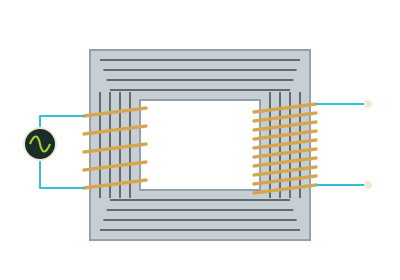
Where you see it: a PhysicsPotential difference (voltage)The energy transferred per coulomb of charge between two points in a circuit, measured in volts.Mains sockets in Nigeria supply about 230 V.Science dictionary ▶ stabiliser in the parlour boosts a low NEPA supply back towards normal by switching to a different number of turns on its PhysicsTransformerA device of two coils on an iron core that changes the voltage of an alternating supply: Vs/Vp = Ns/Np.The transformer on an electricity pole steps high voltage down for homes.Science dictionary ▶ coil. A transformer is two coils on one soft-iron core. PhysicsAlternating currentCurrent that keeps reversing direction. Nigeria's mains supply reverses 50 times a second (50 Hz) at about 230 V rms.Transformers only work with a.c., which is why it is used to send power across the country.Science dictionary ▶ in the primary makes a changing flux in the core, which induces an PhysicsElectromotive force (e.m.f.)The energy a cell or generator gives each coulomb of charge it drives round a whole circuit, in volts.Science dictionary ▶ in the secondary. The voltages are in the same ratio as the turns: Vs/Vp = Ns/Np. More turns on the secondary makes a step-up transformer (the PhysicsPowerHow fast work is done or energy is transferred: power = work ÷ time, in watts (W). 1 W = 1 J every second.A 2 000 W kettle boils water much faster than a 1 000 W one, because it gives the water energy twice as fast.Science dictionary ▶ station's, up to 330 kV); fewer makes a step-down one (the pole outside your house, and your phone charger). For 12 V from 240 V, the ratio is 1 : 20, so 1000 ÷ 20 = 50 turns.
6

Work it out

An ideal transformer's currents

The charger's transformer (240 V in, 12 V out) is ideal: no energy is lost. The phone draws 2 A at 12 V. What current does the charger take from the mains?

Step 1

    Power in, power out

    Where you see it: the welding machine at a roadside workshop holds a PhysicsTransformerA device of two coils on an iron core that changes the voltage of an alternating supply: Vs/Vp = Ns/Np.The transformer on an electricity pole steps high voltage down for homes.Science dictionary ▶ that steps the mains PhysicsPotential difference (voltage)The energy transferred per coulomb of charge between two points in a circuit, measured in volts.Mains sockets in Nigeria supply about 230 V.Science dictionary ▶ down and the PhysicsElectric currentThe rate of flow of electric charge, measured in amperes (1 A = 1 coulomb per second).A phone charger supplies a current of about 1 to 2 A.Science dictionary ▶ up, giving the large current that melts the ChemistrySteel and cast ironIron with a little carbon. Pig or cast iron (about 4% C) is hard but brittle; mild steel (about 0.1–0.3% C) is tough and malleable; high-carbon steel (about 0.6–1.5% C) is very hard.Steel is made by blowing oxygen through molten pig iron to burn off most of the carbon.Science dictionary ▶. In an ideal transformer the PhysicsPowerHow fast work is done or energy is transferred: power = work ÷ time, in watts (W). 1 W = 1 J every second.A 2 000 W kettle boils water much faster than a 1 000 W one, because it gives the water energy twice as fast.Science dictionary ▶ in equals the power out: VpIp = VsIs. So when the voltage is stepped down, the current is stepped up by the same ratio, and the other way round: Is/Ip = Np/Ns. A real transformer loses a little, so its PhysicsEfficiencyHow much of the energy put into a machine comes out as useful work: efficiency = useful output ÷ input × 100%. No real machine reaches 100%.A pump that takes 1250 W of electricity and lifts water at 1000 W is 80% efficient; the rest warms it up.Science dictionary ▶ is (VsIs ÷ VpIp) × 100%, often 95% or more.
    7

    Ash's lab

    Why a.c., and why a laminated core

    A lamp is joined to the secondary. Try the supply as d.c., then as a.c. Then swap the solid iron core for a laminated one and feel the core.

    Choose the supply and the core

    –
    Lamp–Core–

    a.c. only, and the losses

    Where you see it: open an old, heavy PhysicsPowerHow fast work is done or energy is transferred: power = work ÷ time, in watts (W). 1 W = 1 J every second.A 2 000 W kettle boils water much faster than a 1 000 W one, because it gives the water energy twice as fast.Science dictionary ▶ adaptor for a radio and its PhysicsTransformerA device of two coils on an iron core that changes the voltage of an alternating supply: Vs/Vp = Ns/Np.The transformer on an electricity pole steps high voltage down for homes.Science dictionary ▶ core is a stack of thin iron sheets, not one solid block, to stop PhysicsEddy currentsLoops of current induced in a solid piece of metal, such as a transformer's iron core, by a changing magnetic field. They waste energy as heat.Transformer cores are made of thin insulated sheets (laminated) to break the loops up.Science dictionary ▶ wasting energy as heat. A transformer needs PhysicsAlternating currentCurrent that keeps reversing direction. Nigeria's mains supply reverses 50 times a second (50 Hz) at about 230 V rms.Transformers only work with a.c., which is why it is used to send power across the country.Science dictionary ▶: steady d.c. makes a steady flux, and an unchanging flux induces nothing (only a flicker as you switch on or off). A real transformer also loses energy: eddy currents, loops of PhysicsElectric currentThe rate of flow of electric charge, measured in amperes (1 A = 1 coulomb per second).A phone charger supplies a current of about 1 to 2 A.Science dictionary ▶ induced in the iron core itself, heat it up, so the core is laminated from thin insulated sheets that break those loops. Hysteresis loss is cut with soft iron, which magnetises and demagnetises easily; copper (I²R) loss in the coils is cut with thick, low-PhysicsResistanceHow strongly a component opposes current: R = V/I, measured in ohms. It rises with length and falls with thickness of a wire.The coil in an electric iron has a high resistance so it heats up.Science dictionary ▶ wire; and flux leakage by winding the coils on top of each other.
    8

    Exam corner

    How the exam asks it

    The transformer question, every part of it. Tap each step to reveal it.

    A transformer with 400 turns on its primary is joined to the 240 V a.c. mains and gives 12 V. Find the number of turns on the secondary. If the transformer is 80% efficient and the secondary current is 4 A, find the current in the primary.

    Now try the real ones

    Real JAMB, WAEC and NECO past questions on this lesson (the JAMB and WAEC ones in LOEP's words). Answer them one at a time: each is marked, with the worked answer.

    Start the 10 real questions ▶
    1. JAMB 2023A step-down transformer changes 11 kV into 220 V. If its secondary coil has 120 turns, how many turns does the primary coil have?
    2. WAEC 2021The iron core of a transformer is built from thin insulated sheets instead of one solid block. What is the purpose of this?
    3. JAMB 2022A flat coil of area A sits in a uniform magnetic field of flux density B. The field makes an angle θ with the normal to the coil. Which expression gives the mag
    4. WAEC 2018Which of these is NOT a use of an induction coil?
    5. JAMB 2023Which part of a simple dynamo makes the output current flow in one direction only (direct current) instead of alternating?
    6. WAEC 2020A transformer has 1200 turns on its primary coil and 300 turns on its secondary coil. This transformer is
    7. JAMB 2019A coil placed near another coil carrying alternating current has an e.m.f. induced in it. This happens because the alternating current produces
    8. WAEC 2010A coil of inductance 0.2 H carries a steady current of 3 A. How much energy is stored in its magnetic field?
    9. JAMB 2013The size of the e.m.f. induced in a coil is equal to the rate of change of magnetic flux linked with it. This statement is known as
    10. JAMB 2017To reduce the energy lost to eddy currents in a transformer, the core is built from

    Label it

    The a.c. generator, with its coil, slip rings and brushes, and the transformer, with its laminated core and two coils, in the Label lab.
    9

    The League's test

    Pass the League's test

    Six exam-style questions from the League. Get all six right to earn your stamp. Three wrong and you resit.

    The League's badge

    League test · Electromagnetic induction

    You: ♥♥♥

    Press Start when you're ready.

    Remember it

    Tap a card to flip it. Say the answer before you flip.

    Ash:That's electromagnetic induction. Kay, yes: when the light goes, a turbine's coil somewhere stopped turning in its magnets. Your generator is the same idea, the size of a suitcase.
    Electromagnetic induction: Physics explained, with games · L.O.E.P

