15 wks to JAMB

L.O.E.P · PhysicsNo. 06

Explainer · Current electricity · about 15 min

When NEPA takes light every bulb goes off, but when one bulb blows the rest stay on. Why?

Watch the lecture

Ash and Kay teach this lesson, start to finish.

⬇ Save for offline

Keeps it on this phone, so it plays with no signal and no data, at this same address.

In short

The key words in this lesson, in plain English:

Electric current:
The rate of flow of electric charge, measured in amperes (1 A = 1 coulomb per second).
Resistance:
How strongly a component opposes current: R = V/I, measured in ohms. It rises with length and falls with thickness of a wire.
Ammeter:
A meter that measures current, in amperes. It goes in series and has a very low resistance.
Voltmeter:
A meter that measures potential difference, in volts. It goes in parallel across a component and has a very high resistance.

Free this month: 1 of 1 lessons. A free account gives you 3 a month.

When NEPA takes light, every bulb in the house goes off at once. But when one bulb blows, the others carry on shining. Same house, same wires. The difference is how the bulbs are connected, and understanding that is understanding current electricity.

Kay:"Up NEPA!" is the happiest sound in Nigeria. Ash says the electrons were never gone; they just stopped being pushed.
1

Play · count it

Current is flowing charge

Electrons drift round the circuit. The ammeter counts how much charge passes each second. Collect 30 coulombs in 10 seconds.

Set the current, then count

Aelectrons drift this way →
Ammeter1.0 ATime0 sCharge passed0 C

Current, e.m.f. and potential difference

Where you see it: a phone charger labelled 5 V, 2 A delivers up to 2 coulombs of charge to the phone every second, giving 5 PhysicsJouleThe unit of work and energy: the work done when a force of 1 newton moves something 1 metre. 1 kJ = 1000 J.Lifting a 100 g mango through 1 metre takes about 1 joule.Science dictionary ▶ of energy to each coulomb. PhysicsElectric currentThe rate of flow of electric charge, measured in amperes (1 A = 1 coulomb per second).A phone charger supplies a current of about 1 to 2 A.Science dictionary ▶ is the rate of flow of charge: I = Q/t, in amperes (A); 1 A is 1 coulomb per second. In metals the charge carriers are free PhysicsElectronA tiny negatively charged particle that moves around the nucleus of an atom. Moving electrons are an electric current.Rubbing a balloon on your hair moves electrons onto the balloon.Science dictionary ▶; by convention, current is drawn flowing from + to − (the electrons actually go the other way). The PhysicsElectromotive force (e.m.f.)The energy a cell or generator gives each coulomb of charge it drives round a whole circuit, in volts.Science dictionary ▶ of a cell is the energy it gives each coulomb going round the whole circuit; the PhysicsPotential difference (voltage)The energy transferred per coulomb of charge between two points in a circuit, measured in volts.Mains sockets in Nigeria supply about 230 V.Science dictionary ▶ across a component is the energy each coulomb gives up there. Both are measured in volts (1 V = 1 J per C).
2

Ash's lab

Ohm's law

Change the voltage across the resistor and record the current each time. Record four points. Then swap in a filament lamp and see what changes.

Set the voltage, then record

current I (A)V (V)36912123
Voltmeter4 VAmmeter–V ÷ I–

Ohm's law and resistance

Where you see it: the small PhysicsResistanceHow strongly a component opposes current: R = V/I, measured in ohms. It rises with length and falls with thickness of a wire.The coil in an electric iron has a high resistance so it heats up.Science dictionary ▶ beside each LED on a circuit board, in a phone charger or a decoder, is chosen with V = IR so that only the PhysicsElectric currentThe rate of flow of electric charge, measured in amperes (1 A = 1 coulomb per second).A phone charger supplies a current of about 1 to 2 A.Science dictionary ▶ the LED needs gets through. Ohm's law: at constant temperature, the current through a metallic conductor is directly proportional to the PhysicsPotential difference (voltage)The energy transferred per coulomb of charge between two points in a circuit, measured in volts.Mains sockets in Nigeria supply about 230 V.Science dictionary ▶ across it: V = IR. R is the resistance, in ohms (Ω). A V–I graph for such a conductor is a straight line through the origin, and its gradient is R. A filament lamp is not ohmic: it heats up, its resistance rises, and the graph curves.
3

Play · change the wire

What decides resistance

Try each change

Length1 mArea0.5 mm²MaterialnichromeResistance–

Resistivity

Where you see it: electricians use thicker cable for a cooker or a long run from the PhysicsGenerator (dynamo)A machine that turns mechanical energy into electrical energy by turning a coil in a magnetic field (or a magnet near a coil). Slip rings give a.c.; a split-ring commutator gives d.c.The petrol generator outside a shop in a blackout, and the huge turbines at Kainji, work the same way.Science dictionary ▶ to the house: a bigger cross-section has less PhysicsResistanceHow strongly a component opposes current: R = V/I, measured in ohms. It rises with length and falls with thickness of a wire.The coil in an electric iron has a high resistance so it heats up.Science dictionary ▶, so the cable does not overheat or waste PhysicsPotential difference (voltage)The energy transferred per coulomb of charge between two points in a circuit, measured in volts.Mains sockets in Nigeria supply about 230 V.Science dictionary ▶. A wire's resistance is R = ρl/A: proportional to its length l, inversely proportional to its cross-sectional area A, and set by the material's PhysicsResistivityHow strongly a material resists current, whatever the size of the piece: R = ρl/A, measured in ohm metres. Copper's is tiny; nichrome's is high.Science dictionary ▶ ρ (in Ω m). Copper's resistivity is tiny, so it's used for connecting wires; PhysicsNichromeAn alloy of nickel and chromium with a high resistivity and a high melting point, used for the heating elements of irons, kettles and heaters.Science dictionary ▶'s is high, so it's used in PhysicsHeating effect of a currentA current flowing through a resistance turns electrical energy into heat: H = I²Rt. Twice the current gives four times the heat.Science dictionary ▶, like the coil in a pressing iron.
4

Play · blow a bulb

Series and parallel

Two ways to wire three bulbs to the same battery. Tap a bulb in each circuit to blow it, and watch the others.

Tap a bulb to blow it

SERIESPARALLEL
Series: total R–Parallel: total R–

Series and parallel

Where you see it: some strings of Christmas lights are wired PhysicsSeries circuitComponents joined one after another in a single loop: the same current flows through all of them, and if one breaks they all stop.Science dictionary ▶, which is why one loose bulb can make the whole string go dark. In series, there's one path: the same PhysicsElectric currentThe rate of flow of electric charge, measured in amperes (1 A = 1 coulomb per second).A phone charger supplies a current of about 1 to 2 A.Science dictionary ▶ flows through everything, the PhysicsPotential difference (voltage)The energy transferred per coulomb of charge between two points in a circuit, measured in volts.Mains sockets in Nigeria supply about 230 V.Science dictionary ▶ add up, and R = R₁ + R₂ + …. Break one bulb and the whole circuit stops. In parallel, each component has its own branch: each gets the full voltage, the currents add up, and 1/R = 1/R₁ + 1/R₂ + … (the total is less than the smallest). Houses are wired PhysicsParallel circuitComponents on separate branches across the same supply: each gets the full voltage and works on its own. Houses are wired this way.Science dictionary ▶, so each appliance works on its own. And at any junction, the current in equals the current out (Kirchhoff's first law).
5

Play · quick rounds

Combine the resistors

Press Next network

Right0 / 4
Ash:Two equal resistors in parallel give half of one. And product over sum works for any two: 4 and 12 in parallel is 48 ÷ 16 = 3.
6

Play · arcade

Ammeter or voltmeter?

Press Start

Swipe left for ammeter, right for voltmeter

Score0Streak0Lives♥♥♥

Measuring instruments

Where you see it: an electrician's multimeter does both jobs: on its volts setting the probes go across the two points, and on its amps setting it must be connected into the circuit so the PhysicsElectric currentThe rate of flow of electric charge, measured in amperes (1 A = 1 coulomb per second).A phone charger supplies a current of about 1 to 2 A.Science dictionary ▶ flows through it. An PhysicsAmmeterA meter that measures current, in amperes. It goes in series and has a very low resistance.Science dictionary ▶ goes in series and has a very low PhysicsResistanceHow strongly a component opposes current: R = V/I, measured in ohms. It rises with length and falls with thickness of a wire.The coil in an electric iron has a high resistance so it heats up.Science dictionary ▶, so it doesn't reduce the current it measures. A PhysicsVoltmeterA meter that measures potential difference, in volts. It goes in parallel across a component and has a very high resistance.Science dictionary ▶ goes in parallel and has a very high resistance, so hardly any current is drawn through it. A PhysicsWheatstone bridgeFour resistors in a diamond with a galvanometer across the middle. It reads zero when P ÷ Q = R ÷ S, which finds an unknown resistance.Digital bathroom scales and car sensors use bridge circuits to measure tiny changes in resistance.Science dictionary ▶ (Wheatstone bridge) compares an unknown resistance with a known one; a PhysicsPotentiometerA long uniform wire used to compare or measure e.m.f.s accurately: at balance no current is drawn from the cell being tested.Science dictionary ▶ measures PhysicsElectromotive force (e.m.f.)The energy a cell or generator gives each coulomb of charge it drives round a whole circuit, in volts.Science dictionary ▶ more accurately than a voltmeter because at balance it draws no current.
7

Work it out

Lost volts

A battery of e.m.f. 12 V has an internal resistance of 1 Ω. It drives a current through a 5 Ω resistor. Why is the voltage across the resistor less than 12 V?

Step 1

    E.m.f. and internal resistance

    Where you see it: a car's headlamps dim while the starter motor is cranking: the starter draws a very large PhysicsElectric currentThe rate of flow of electric charge, measured in amperes (1 A = 1 coulomb per second).A phone charger supplies a current of about 1 to 2 A.Science dictionary ▶, so the PhysicsInternal resistanceThe resistance inside a cell itself. Driving current through it uses up some of the e.m.f., the 'lost volts', so E = I(R + r).Science dictionary ▶ inside the battery are large and the terminal PhysicsPotential difference (voltage)The energy transferred per coulomb of charge between two points in a circuit, measured in volts.Mains sockets in Nigeria supply about 230 V.Science dictionary ▶ drops. Every cell has some PhysicsResistanceHow strongly a component opposes current: R = V/I, measured in ohms. It rises with length and falls with thickness of a wire.The coil in an electric iron has a high resistance so it heats up.Science dictionary ▶ inside it, its internal resistance r. Some of the PhysicsElectromotive force (e.m.f.)The energy a cell or generator gives each coulomb of charge it drives round a whole circuit, in volts.Science dictionary ▶ is used driving current through it: those are the lost volts, Ir. So E = IR + Ir, or I = E ÷ (R + r), and the terminal p.d. is V = E − Ir. With no current flowing (an open circuit), the terminal p.d. equals the e.m.f.
    8

    Exam corner

    How the exam asks it

    A mixed circuit. Tap each step to reveal it.

    A 6 V battery (no internal resistance) is connected to a 2 Ω resistor in series with a 3 Ω and a 6 Ω resistor in parallel. Find the current from the battery and the current in the 3 Ω resistor.

    Now try the real ones

    Real JAMB, WAEC and NECO past questions on this lesson (the JAMB and WAEC ones in LOEP's words). Answer them one at a time: each is marked, with the worked answer.

    Start the 10 real questions ▶
    1. JAMB 2023A battery of e.m.f. 18.0 V and internal resistance 1.5 Ω is connected to an external resistor of 4.5 Ω. What is the potential difference across the battery term
    2. WAEC 2021The cable of an electric pressing iron becomes too hot. Which change to the cable would reduce the heat produced in it?
    3. JAMB 2019In a slide wire bridge with a 1 m wire, the balance point is 40 cm from the end to which the unknown resistance is connected. A standard resistance of 4.5 Ω is
    4. WAEC 2018Which name is given to a resistor whose resistance has a single, fixed and accurately known value?
    5. JAMB 2019Three resistors of 100 Ω, 300 Ω and 600 Ω are connected in series across a 12 V battery. What is the p.d. across the 300 Ω resistor?
    6. WAEC 2016A copper cable of diameter 2.0 × 10⁻³ m and resistivity 2.0 × 10⁻⁸ Ω m has a resistance of 10 Ω. Find its length. (π = 3.14)
    7. JAMB 2022A cell of internal resistance 0.35 Ω supplies a current of 6 A to an external resistor. What are the lost volts of the cell?
    8. WAEC 2015A wire has a cross-sectional area of 0.50 mm² and a resistivity of 5.0 × 10⁻⁷ Ω m. What length of this wire has a resistance of 4 Ω?
    9. JAMB 2018In a metre bridge, a standard resistor of 6.0 Ω is placed in the left gap, next to the 0 cm end of the wire, and the unknown resistor is placed in the right gap
    10. JAMB 2017Three 6 Ω resistors are connected in parallel. What is their combined resistance?

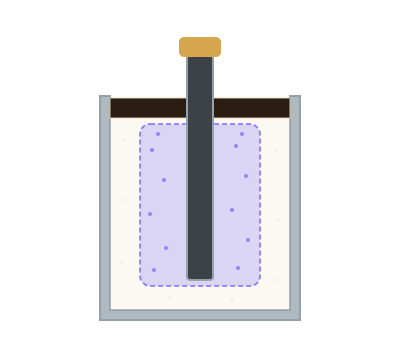
    Label it

    Inside a dry cell, the source of the e.m.f., in the Label lab.
    9

    The League's test

    Pass the League's test

    Six exam-style questions from the League. Get all six right to earn your stamp. Three wrong and you resit.

    The League's badge

    League test · Current electricity

    You: ♥♥♥

    Press Start when you're ready.

    Remember it

    Tap a card to flip it. Say the answer before you flip.

    Kay:That's current electricity. Next time one bulb blows and the rest stay on, say "parallel" out loud. People will be impressed. Mostly.
    Current electricity: Physics explained, with games · L.O.E.P

