15 wks to JAMB

L.O.E.P · ChemistryNo. 07

Explainer · The mole · about 15 min

Nobody at the market counts grains of rice. So how do chemists count atoms?

Watch the lecture

Ash and Kay teach this lesson, start to finish.

⬇ Save for offline

Keeps it on this phone, so it plays with no signal and no data, at this same address.

In short

The key words in this lesson, in plain English:

Mole:
The amount of substance containing 6.02 × 10^23 particles (Avogadro's number). One mole's mass in grams equals the relative formula mass.
Molecular formula:
The actual number of each kind of atom in one molecule: a whole-number multiple of the empirical formula.

Free this month: 1 of 1 lessons. A free account gives you 3 a month.

Nobody at the market counts grains of rice. The trader scoops it with a mudu, or weighs it, because if you know what one grain weighs, the weight tells you the number. Atoms are far too small and far too many to count one by one, so chemists do exactly the same: they count atoms by weighing. Their counting unit is the mole.

Kay:A dozen is 12. A mole is 602 000 000 000 000 000 000 000. Same idea, Ash says, just with more zeros and less bread.
1

Play · weigh it out

Counting by weighing

Weigh out exactly 1 000 of each. You know what one of each weighs.

Pick an item and weigh it out

0 g
On the scale0 gThat's0 itemsWeighed out0 / 3

The mole

Where you see it: a hospital blood test reports sugar and sodium levels in millimoles per litre, mmol/L: a count of PhysicsParticleA tiny piece of matter or energy, such as an atom, an electron or a photon.Light can behave like a stream of particles.Science dictionary ▶, not a PhysicsWeightThe pull of gravity on a mass, measured in newtons: W = mg, about 10 N for every kilogram on Earth.A 50 kg student weighs about 500 N.Science dictionary ▶. A ChemistryMoleThe amount of substance containing 6.02 × 10^23 particles (Avogadro's number). One mole's mass in grams equals the relative formula mass.18 g of water, about a tablespoon, is one mole of water molecules.Science dictionary ▶ is the amount of substance containing as many particles as there are atoms in exactly 12 g of carbon-12: 6.02 × 10²³, the ChemistryAvogadro constantThe number of particles in one mole: 6.02 × 10²³.Science dictionary ▶. Relative atomic PhysicsMassThe amount of matter in something, measured in kilograms. It doesn't change from place to place.Your mass is the same on the Moon, but your weight there is about a sixth.Science dictionary ▶ (Aᵣ) compare atoms on that carbon-12 scale: a carbon atom is 12, hydrogen 1, so 12 g of carbon and 1 g of hydrogen hold the same number of atoms, one mole each. The mass of one mole of a substance is its molar mass, in g/mol.
2

Play · load the balance

Molar mass

Put every atom in the formula onto the balance to find the molar mass. Get 4.

Add the atoms in the formula

–0 g/mol
Done0 / 4

Relative molecular (formula) mass

Where you see it: a bag of BiologyUreaThe main nitrogen-containing waste in human urine, made in the liver from extra amino acids and removed by the kidneys.Urea is also made in factories and sold as a nitrogen fertiliser.Science dictionary ▶ fertiliser is printed 46% N: urea's Mr is 60, and its two nitrogen atoms (28) make up just under half of that PhysicsMassThe amount of matter in something, measured in kilograms. It doesn't change from place to place.Your mass is the same on the Moon, but your weight there is about a sixth.Science dictionary ▶. Add up the relative atomic masses of every atom in the formula: Mᵣ of H₂SO₄ = 2(1) + 32 + 4(16) = 98. Remember brackets multiply: Ca(OH)₂ = 40 + 2(16 + 1) = 74. The ChemistryMoleThe amount of substance containing 6.02 × 10^23 particles (Avogadro's number). One mole's mass in grams equals the relative formula mass.18 g of water, about a tablespoon, is one mole of water molecules.Science dictionary ▶ is the same number in grams per mole: one mole of H₂SO₄ PhysicsWeightThe pull of gravity on a mass, measured in newtons: W = mg, about 10 N for every kilogram on Earth.A 50 kg student weighs about 500 N.Science dictionary ▶ 98 g. Common Aᵣ values: H 1, C 12, N 14, O 16, Na 23, Mg 24, S 32, Cl 35.5, Ca 40.
3

Play · quick rounds

The mole triangle

Mass, moles and molar mass: cover the one you want and the triangle shows the sum. Get 4 right.

Press Start

massmolesmolar mass
Right0 / 4

Moles from mass

ChemistryMoleThe amount of substance containing 6.02 × 10^23 particles (Avogadro's number). One mole's mass in grams equals the relative formula mass.18 g of water, about a tablespoon, is one mole of water molecules.Science dictionary ▶ = PhysicsMassThe amount of matter in something, measured in kilograms. It doesn't change from place to place.Your mass is the same on the Moon, but your weight there is about a sixth.Science dictionary ▶ ÷ molar mass; mass = moles × molar mass. And for PhysicsParticleA tiny piece of matter or energy, such as an atom, an electron or a photon.Light can behave like a stream of particles.Science dictionary ▶: number of particles = moles × 6.02 × 10²³. Always find the molar mass first, and keep the units: grams, g/mol, mol.
4

Play · fill it

Moles of gas

At s.t.p. (0 °C, 1 atmosphere) every gas behaves the same way by volume. Fill the balloon to complete each order.

Pick a gas and fill

pick a gas
Volume0 dm³Moles0Mass0 gMolecules0
  • ☐ Exactly 1 mole of oxygen
  • ☐ Exactly 4 g of methane
  • ☐ 2 moles of nitrogen

Molar volume and Avogadro's law

Where you see it: a helium party balloon floats while one blown up by mouth sinks, yet at the same size, temperature and PhysicsPressureHow hard a force presses on each square metre of a surface: pressure = force ÷ area, measured in pascals (Pa).A sharp knife cuts because its thin edge puts the force on a tiny area. Tractors and camels have wide tyres or feet so they don't sink.Science dictionary ▶ both hold about the same number of gas PhysicsParticleA tiny piece of matter or energy, such as an atom, an electron or a photon.Light can behave like a stream of particles.Science dictionary ▶; helium atoms are simply much lighter. ChemistryAvogadro's lawEqual volumes of all gases at the same temperature and pressure contain the same number of molecules. One mole of any gas fills 22.4 dm³ at s.t.p.Science dictionary ▶: equal volumes of all gases at the same temperature and pressure contain the same number of molecules. So one ChemistryMoleThe amount of substance containing 6.02 × 10^23 particles (Avogadro's number). One mole's mass in grams equals the relative formula mass.18 g of water, about a tablespoon, is one mole of water molecules.Science dictionary ▶ of any gas takes up the same volume: 22.4 dm³ at s.t.p. (about 24 dm³ at room temperature). moles of gas = volume ÷ 22.4 dm³. The PhysicsMassThe amount of matter in something, measured in kilograms. It doesn't change from place to place.Your mass is the same on the Moon, but your weight there is about a sixth.Science dictionary ▶ differ because the molecules do: 22.4 dm³ of methane PhysicsWeightThe pull of gravity on a mass, measured in newtons: W = mg, about 10 N for every kilogram on Earth.A 50 kg student weighs about 500 N.Science dictionary ▶ 16 g, of oxygen 32 g.
5

Ash's lab

Make up a solution

Weigh sodium hydroxide (NaOH, molar mass 40 g/mol) into a volumetric flask and top it up to the mark with water. Make each solution Ash asks for.

Choose a flask and a mass

– cm³
Moles0Concentration–
  • ☐ 250 cm³ of 1.0 mol/dm³
  • ☐ 1 dm³ of 0.10 mol/dm³

Concentration

Where you see it: a sachet of oral rehydration ChemistrySalt (in chemistry)The compound formed when the hydrogen of an acid is replaced by a metal or ammonium ion, as when an acid neutralises a base: sodium chloride, copper(II) sulfate.Science dictionary ▶ must be dissolved in exactly the volume of clean water printed on the pack: too little water makes the solution too concentrated to be safe. ChemistryConcentrationHow much solute is dissolved in each cubic decimetre of solution: moles ÷ volume in dm³ (mol/dm³), or grams per dm³.Science dictionary ▶ tells you how much ChemistrySolute and solventIn a solution, the solute is the substance dissolved and the solvent is the liquid it dissolves in: sugar is the solute and water the solvent in sugar solution.Like dissolves like: polar solvents such as water dissolve ionic and polar substances; non-polar ones such as kerosene dissolve grease and wax.Science dictionary ▶ is in each cubic decimetre (1 dm³ = 1 000 cm³) of solution: concentration (ChemistryMoleThe amount of substance containing 6.02 × 10^23 particles (Avogadro's number). One mole's mass in grams equals the relative formula mass.18 g of water, about a tablespoon, is one mole of water molecules.Science dictionary ▶/dm³) = moles ÷ volume in dm³. In g/dm³ it's PhysicsMassThe amount of matter in something, measured in kilograms. It doesn't change from place to place.Your mass is the same on the Moon, but your weight there is about a sixth.Science dictionary ▶ ÷ volume; multiply mol/dm³ by the molar mass to convert. A ChemistryStandard solutionA solution whose concentration is known accurately, made by dissolving a weighed mass and making it up to the mark in a volumetric flask.Science dictionary ▶ has an accurately known concentration, made exactly this way, ready for ChemistryTitrationAdding one solution from a burette to a measured volume of another until the reaction is just complete (the end point), to find a concentration.Food laboratories titrate fruit juices to measure their acid content.Science dictionary ▶.
6

Work it out

Empirical and molecular formula

A sugar contains 40.0% carbon, 6.7% hydrogen and 53.3% oxygen by mass. Its relative molecular mass is 180. Find its formula.

Step 1

    Empirical and molecular formulae

    Where you see it: the glucose in a hospital drip, C₆H₁₂O₆, and the ChemistryAlkanoic acidsWeak organic acids with the −COOH (carboxyl) group: methanoic acid (ant stings), ethanoic acid (vinegar). They turn blue litmus red, neutralise alkalis and fizz with carbonates.Science dictionary ▶ in vinegar, C₂H₄O₂, are very different substances with the same ChemistryEmpirical formulaThe simplest whole-number ratio of atoms in a compound. Glucose, C₆H₁₂O₆, has the empirical formula CH₂O.Science dictionary ▶, CH₂O. The empirical formula is the simplest whole-number ratio of atoms; the ChemistryMolecular formulaThe actual number of each kind of atom in one molecule: a whole-number multiple of the empirical formula.Science dictionary ▶ is the actual number in a molecule. To find the empirical formula: take the PhysicsMassThe amount of matter in something, measured in kilograms. It doesn't change from place to place.Your mass is the same on the Moon, but your weight there is about a sixth.Science dictionary ▶ (or percentages), divide each by its Aᵣ to get ChemistryMoleThe amount of substance containing 6.02 × 10^23 particles (Avogadro's number). One mole's mass in grams equals the relative formula mass.18 g of water, about a tablespoon, is one mole of water molecules.Science dictionary ▶, divide by the smallest, and round to whole numbers. Then molecular formula = (empirical formula)ₙ, where n = Mᵣ ÷ empirical formula mass.
    7

    Play · run the kiln

    Reacting masses

    A lime kiln heats limestone: CaCO₃ → CaO + CO₂. Load the kiln to meet each order. (Ca = 40, C = 12, O = 16)

    Load the limestone, then fire

    Quicklime, CaO–CO₂ given off–
    • ☐ Exactly 56 g of quicklime
    • ☐ Exactly 11.2 dm³ of carbon(IV) oxide at s.t.p.

    Calculations from equations

    The balanced equation gives the ChemistryMoleThe amount of substance containing 6.02 × 10^23 particles (Avogadro's number). One mole's mass in grams equals the relative formula mass.18 g of water, about a tablespoon, is one mole of water molecules.Science dictionary ▶ ratio. Steps: convert the PhysicsMassThe amount of matter in something, measured in kilograms. It doesn't change from place to place.Your mass is the same on the Moon, but your weight there is about a sixth.Science dictionary ▶ you know to moles; use the ratio from the equation; convert back to mass (× molar mass) or gas volume (× 22.4 dm³). Here 1 mol CaCO₃ (100 g) gives 1 mol CaO (56 g) and 1 mol CO₂ (44 g, or 22.4 dm³ at s.t.p.). Mass is conserved: 100 = 56 + 44.
    8

    Exam corner

    How the exam asks it

    A reacting-mass question. Tap each step to reveal it.

    What mass of magnesium oxide forms when 6.0 g of magnesium burns completely in oxygen? (Mg = 24, O = 16)

    Now try the real ones

    Real JAMB, WAEC and NECO past questions on this lesson (the JAMB and WAEC ones in LOEP's words). Answer them one at a time: each is marked, with the worked answer.

    Start the 10 real questions ▶
    1. JAMB 2023What is the percentage by mass of carbon in ethane, C₂H₆? [C = 12, H = 1]
    2. WAEC 2021Element X has two isotopes: 60% of ¹⁰X and 40% of ¹¹X. What is its relative atomic mass?
    3. JAMB 2023What is the molar mass of ammonia, NH₃? [N = 14, H = 1]
    4. WAEC 2021A hydrocarbon sample contains 0.20 mol of carbon atoms and 0.50 mol of hydrogen atoms. What is its empirical formula?
    5. JAMB 2021What is the mass of 3.01 × 10²³ atoms of calcium? [Ca = 40]
    6. WAEC 2021The ratio of carbon atoms to hydrogen atoms in a hydrocarbon is 1:2 and its relative molecular mass is 70. What is its molecular formula?
    7. JAMB 2016Naturally occurring neon consists of 90% neon-20 and 10% neon-22. Its relative atomic mass is
    8. WAEC 2009In a sample of element X, 80 out of every 100 atoms have mass 10 and the other 20 have mass 12. What is the relative atomic mass of X?
    9. JAMB 2021How many moles of carbon(IV) oxide are contained in 132 g of the gas?
    10. JAMB 2014A sample of magnesium contains 79% ²⁴Mg, 10% ²⁵Mg and 11% ²⁶Mg. What is the relative atomic mass of the magnesium?

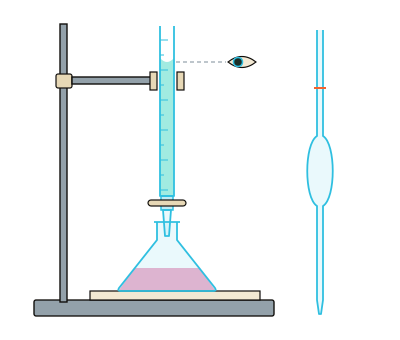
    Label it

    The titration set-up, where standard solutions and moles meet, in the Label lab.
    9

    The League's test

    Pass the League's test

    Six exam-style questions from the League. Get all six right to earn your stamp. Three wrong and you resit.

    The League's badge

    League test · The mole

    You: ♥♥♥

    Press Start when you're ready.

    Remember it

    Tap a card to flip it. Say the answer before you flip.

    Kay:That's the mole. Next time the rice seller says "one mudu", tell her you'd prefer it in moles. Then step back.
    The mole: Chemistry explained, with games · L.O.E.P

