15 wks to JAMB

L.O.E.P · ChemistryNo. 14

Explainer · Separation of mixtures · about 15 min

Kerosene got into the borehole tank. Does the whole tank have to go, or can chemistry pull it out?


Watch the lecture

Ash and Kay teach this lesson, start to finish.

⬇ Save for offline

Keeps it on this phone, so it plays with no signal and no data, at this same address.

In short

The key words in this lesson, in plain English:

Mixture:
Two or more substances mixed but not chemically joined, in any proportion. Their parts keep their own properties and can be separated physically.
Compound:
Two or more elements chemically joined in a fixed ratio, with properties different from the elements, such as water (H2O) or salt (NaCl).
Salt (in chemistry):
The compound formed when the hydrogen of an acid is replaced by a metal or ammonium ion, as when an acid neutralises a base: sodium chloride, copper(II) sulfate.
Distillation:
Separating a liquid from a mixture by boiling it and condensing the vapour. Fractional distillation separates liquids with different boiling points.

Free this month: 1 of 1 lessons. A free account gives you 3 a month.

Your mother sieves garri, strains pap through a cloth, and skims palm oil off the top of a pot. The refinery at Port Harcourt splits crude oil into petrol and kerosene. They are all doing the same thing: separating a mixture by a difference in its parts, such as size, solubility, boiling point or density. Spot the difference and you know the method.

Kay:Our borehole water got kerosene in it from the generator. Mum says we have to throw the whole tank away. Do we?
1

Play · arcade

Mixture or compound?

Press Start

Swipe left for a mixture, right for a compound

Score0Streak0Lives♥♥♥

Elements, compounds and mixtures

Where you see it: a bowl of garri soaked with sugar and groundnuts is a ChemistryMixtureTwo or more substances mixed but not chemically joined, in any proportion. Their parts keep their own properties and can be separated physically.Air, sea water and garri with sugar are mixtures.Science dictionary ▶: each part keeps its own taste and could be picked apart, while the sugar itself is a ChemistryCompoundTwo or more elements chemically joined in a fixed ratio, with properties different from the elements, such as water (H2O) or salt (NaCl).Poisonous chlorine and reactive sodium combine into the salt you eat.Science dictionary ▶ of carbon, hydrogen and oxygen in a fixed ratio. An ChemistryElementA substance made of only one kind of atom, which cannot be split into simpler substances by chemical means, such as iron, oxygen or carbon.The iron in a cooking pot and the oxygen you breathe are elements.Science dictionary ▶ can't be split into anything simpler by chemical means. A compound is two or more elements chemically joined in a fixed ratio: it has new properties, a fixed PhysicsMelting pointThe temperature at which a pure solid melts. Its liquid freezes at the same temperature: for water, 0 °C. Impurities such as salt lower the freezing point.Science dictionary ▶, and needs a chemical reaction to split it. A mixture is substances mixed but not joined, in any proportion: each part keeps its own properties, and you separate them by physical means. Air, sea water and brass are mixtures; water, ChemistrySalt (in chemistry)The compound formed when the hydrogen of an acid is replaced by a metal or ammonium ion, as when an acid neutralises a base: sodium chloride, copper(II) sulfate.Science dictionary ▶ and ChemistryRustingThe corrosion of iron into hydrated iron(III) oxide. A redox reaction that needs both oxygen and water, and goes faster with salt. Stopped by paint, oil, tin plating or galvanising.Science dictionary ▶ are compounds.
2

Play · quick rounds

Physical or chemical? Pure or not?

Press Next

Five right to pass.

Right0 / 5

Changes, and how to tell a pure substance

Where you see it: a drug-testing laboratory checks a batch of paracetamol powder by its PhysicsMelting pointThe temperature at which a pure solid melts. Its liquid freezes at the same temperature: for water, 0 °C. Impurities such as salt lower the freezing point.Science dictionary ▶: a pure sample melts sharply at one temperature, while an impure one melts lower and over a range. A ChemistryPhysical and chemical changeA physical change makes no new substance and is usually easy to reverse (melting, dissolving). A chemical change makes a new substance, with heat given out or taken in, and is hard to reverse (burning, rusting).Ice melting is physical; kerosene burning is chemical.Science dictionary ▶ makes no new substance and is usually easy to reverse: melting, boiling, dissolving, magnetising. A chemical change makes a new substance, usually with heat given out or taken in, and is hard to reverse: burning, ChemistryRustingThe corrosion of iron into hydrated iron(III) oxide. A redox reaction that needs both oxygen and water, and goes faster with salt. Stopped by paint, oil, tin plating or galvanising.Science dictionary ▶, cooking, BiologyFermentationAnaerobic respiration by micro-organisms such as yeast or bacteria, making products like alcohol, carbon(IV) oxide or lactic acid.Palm wine, ogi, garri, bread and yoghurt all depend on fermentation.Science dictionary ▶. A pure substance has a sharp, fixed melting point and PhysicsBoiling pointThe temperature at which a liquid boils, where its saturated vapour pressure equals the pressure above it. Water: 100 °C at sea level, lower up a mountain, higher in a pressure cooker or with salt in it.Science dictionary ▶. Impurities lower the melting point and spread it over a range, and raise the boiling point: that's how you test purity.
3

Play · pick the method

Which method separates it?

Each card is a mixture. Find the difference between its parts, then choose the method. Eight right to pass.

Press Next

Eight right to pass.

Right0 / 8

Match the method to the difference

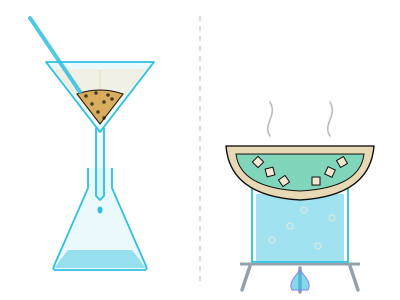
Insoluble solid in a liquid: ChemistryFiltrationSeparating an insoluble solid from a liquid by passing the mixture through a filter. The solid left behind is the residue; the liquid is the filtrate.Straining pap through a cloth is filtration.Science dictionary ▶ (or ChemistryDecantationPouring off a liquid carefully, leaving a solid that has settled at the bottom behind.Pouring the water off rice or beans after soaking is decanting.Science dictionary ▶, if it settles). Dissolved solid you want back: PhysicsEvaporationWhen a liquid turns into a gas at its surface, below its boiling point, like puddles drying up.Sweat cools you by evaporating.Science dictionary ▶, or ChemistryCrystallisationGetting a dissolved solid back as crystals: heat the solution until it is saturated, then let it cool so crystals grow. Purer than evaporating to dryness, because soluble impurities stay in the liquid.Copper(II) sulphate and salt crystals are made this way.Science dictionary ▶ for neat crystals. A liquid you want back from a solution: simple ChemistryDistillationSeparating a liquid from a mixture by boiling it and condensing the vapour. Fractional distillation separates liquids with different boiling points.Refineries separate crude oil into petrol, kerosene and diesel by fractional distillation.Science dictionary ▶. Liquids that mix, with PhysicsBoiling pointThe temperature at which a liquid boils, where its saturated vapour pressure equals the pressure above it. Water: 100 °C at sea level, lower up a mountain, higher in a pressure cooker or with salt in it.Science dictionary ▶ close together: fractional distillation. Liquids that don't mix (ChemistryImmiscible liquidsLiquids that do not mix, such as kerosene and water, and settle into two layers with the less dense one on top. They are separated with a separating funnel. Liquids that mix are miscible.Palm oil floats on water in the pot for the same reason.Science dictionary ▶): a separating funnel. A magnetic solid, such as iron filings in sulphur: a magnet. A solid that ChemistrySublimationA solid turning straight into a gas without melting, as iodine, naphthalene and ammonium chloride do when heated.Naphthalene balls in wardrobes shrink by sublimation.Science dictionary ▶ (iodine, ammonium chloride, naphthalene): sublimation. Coloured substances in a solution: ChemistryChromatographySeparating the parts of a mixture, such as dyes in ink, by how far they travel through a medium like paper with a solvent.Forensic scientists use it to check whether two inks match.Science dictionary ▶. Solid too fine to filter: ChemistryCentrifugingSpinning a mixture very fast so the denser solid is thrown to the bottom of the tube. Used for solids too fine to filter.Hospital laboratories separate blood cells from plasma this way.Science dictionary ▶.
4

Ash's lab

Clean salt from dirty rock salt

Rock salt is salt mixed with sand and grit. Tap the steps in order to get clean salt crystals.

Tap the first step

    Filtration and crystallisation

    Where you see it: the ceramic candle in a household water filter traps the mud and fine PhysicsParticleA tiny piece of matter or energy, such as an atom, an electron or a photon.Light can behave like a stream of particles.Science dictionary ▶ as residue, while the clean water passes through as ChemistryFiltrationSeparating an insoluble solid from a liquid by passing the mixture through a filter. The solid left behind is the residue; the liquid is the filtrate.Straining pap through a cloth is filtration.Science dictionary ▶. ChemistrySalt (in chemistry)The compound formed when the hydrogen of an acid is replaced by a metal or ammonium ion, as when an acid neutralises a base: sodium chloride, copper(II) sulfate.Science dictionary ▶ dissolves and sand doesn't: that's the difference. Stir in warm water, filter: the sand stays in the paper as the residue, the salt solution runs through as the filtrate. Heat the filtrate until it's ChemistrySaturated and unsaturatedA saturated compound has only single carbon–carbon bonds and holds all the hydrogen it can; an unsaturated one has double or triple bonds and decolourises bromine water.Science dictionary ▶ (a drop on a cold rod forms crystals), then leave it to cool: crystals grow. Filter them off and dry them between filter papers. PhysicsEvaporationWhen a liquid turns into a gas at its surface, below its boiling point, like puddles drying up.Sweat cools you by evaporating.Science dictionary ▶ right to dryness also gets the salt, but as a powder, and it can spit and decompose some salts. ChemistryCrystallisationGetting a dissolved solid back as crystals: heat the solution until it is saturated, then let it cool so crystals grow. Purer than evaporating to dryness, because soluble impurities stay in the liquid.Copper(II) sulphate and salt crystals are made this way.Science dictionary ▶ gives purer crystals, because soluble impurities stay in the liquid.
    5

    Play · fractional distillation

    Palm wine to spirit: distil it

    The flask holds ethanol (boils at 78 °C) and water (boils at 100 °C). Set the heat, watch the thermometer at the top of the column, and collect each liquid in its own flask.

    Set the heat, then collect

    flask 1flask 2
    Thermometer25 °CDripping overnothingCollected0 / 2

    Simple and fractional distillation

    Where you see it: the ChemistryDistillationSeparating a liquid from a mixture by boiling it and condensing the vapour. Fractional distillation separates liquids with different boiling points.Refineries separate crude oil into petrol, kerosene and diesel by fractional distillation.Science dictionary ▶ sold for topping up car batteries is water boiled off and PhysicsCondensationWhen a gas cools and turns back into a liquid, like water droplets on a cold bottle.It's the reverse of evaporation.Science dictionary ▶, leaving the dissolved ChemistrySalt (in chemistry)The compound formed when the hydrogen of an acid is replaced by a metal or ammonium ion, as when an acid neutralises a base: sodium chloride, copper(II) sulfate.Science dictionary ▶ behind in the boiler. Distillation boils a liquid off and condenses the vapour in a water-cooled condenser; the liquid collected is the distillate. Simple distillation gets pure water from salt water (the salt stays behind). For two liquids that mix, like ChemistryEthanolThe alcohol in alcoholic drinks (C₂H₅OH). It is also used as a fuel and a solvent.The liver breaks it down in steps.Science dictionary ▶ and water, a ChemistryFractionating columnThe tall tower in which crude oil vapour is separated into fractions: cooler at the top, where the smallest molecules condense.Science dictionary ▶ lets the lower-boiling one come over first: the thermometer sits at the top of the column, by the side arm, and stays steady at 78 °C while ethanol distils, then climbs to 100 °C for water. Refineries split crude oil into fractions the same way, and local gin is purified by distillation.
    6

    Play · the separating funnel

    Kerosene off the water

    Kerosene and water don't mix. Let them settle, open the tap, and close it just as the water has gone.

    Open the tap

    kerosenewater
    Run off0 cm³Water left50 cm³

    Immiscible liquids

    Where you see it: water that leaks into a filling station's underground tank sinks below the petrol, so the dipstick is coated with a paste that changes colour where it touches the water at the bottom. Liquids that don't mix are ChemistryImmiscible liquidsLiquids that do not mix, such as kerosene and water, and settle into two layers with the less dense one on top. They are separated with a separating funnel. Liquids that mix are miscible.Palm oil floats on water in the pot for the same reason.Science dictionary ▶. In a separating funnel they settle into two layers, the less dense on top: kerosene, petrol and palm oil float on water. Open the tap to run off the lower layer, close it at the boundary, then pour the top layer out through the neck. That's how the kerosene in Kay's tank can be drawn off the top. Liquids that do mix (miscible), such as ChemistryEthanolThe alcohol in alcoholic drinks (C₂H₅OH). It is also used as a fuel and a solvent.The liver breaks it down in steps.Science dictionary ▶ and water, need ChemistryDistillationSeparating a liquid from a mixture by boiling it and condensing the vapour. Fractional distillation separates liquids with different boiling points.Refineries separate crude oil into petrol, kerosene and diesel by fractional distillation.Science dictionary ▶ instead.
    7

    Play · chromatography

    What's in the black ink?

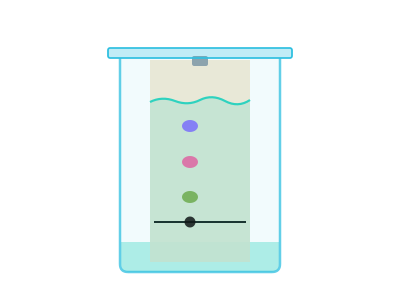
    A spot of black ink and three known dyes sit on the pencil line. Run the solvent up the paper, then say which dyes the ink contains.

    Run the solvent

    inkRBY

    Paper chromatography

    Where you see it: a food-testing laboratory runs ChemistryChromatographySeparating the parts of a mixture, such as dyes in ink, by how far they travel through a medium like paper with a solvent.Forensic scientists use it to check whether two inks match.Science dictionary ▶ on sweets and soft drinks to check that only permitted food colourings are in them. The ChemistryMixtureTwo or more substances mixed but not chemically joined, in any proportion. Their parts keep their own properties and can be separated physically.Air, sea water and garri with sugar are mixtures.Science dictionary ▶ is spotted on a pencil line (ink would run) above the ChemistrySolute and solventIn a solution, the solute is the substance dissolved and the solvent is the liquid it dissolves in: sugar is the solute and water the solvent in sugar solution.Like dissolves like: polar solvents such as water dissolve ionic and polar substances; non-polar ones such as kerosene dissolve grease and wax.Science dictionary ▶. As the solvent soaks up the paper, each dye travels a different distance, depending on how well it dissolves in the solvent and how strongly it sticks to the paper. A dye matches a known one if its spot rises to the same height. Its Rf value is the distance the spot moved ÷ the distance the solvent front moved: always less than 1. A pure substance gives one spot.
    8

    Exam corner

    How the exam asks it

    The Rf value, every part of it. Tap each step to reveal it.

    On a chromatogram, the solvent front moved 8.0 cm from the base line and a green dye moved 3.2 cm. What is the Rf of the dye, and could it be a dye with Rf = 0.4?

    Now try the real ones

    Real JAMB, WAEC and NECO past questions on this lesson (the JAMB and WAEC ones in LOEP's words). Answer them one at a time: each is marked, with the worked answer.

    Start the 10 real questions ▶
    1. JAMB 2023Kerosene has a density of 0.80 g/mL. What is the mass of 400 mL of kerosene?
    2. WAEC 2010In a titration, exactly 25.0 cm³ of alkali must be transferred into a conical flask. Which piece of apparatus is used for this?
    3. JAMB 2023Which technique is used to separate the coloured dyes in black ink using paper and a solvent?
    4. WAEC 2021A hot saturated solution of potassium trioxonitrate(V) is left to cool and well-formed solid appears. The method of separation used is
    5. JAMB 2020Which of the following is a mixture?
    6. WAEC 2018A student wants to check how pure a sample of liquid benzene is. Which measurement is most useful?
    7. JAMB 2015Which observation is the defining feature of a chemical change?
    8. WAEC 2020Which method is the most suitable for obtaining pure water from salt solution?
    9. JAMB 2022Common salt is dissolved in pure water. Compared with pure water, the solution will?
    10. JAMB 2019Which observation supports the idea that air is a mixture and not a compound?

    Label it

    Filtration and crystallisation, and a paper chromatogram, in the Label lab.
    9

    The League's test

    Pass the League's test

    Six exam-style questions from the League. Get all six right to earn your stamp. Three wrong and you resit.

    The League's badge

    League test · Separation

    You: ♥♥♥

    Press Start when you're ready.

    Remember it

    Tap a card to flip it. Say the answer before you flip.

    Ash:Find the difference, pick the method. And Kay: the kerosene floats, so it can be drawn off the top. But some of it dissolves and you can't see it, so don't drink that water until it's been tested. Use it for washing.
    Separation of mixtures: Chemistry explained, with games · L.O.E.P