15 wks to JAMB

L.O.E.P · ChemistryNo. 10

Explainer · Oxidation and reduction (redox) · about 15 min

A cut plantain turns brown in minutes, but not if you squeeze lime on it. Why?

Watch the lecture

Ash and Kay teach this lesson, start to finish.

⬇ Save for offline

Keeps it on this phone, so it plays with no signal and no data, at this same address.

In short

The key words in this lesson, in plain English:

Oxidation and reduction (redox):
Oxidation is loss of electrons (or gain of oxygen); reduction is gain of electrons (or loss of oxygen). They always happen together.
Oxidation number:
The charge an atom would carry if all its bonds were ionic. An element is 0; oxygen is usually −2 and hydrogen +1; they add up to 0 in a compound. A rise is oxidation, a fall is reduction.
Rusting:
The corrosion of iron into hydrated iron(III) oxide. A redox reaction that needs both oxygen and water, and goes faster with salt. Stopped by paint, oil, tin plating or galvanising.

Free this month: 1 of 1 lessons. A free account gives you 3 a month.

Slice a plantain or an apple and leave it: in minutes the cut face goes brown. Squeeze lime juice over the next slice and it stays pale. The browning is the fruit's own chemicals reacting with oxygen from the air; the lime's vitamin C reacts first and protects them. That's oxidation, and stopping it is reduction. The same pair of changes rusts the gate, burns the gas in the cooker, runs every battery and pulls iron out of its ore.

Ash:Kay calls lime juice "plantain sunscreen". It's actually an antioxidant, which is the same idea with better marks.
1

Play · pass the electrons

Oxidation is loss

Magnesium burns in oxygen to make magnesium oxide, an ionic compound. Pass electrons from the magnesium atom to the oxygen atom until both have full outer shells. Then say which one was oxidised.

Pass an electron

MgO
MagnesiumMg (2, 8, 2)OxygenO (2, 6)

Three ways to say it

Where you see it: a silver chain slowly darkens as its silver atoms lose PhysicsElectronA tiny negatively charged particle that moves around the nucleus of an atom. Moving electrons are an electric current.Rubbing a balloon on your hair moves electrons onto the balloon.Science dictionary ▶ and form black silver sulphide with traces of sulphur ChemistryCompoundTwo or more elements chemically joined in a fixed ratio, with properties different from the elements, such as water (H2O) or salt (NaCl).Poisonous chlorine and reactive sodium combine into the salt you eat.Science dictionary ▶ in the air: the silver is being ChemistryOxidation and reduction (redox)Oxidation is loss of electrons (or gain of oxygen); reduction is gain of electrons (or loss of oxygen). They always happen together.Rusting oxidises iron; a blast furnace reduces iron ore back to iron.Science dictionary ▶. Oxidation is the gain of oxygen, the loss of hydrogen, or, most usefully, the loss of electrons. Reduction is the opposite: loss of oxygen, gain of hydrogen, gain of electrons. Remember OIL RIG: Oxidation Is Loss, Reduction Is Gain (of electrons). The two always happen together, because the electrons one substance loses must go somewhere: a reaction with both is a redox reaction. Burning, ChemistryRustingThe corrosion of iron into hydrated iron(III) oxide. A redox reaction that needs both oxygen and water, and goes faster with salt. Stopped by paint, oil, tin plating or galvanising.Science dictionary ▶, BiologyRespirationThe breakdown of food (glucose) in every living cell to release energy. Aerobic respiration uses oxygen; anaerobic respiration does not.Breathing is not respiration: breathing brings in the oxygen that respiration in your cells uses.Science dictionary ▶ and every PhysicsDisplacementDistance moved in a stated direction: the straight line from start to finish. It is a vector.Science dictionary ▶ of one metal by another are redox.
2

Play · arcade

Oxidation or reduction?

Press Start

Swipe left for oxidation, right for reduction

Score0Streak0Lives♥♥♥
Kay:If it's losing electrons or gaining oxygen, it's oxidation. Ash makes me say OIL RIG before every test. I've started saying it in my sleep.
3

Play · quick rounds

Oxidation numbers

Press Next

Find the oxidation number of the coloured atom

–

Right0 / 5

The rules, and the names

An ChemistryOxidation numberThe charge an atom would carry if all its bonds were ionic. An element is 0; oxygen is usually −2 and hydrogen +1; they add up to 0 in a compound. A rise is oxidation, a fall is reduction.Science dictionary ▶ is the charge an atom would have if all its bonds were ionic. An uncombined ChemistryElementA substance made of only one kind of atom, which cannot be split into simpler substances by chemical means, such as iron, oxygen or carbon.The iron in a cooking pot and the oxygen you breathe are elements.Science dictionary ▶ is 0. In ChemistryCompoundTwo or more elements chemically joined in a fixed ratio, with properties different from the elements, such as water (H2O) or salt (NaCl).Poisonous chlorine and reactive sodium combine into the salt you eat.Science dictionary ▶, oxygen is usually −2 (−1 in peroxides), hydrogen +1 (−1 in metal hydrides), Group 1 metals +1 and Group 2 +2. They add up to 0 in a compound and to the charge in an ChemistryIonAn atom or group of atoms with an electric charge, formed by losing electrons (positive cation) or gaining them (negative anion).Sports drinks replace sodium and potassium ions lost in sweat.Science dictionary ▶. A rise in oxidation number is ChemistryOxidation and reduction (redox)Oxidation is loss of electrons (or gain of oxygen); reduction is gain of electrons (or loss of oxygen). They always happen together.Rusting oxidises iron; a blast furnace reduces iron ore back to iron.Science dictionary ▶; a fall is reduction. The ChemistryIUPAC nomenclatureThe international rules for naming chemical compounds, so each structure has one name: prefixes, then the stem for the longest chain, then the ending for the functional group.Science dictionary ▶ carry it in Roman numerals: Na₂SO₄ is sodium tetraoxosulphate(VI) (four oxygens, sulphur +6), KNO₃ is potassium trioxonitrate(V), and iron(III) chloride has iron at +3.
4

Play · find the agents

Oxidising and reducing agents

In each equation, tap the oxidising agent first, then the reducing agent.

Tap the oxidising agent

–

Equations done0 / 4

Who does what

Where you see it: the purple potassium tetraoxomanganate(VII) crystals sold at chemists are dissolved in water to wash vegetables: it is a strong ChemistryOxidation and reduction (redox)Oxidation is loss of electrons (or gain of oxygen); reduction is gain of electrons (or loss of oxygen). They always happen together.Rusting oxidises iron; a blast furnace reduces iron ore back to iron.Science dictionary ▶, so it oxidises the germs and is itself reduced. The oxidising agent oxidises something else, so it takes PhysicsElectronA tiny negatively charged particle that moves around the nucleus of an atom. Moving electrons are an electric current.Rubbing a balloon on your hair moves electrons onto the balloon.Science dictionary ▶ and is itself reduced: oxygen, chlorine, acidified potassium tetraoxomanganate(VII) (KMnO₄), acidified potassium heptaoxodichromate(VI) (K₂Cr₂O₇), concentrated trioxonitrate(V) ChemistryAcidA substance with a pH below 7 that releases hydrogen ions in water. Strong acids are corrosive; the stomach uses hydrochloric acid to digest food.Acids turn blue litmus paper red.Science dictionary ▶. The reducing agent gives electrons and is itself oxidised: hydrogen, carbon, ChemistryCarbon(II) oxide (carbon monoxide)CO, a colourless, odourless, poisonous gas from fuel burnt in too little oxygen. It binds to haemoglobin far more strongly than oxygen, so the blood can't carry oxygen.Never run a generator indoors or near a window: it's a common cause of death in blackouts.Science dictionary ▶, reactive metals, hydrogen sulphide, sulphur(IV) oxide, iron(II) ChemistryIonAn atom or group of atoms with an electric charge, formed by losing electrons (positive cation) or gaining them (negative anion).Sports drinks replace sodium and potassium ions lost in sweat.Science dictionary ▶. Hydrogen peroxide can act as either.
5

Work it out

Two halves make a redox equation

Chlorine water turns pale green iron(II) chloride solution yellow-brown: it oxidises Fe²⁺ to Fe³⁺. Build the ionic equation from its two halves.

Step 1

    Balancing with half-equations

    Write the ChemistryOxidation and reduction (redox)Oxidation is loss of electrons (or gain of oxygen); reduction is gain of electrons (or loss of oxygen). They always happen together.Rusting oxidises iron; a blast furnace reduces iron ore back to iron.Science dictionary ▶ half and the reduction half separately, each balanced for atoms and for charge with PhysicsElectronA tiny negatively charged particle that moves around the nucleus of an atom. Moving electrons are an electric current.Rubbing a balloon on your hair moves electrons onto the balloon.Science dictionary ▶. Multiply them so the electrons lost equal the electrons gained, then add and cancel the electrons. Check that the charges on both sides match. In ChemistryAcidA substance with a pH below 7 that releases hydrogen ions in water. Strong acids are corrosive; the stomach uses hydrochloric acid to digest food.Acids turn blue litmus paper red.Science dictionary ▶, balance oxygen with H₂O and hydrogen with H⁺: that's how MnO₄⁻ + 8H⁺ + 5e⁻ → Mn²⁺ + 4H₂O gets its numbers.
    6

    Ash's lab

    Is it oxidising or reducing?

    Ash has a mystery substance. Add it to one of the four test reagents, watch the colour, then say whether it's an oxidising or a reducing agent. Get three right.

    Press New sample

    choose a reagent
    Sample–Right0 / 3

    The colour tests

    Reducing agents turn acidified KMnO₄ from purple to colourless (Mn +7 to +2), and acidified K₂Cr₂O₇ from orange to green (Cr +6 to +3): that's how a ChemistryBreathalyserA device that tests a driver's breath for ethanol: the ethanol reduces orange acidified potassium heptaoxodichromate(VI) to green chromium(III).Science dictionary ▶ spots ChemistryEthanolThe alcohol in alcoholic drinks (C₂H₅OH). It is also used as a fuel and a solvent.The liver breaks it down in steps.Science dictionary ▶ on a driver's breath, and how sulphur(IV) oxide and hydrogen sulphide are tested. Oxidising agents turn colourless potassium iodide solution yellow-brown (iodide ChemistryIonAn atom or group of atoms with an electric charge, formed by losing electrons (positive cation) or gaining them (negative anion).Sports drinks replace sodium and potassium ions lost in sweat.Science dictionary ▶ to iodine), and damp starch-iodide paper blue-black: that's the test for chlorine. In ChemistryTitrationAdding one solution from a burette to a measured volume of another until the reaction is just complete (the end point), to find a concentration.Food laboratories titrate fruit juices to measure their acid content.Science dictionary ▶, KMnO₄ is its own ChemistryIndicatorA dye whose colour shows whether a solution is acidic or alkaline. Litmus turns red in acid and blue in alkali; universal indicator shows the whole pH scale.Science dictionary ▶: the first lasting pink means the ChemistryOxidation and reduction (redox)Oxidation is loss of electrons (or gain of oxygen); reduction is gain of electrons (or loss of oxygen). They always happen together.Rusting oxidises iron; a blast furnace reduces iron ore back to iron.Science dictionary ▶ is used up.
    7

    Play · the rusting race

    What makes iron rust?

    Six iron nails, six conditions, one week. Set up each one and watch. Then find what rust needs, and what stops it.

    Choose a set-up

    Set-up–Rust–Tried0 / 6

    Rusting and how to stop it

    Where you see it: a bicycle left out through the rainy season ChemistryRustingThe corrosion of iron into hydrated iron(III) oxide. A redox reaction that needs both oxygen and water, and goes faster with salt. Stopped by paint, oil, tin plating or galvanising.Science dictionary ▶ on its chain and spokes unless they are oiled; the film of oil keeps the air and water off the iron. Rusting is a ChemistryOxidation and reduction (redox)Oxidation is loss of electrons (or gain of oxygen); reduction is gain of electrons (or loss of oxygen). They always happen together.Rusting oxidises iron; a blast furnace reduces iron ore back to iron.Science dictionary ▶ reaction: iron is oxidised (Fe → Fe³⁺, losing PhysicsElectronA tiny negatively charged particle that moves around the nucleus of an atom. Moving electrons are an electric current.Rubbing a balloon on your hair moves electrons onto the balloon.Science dictionary ▶) while oxygen is reduced, giving hydrated iron(III) oxide, Fe₂O₃·xH₂O. It needs both oxygen and water; ChemistrySalt (in chemistry)The compound formed when the hydrogen of an acid is replaced by a metal or ammonium ion, as when an acid neutralises a base: sodium chloride, copper(II) sulfate.Science dictionary ▶ (from sea air or roads) makes it faster. Stop it by keeping air and water out (paint, oil, grease, plastic, a coat of tin) or by ChemistryGalvanisingCoating iron with zinc. Zinc is more reactive, so it is oxidised instead of the iron, protecting it even where scratched.Science dictionary ▶: a zinc coat, which is more reactive than iron, is oxidised instead, so even a scratched zinc roof doesn't rust. That's sacrificial protection, also used on ships' hulls with blocks of magnesium or zinc.
    8

    Exam corner

    How the exam asks it

    One equation, four questions. Tap each step to reveal it.

    Acidified potassium heptaoxodichromate(VI) oxidises iodide ions: Cr₂O₇²⁻ + 14H⁺ + 6I⁻ → 2Cr³⁺ + 3I₂ + 7H₂O. State the change in the oxidation number of chromium, name the reducing agent, give the electrons gained by each Cr₂O₇²⁻ ion, and find the moles of iodine set free by 0.10 mol of dichromate.

    Now try the real ones

    Real JAMB, WAEC and NECO past questions on this lesson (the JAMB and WAEC ones in LOEP's words). Answer them one at a time: each is marked, with the worked answer.

    Start the 10 real questions ▶
    1. JAMB 2023In the reaction Mg + FeSO₄ → MgSO₄ + Fe, which species is the reducing agent?
    2. WAEC 2015In the reaction Fe₂O₃(s) + 3CO(g) → 2Fe(s) + 3CO₂(g), which substance acts as the reducing agent?
    3. JAMB 2023Which equation correctly represents the reduction of magnetite by carbon(II) oxide?
    4. WAEC 2020What is the oxidation number of chlorine in potassium chlorate(V), KClO₃?
    5. JAMB 2021What is the name of FeCl₃ when oxidation numbers are used in the name?
    6. WAEC 2012What is the formula of copper(II) dioxonitrate(III)?
    7. JAMB 2021Police use a breathalyser to detect alcohol on a driver's breath. Which reagent in the device changes colour from orange to green when alcohol is present?
    8. WAEC 2001Which of these substances gains mass when heated strongly in air?
    9. JAMB 2021In the half-equation Fe³⁺ + e⁻ → Fe²⁺, the iron(III) ion undergoes?
    10. JAMB 2019Hydrogen sulphide is bubbled into a yellow-brown solution of iron(III) chloride. A yellow solid forms and the filtrate becomes pale green. Which ion causes the

    Label it

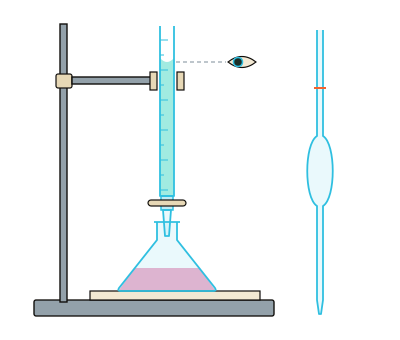
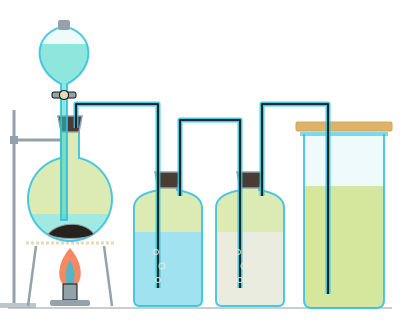
    The titration set-up for redox titrations, and the preparation of chlorine, where MnO₂ is the oxidising agent, in the Label lab.
    9

    The League's test

    Pass the League's test

    Six exam-style questions from the League. Get all six right to earn your stamp. Three wrong and you resit.

    The League's badge

    League test · Redox

    You: ♥♥♥

    Press Start when you're ready.

    Remember it

    Tap a card to flip it. Say the answer before you flip.

    Kay:That's redox. Every time I see a brown plantain now I say "oxidised". Ash says I can stop narrating breakfast.
    Oxidation and reduction (redox): Chemistry explained, with games

