15 wks to JAMB

L.O.E.P · ChemistryNo. 12

Explainer · Non-metals: nitrogen, sulphur and carbon · about 15 min

Why does a farmer's urea start as air, and how can a pencil and a diamond be the same element?

Watch the lecture

Ash and Kay teach this lesson, start to finish.

⬇ Save for offline

Keeps it on this phone, so it plays with no signal and no data, at this same address.

In short

The key words in this lesson, in plain English:

Haber process:
The industrial making of ammonia from nitrogen and hydrogen over an iron catalyst: N₂ + 3H₂ ⇌ 2NH₃. About 450 °C and 200 atm, a compromise between a good yield and a fast rate.
Noble gases:
The Group 0 (Group 18) elements: helium, neon, argon, krypton, xenon and radon. Their outer shells are full, so they hardly react.
Acid:
A substance with a pH below 7 that releases hydrogen ions in water. Strong acids are corrosive; the stomach uses hydrochloric acid to digest food.
Contact process:
The industrial making of tetraoxosulphate(VI) acid: sulphur(IV) oxide and oxygen pass over vanadium(V) oxide at about 450 °C to give sulphur(VI) oxide, which is absorbed in concentrated acid (oleum) and diluted.

Free this month: 1 of 1 lessons. A free account gives you 3 a month.

The bag of fertiliser on a farm, the head of a match, the fizz in a bottle of malt drink and the pencil in your bag: nitrogen, sulphur and carbon are in all of them. Part 1 covered oxygen, hydrogen, water and the halogens. This part makes ammonia in the lab and by the tonne, puts concentrated acid to work, and finds out why the same element can be both the hardest thing on Earth and the grey stuff in a pencil.

Kay:My uncle in Kano says his maize won't grow without urea. Ash says urea is mostly nitrogen. Is that true?
1

Ash's lab

Making ammonia in the lab

Set up the preparation of dry ammonia, one choice at a time.

Step 1

    Ammonia, NH₃

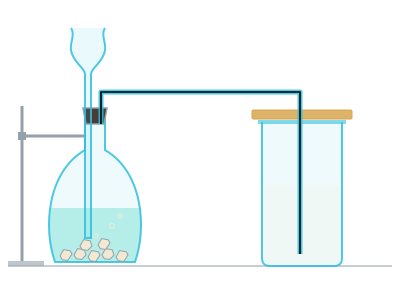
    Where you see it: the sharp smell around a toilet that hasn't been washed is ammonia, given off as BiologyBacteriumA tiny single-celled organism with no true nucleus. Some cause disease (cholera, typhoid); many are useful, making yoghurt, fixing nitrogen and rotting dead matter.Science dictionary ▶ break down the BiologyUreaThe main nitrogen-containing waste in human urine, made in the liver from extra amino acids and removed by the kidneys.Urea is also made in factories and sold as a nitrogen fertiliser.Science dictionary ▶ in urine; it is light and spreads quickly through the air. Heat any ammonium ChemistrySalt (in chemistry)The compound formed when the hydrogen of an acid is replaced by a metal or ammonium ion, as when an acid neutralises a base: sodium chloride, copper(II) sulfate.Science dictionary ▶ with an ChemistryAlkaliA base that dissolves in water, giving hydroxide ions, such as sodium hydroxide. Alkalis turn red litmus blue and have pH above 7.Caustic soda used in soap-making is a strong alkali.Science dictionary ▶: 2NH₄Cl + Ca(OH)₂ → CaCl₂ + 2H₂O + 2NH₃. Dry it with ChemistryCalciumA metal element (Ca) that our bones and teeth are built from. We get it from milk, beans and green vegetables.Chalk and limestone are calcium carbonate.Science dictionary ▶ oxide (quicklime); concentrated tetraoxosulphate(VI) ChemistryAcidA substance with a pH below 7 that releases hydrogen ions in water. Strong acids are corrosive; the stomach uses hydrochloric acid to digest food.Acids turn blue litmus paper red.Science dictionary ▶ would react with it, and calcium chloride forms a ChemistryCompoundTwo or more elements chemically joined in a fixed ratio, with properties different from the elements, such as water (H2O) or salt (NaCl).Poisonous chlorine and reactive sodium combine into the salt you eat.Science dictionary ▶ with it. Ammonia is lighter than air and very soluble in water, so it is collected by upward delivery (downward PhysicsDisplacementDistance moved in a stated direction: the straight line from start to finish. It is a vector.Science dictionary ▶ of air). It is the only common alkaline gas: it turns damp red ChemistryIndicatorA dye whose colour shows whether a solution is acidic or alkaline. Litmus turns red in acid and blue in alkali; universal indicator shows the whole pH scale.Science dictionary ▶ blue, and makes dense white fumes with hydrogen chloride.
    2

    Play · the Haber process

    Yield or speed? The Haber process

    N₂ + 3H₂ ⇌ 2NH₃, and the forward reaction gives out heat. Set the factory's temperature, pressure and catalyst. You want a decent yield, made fast enough, at a pressure the plant can safely afford.

    Set the conditions

    N₂ + 3H₂⇌2NH₃yieldrate
    Temperature250 °CPressure50 atmYield (about)–Rate–

    The Haber process

    Where you see it: the fertiliser plants at Eleme near Port Harcourt and at Lekki in Lagos make ammonia this way, from nitrogen in the air and hydrogen from natural gas, before turning it into BiologyUreaThe main nitrogen-containing waste in human urine, made in the liver from extra amino acids and removed by the kidneys.Urea is also made in factories and sold as a nitrogen fertiliser.Science dictionary ▶. Ammonia is made from nitrogen (from the air) and hydrogen (from natural gas) over finely divided iron as a ChemistryCatalystA substance that speeds up a reaction by giving it an easier route (lower activation energy), and is unchanged at the end.Car exhausts contain catalytic converters; your saliva contains enzyme catalysts.Science dictionary ▶. Because the forward reaction is ChemistryExothermic and endothermicAn exothermic reaction gives out heat (ΔH negative); an endothermic one takes heat in (ΔH positive).Burning gas is exothermic; an instant cold pack is endothermic.Science dictionary ▶ and makes fewer gas molecules (4 → 2), a low temperature and a high PhysicsPressureHow hard a force presses on each square metre of a surface: pressure = force ÷ area, measured in pascals (Pa).A sharp knife cuts because its thin edge puts the force on a tiny area. Tractors and camels have wide tyres or feet so they don't sink.Science dictionary ▶ give more ammonia (ChemistryChemical equilibriumThe state of a reversible reaction in a closed system when the forward and backward reactions go at the same rate, so amounts stay constant.Ammonia factories change pressure and temperature to push the equilibrium towards more product.Science dictionary ▶). But at a low temperature the reaction is far too slow, and very high pressure is expensive and dangerous. So the plant compromises: about 450 °C, 200 atm, with the iron catalyst, and recycles the unreacted gases. Nigeria's Notore plant at Onne makes ammonia and urea fertiliser this way.
    3

    Play · quick rounds

    Nitrogen and the noble gases

    Press Next

    Five right to pass.

    Right0 / 5

    Nitrogen, its compounds, and the noble gases

    Where you see it: a farmer who top-dresses maize with BiologyUreaThe main nitrogen-containing waste in human urine, made in the liver from extra amino acids and removed by the kidneys.Urea is also made in factories and sold as a nitrogen fertiliser.Science dictionary ▶ or NPK fertiliser soon sees the leaves turn a deeper green, because nitrogen drives leafy growth. Nitrogen is 78% of the air and very unreactive (its N≡N triple bond is strong), so it's used to keep food packs fresh. Ammonia is ChemistryOxidation and reduction (redox)Oxidation is loss of electrons (or gain of oxygen); reduction is gain of electrons (or loss of oxygen). They always happen together.Rusting oxidises iron; a blast furnace reduces iron ore back to iron.Science dictionary ▶ over hot platinum to nitrogen(II) oxide, the first step to trioxonitrate(V) ChemistryAcidA substance with a pH below 7 that releases hydrogen ions in water. Strong acids are corrosive; the stomach uses hydrochloric acid to digest food.Acids turn blue litmus paper red.Science dictionary ▶ (nitric acid), which is stored in brown bottles because light decomposes it. Nitrates and ammonium ChemistrySalt (in chemistry)The compound formed when the hydrogen of an acid is replaced by a metal or ammonium ion, as when an acid neutralises a base: sodium chloride, copper(II) sulfate.Science dictionary ▶ make fertilisers (N gives leafy growth). The ChemistryNoble gasesThe Group 0 (Group 18) elements: helium, neon, argon, krypton, xenon and radon. Their outer shells are full, so they hardly react.Helium fills balloons, neon glows red in signs, argon fills light bulbs.Science dictionary ▶ are in Group 0, with full outer shells, so they hardly react: helium is light and safe for balloons, neon glows red in signs, argon fills light bulbs so the filament doesn't burn.
    4

    Ash's lab

    Concentrated tetraoxosulphate(VI) acid at work

    Concentrated H₂SO₄ pulls water out of things. Try it on sugar, on blue copper(II) sulphate crystals, and then dilute it the safe way.

    Choose what to add the acid to

    heat ~ steam
    You see–

    A dehydrating agent

    Where you see it: a drop of concentrated sulphuric ChemistryAcidA substance with a pH below 7 that releases hydrogen ions in water. Strong acids are corrosive; the stomach uses hydrochloric acid to digest food.Acids turn blue litmus paper red.Science dictionary ▶ on a cotton lab coat leaves a charred black hole: the acid pulls the ChemistryElementA substance made of only one kind of atom, which cannot be split into simpler substances by chemical means, such as iron, oxygen or carbon.The iron in a cooking pot and the oxygen you breathe are elements.Science dictionary ▶ of water out of the cotton and leaves carbon behind. Concentrated tetraoxosulphate(VI) acid (sulphuric acid) is a strong ChemistryDehydrating agentA substance that removes water, or the elements of water, from another substance. Concentrated tetraoxosulphate(VI) acid chars sugar to carbon and turns blue copper(II) sulphate crystals white.To dilute concentrated acid, always add the acid slowly to water, never water to the acid.Science dictionary ▶: it removes water, or the elements of water, from other substances. Sugar, C₁₂H₂₂O₁₁, loses H and O as water and leaves a black, steaming column of carbon. Blue hydrated copper(II) sulphate loses its ChemistryWater of crystallisationWater that is part of a salt's crystal structure, as in blue CuSO₄·5H₂O. Heating drives it off, leaving the anhydrous salt.White anhydrous copper(II) sulphate turns blue with water, so it's used to test for water.Science dictionary ▶ and turns white. Diluting it gives out a lot of heat, so always add the acid slowly to water, never water to the acid, which can boil and spit. It is also ChemistryHygroscopic, deliquescent, efflorescentHygroscopic substances absorb water from the air without dissolving (conc. H₂SO₄); deliquescent ones absorb so much they dissolve (CaCl₂, NaOH); efflorescent crystals lose water to the air (washing soda).Science dictionary ▶, used to dry gases (not ammonia).
    5

    Work it out

    The Contact process

    Make tetraoxosulphate(VI) acid from sulphur, one stage at a time.

    Step 1

      Making sulphuric acid

      Where you see it: the ChemistryAcidA substance with a pH below 7 that releases hydrogen ions in water. Strong acids are corrosive; the stomach uses hydrochloric acid to digest food.Acids turn blue litmus paper red.Science dictionary ▶ inside a lead-acid car or PhysicsGenerator (dynamo)A machine that turns mechanical energy into electrical energy by turning a coil in a magnetic field (or a magnet near a coil). Slip rings give a.c.; a split-ring commutator gives d.c.The petrol generator outside a shop in a blackout, and the huge turbines at Kainji, work the same way.Science dictionary ▶ battery is dilute sulphuric acid, and nearly all sulphuric acid is made by the ChemistryContact processThe industrial making of tetraoxosulphate(VI) acid: sulphur(IV) oxide and oxygen pass over vanadium(V) oxide at about 450 °C to give sulphur(VI) oxide, which is absorbed in concentrated acid (oleum) and diluted.The SO₃ is never added straight to water: that makes a dense acid mist.Science dictionary ▶. Sulphur burns in air to give sulphur(IV) oxide, SO₂ (the choking gas that also forms BiologyAcid rainRain made acidic by sulphur(IV) oxide and nitrogen oxides from burning fuels. It damages buildings, leaves, soils and the life in lakes.Science dictionary ▶). In the Contact process, SO₂ and oxygen pass over vanadium(V) oxide at about 450 °C to make sulphur(VI) oxide: 2SO₂ + O₂ ⇌ 2SO₃. The SO₃ is dissolved in concentrated acid to make oleum, H₂S₂O₇, which is diluted with water to give the acid. SO₃ is not added straight to water: that makes a dense acid mist. Hydrogen sulphide, H₂S, the other sulphur gas, smells of rotten eggs and is poisonous.
      6

      Play · arcade

      Diamond or graphite?

      Press Start

      Swipe left for diamond, right for graphite

      Score0Streak0Lives♥♥♥

      Allotropes of carbon

      Where you see it: the small carbon brushes inside the motor of a blender or an electric drill are ChemistryAllotropyThe existence of an element in different forms in the same physical state, such as diamond and graphite (carbon), or oxygen and ozone.Pencil 'lead' (graphite) and a diamond ring are both pure carbon.Science dictionary ▶: they carry PhysicsElectric currentThe rate of flow of electric charge, measured in amperes (1 A = 1 coulomb per second).A phone charger supplies a current of about 1 to 2 A.Science dictionary ▶ to the spinning part, and the slippery layers let them rub against it without much wear. Allotropes are different forms of the same ChemistryElementA substance made of only one kind of atom, which cannot be split into simpler substances by chemical means, such as iron, oxygen or carbon.The iron in a cooking pot and the oxygen you breathe are elements.Science dictionary ▶. In diamond, every carbon atom is joined to four others in a rigid 3-D network: very hard (cutting and drilling), no free PhysicsElectronA tiny negatively charged particle that moves around the nucleus of an atom. Moving electrons are an electric current.Rubbing a balloon on your hair moves electrons onto the balloon.Science dictionary ▶, so it doesn't conduct. In graphite, each atom is joined to three others in flat layers held together weakly: the layers slide (pencils, PhysicsLubricantA substance such as oil, grease or graphite put between moving surfaces to keep them apart and reduce friction. Ball bearings reduce it by replacing sliding with rolling.Less friction means less wear and less energy wasted as heat.Science dictionary ▶), and one free electron per atom lets it conduct electricity (ChemistryCathode and anodeThe two conductors that carry current into an electrolyte. The cathode is negative: cations go there and are reduced. The anode is positive: anions go there and are oxidised.Science dictionary ▶). Charcoal, soot and coke are PhysicsCrystalline and amorphous solidsA crystalline solid has its particles in a regular, repeating pattern and melts at one sharp temperature (salt, diamond, metals). An amorphous solid has them at random and softens gradually (glass, rubber, pitch).A glass-blower can shape glass because it has no sharp melting point.Science dictionary ▶ carbon.
      7

      Play · the lime water test

      Carbon(IV) oxide through lime water

      Bubble carbon(IV) oxide through lime water. Watch it turn milky, then keep going.

      Bubble the gas in

      Bubbled0 sIt looksclear

      Carbon(IV) oxide and carbonates

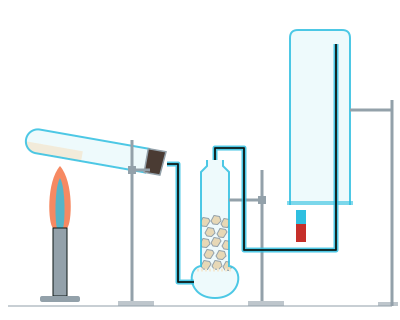
      Where you see it: baking powder in cake or chin-chin dough is mostly sodium hydrogentrioxocarbonate(IV) with a dry ChemistryAcidA substance with a pH below 7 that releases hydrogen ions in water. Strong acids are corrosive; the stomach uses hydrochloric acid to digest food.Acids turn blue litmus paper red.Science dictionary ▶; once wet and heated, they react and give off carbon(IV) oxide, and the bubbles make the dough rise. Carbon(IV) oxide turns ChemistryLime waterA clear solution of calcium hydroxide, Ca(OH)₂, used to test for carbon(IV) oxide: the gas turns it milky as white calcium carbonate forms. Excess gas makes it clear again.The milkiness clears because calcium hydrogencarbonate, Ca(HCO₃)₂, dissolves.Science dictionary ▶ milky: Ca(OH)₂ + CO₂ → CaCO₃ (white solid) + H₂O. Bubble more and the milkiness clears, as soluble ChemistryCalciumA metal element (Ca) that our bones and teeth are built from. We get it from milk, beans and green vegetables.Chalk and limestone are calcium carbonate.Science dictionary ▶ hydrogencarbonate forms: CaCO₃ + H₂O + CO₂ → Ca(HCO₃)₂ (the same reaction that makes water temporarily hard). Make CO₂ in the lab from marble chips (CaCO₃) and dilute hydrochloric acid; any carbonate fizzes with acid and gives it off. It's denser than air and doesn't burn, so it's used in fire extinguishers and fizzy drinks. ChemistryCarbon(II) oxide (carbon monoxide)CO, a colourless, odourless, poisonous gas from fuel burnt in too little oxygen. It binds to haemoglobin far more strongly than oxygen, so the blood can't carry oxygen.Never run a generator indoors or near a window: it's a common cause of death in blackouts.Science dictionary ▶, CO, comes from burning fuel in too little air: it's colourless, odourless and poisonous, because it stops BiologyHaemoglobinThe iron-containing red protein in red blood cells that carries oxygen from the lungs to the tissues.Lack of iron in the diet means less haemoglobin, so the person tires easily (anaemia).Science dictionary ▶ carrying oxygen, which is why a PhysicsGenerator (dynamo)A machine that turns mechanical energy into electrical energy by turning a coil in a magnetic field (or a magnet near a coil). Slip rings give a.c.; a split-ring commutator gives d.c.The petrol generator outside a shop in a blackout, and the huge turbines at Kainji, work the same way.Science dictionary ▶ must never run indoors.
      8

      Exam corner

      How the exam asks it

      The ammonia calculation, every part of it. Tap each step to reveal it.

      10.7 g of ammonium chloride is heated with excess calcium hydroxide. What volume of ammonia, measured at s.t.p., is given off? (H = 1, N = 14, Cl = 35.5; molar volume at s.t.p. = 22.4 dm³)

      Now try the real ones

      Real JAMB, WAEC and NECO past questions on this lesson (the JAMB and WAEC ones in LOEP's words). Answer them one at a time: each is marked, with the worked answer.

      Start the 10 real questions ▶
      1. JAMB 2023Vanadium(V) oxide is the catalyst in an industrial process. Which acid is manufactured by this process?
      2. WAEC 2015Which of these gases exists as single, separate atoms rather than as molecules of two atoms?
      3. JAMB 2023Which noble gas is radioactive and seeps out of rocks containing uranium?
      4. WAEC 2013The chemical inertness of neon is mainly due to its
      5. JAMB 2023Which industrial process combines nitrogen and hydrogen over an iron catalyst at high pressure to make ammonia?
      6. WAEC 2017Diamond is used in drill bits and glass cutters because it is
      7. JAMB 2020Strongly heating coal in the absence of air breaks it down into coal gas, coal tar, ammoniacal liquor and coke. This process is called
      8. WAEC 2012Silicon has some properties of metals and some of non-metals. It is therefore classed as a
      9. JAMB 2022Which sulphide is used as a luminescent coating on fluorescent tubes and television screens?
      10. JAMB 2016Which noble gas is radioactive and has been used in radiotherapy for cancer?

      Label it

      The preparation of ammonia, with its drying tower and upward delivery, and of carbon(IV) oxide from marble chips, in the Label lab.
      9

      The League's test

      Pass the League's test

      Six exam-style questions from the League. Get all six right to earn your stamp. Three wrong and you resit.

      The League's badge

      League test · Nitrogen, sulphur, carbon

      You: ♥♥♥

      Press Start when you're ready.

      Remember it

      Tap a card to flip it. Say the answer before you flip.

      Ash:That's nitrogen, sulphur and carbon. Kay, yes: urea is 46% nitrogen, and most of it started as nitrogen from the air, fixed by the Haber process.
      Non-metals: nitrogen, sulphur and carbon: Chemistry explained, with…

