15 wks to JAMB

L.O.E.P · ChemistryNo. 11

Explainer · Non-metals: oxygen, hydrogen, water and the halogens · about 15 min

Why does tap water taste of a swimming pool, and why won't soap lather in some borehole water?

Watch the lecture

Ash and Kay teach this lesson, start to finish.

⬇ Save for offline

Keeps it on this phone, so it plays with no signal and no data, at this same address.

In short

The key words in this lesson, in plain English:

Halogens:
Group 7: fluorine, chlorine, bromine, iodine. Each atom needs one electron to fill its shell, so they are oxidising agents; they get darker and less reactive down the group, and each displaces those below it.
Hard water:
Water containing dissolved calcium or magnesium ions, which does not lather easily with soap and forms scum.
Acid:
A substance with a pH below 7 that releases hydrogen ions in water. Strong acids are corrosive; the stomach uses hydrochloric acid to digest food.
Acidic, basic and amphoteric oxides:
Non-metal oxides (CO₂, SO₂) are usually acidic and give acids in water; metal oxides (Na₂O, CaO) are basic. Amphoteric oxides (ZnO, Al₂O₃) react with both acids and alkalis.

Free this month: 1 of 1 lessons. A free account gives you 3 a month.

Tap water in a big town tastes faintly of a swimming pool: that's chlorine, added to kill the germs. Wash with soap in some borehole water and you get grey scum instead of lather: that water is hard. Every breath you take is 21% oxygen, and the lightest gas of all, hydrogen, is how margarine is made from vegetable oil. Four non-metals, one lesson.

Kay:The water at my uncle's house in Abuja won't lather at all. Ash says the rock under it is in the water. I thought it was the soap.
1

Ash's lab

Name that gas

Three gas jars, no labels. Test each one with a glowing splint, a lighted splint or damp blue litmus, then name it. Get three right.

Press New jar

POP!
Right0 / 3

The gas tests

Oxygen relights a glowing splint. Hydrogen burns with a squeaky "pop" when a lighted splint is held to it (it's explosive mixed with air). Chlorine is greenish-yellow and choking; it turns damp blue ChemistryIndicatorA dye whose colour shows whether a solution is acidic or alkaline. Litmus turns red in acid and blue in alkali; universal indicator shows the whole pH scale.Science dictionary ▶ red, then bleaches it white. (Carbon(IV) oxide turns ChemistryLime waterA clear solution of calcium hydroxide, Ca(OH)₂, used to test for carbon(IV) oxide: the gas turns it milky as white calcium carbonate forms. Excess gas makes it clear again.The milkiness clears because calcium hydrogencarbonate, Ca(HCO₃)₂, dissolves.Science dictionary ▶ milky; ammonia turns damp red litmus blue.)
2

Play · quick rounds

Making them in the lab

Press Next

How is it made, and how is it collected?

Right0 / 5

Preparing the gases

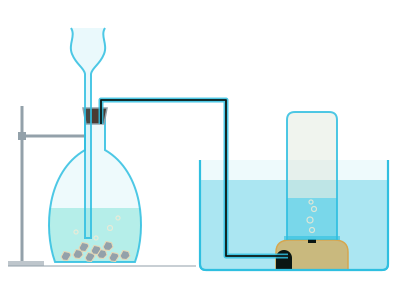
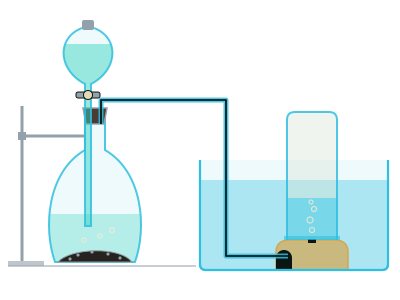
Where you see it: hydrogen peroxide from the pharmacy foams when dabbed on a cut: an BiologyEnzymeA protein that speeds up a chemical reaction in living things without being used up, like the enzymes that break down food.Most enzymes stop working if they get too hot.Science dictionary ▶ in the blood breaks it into water and oxygen, the same reaction manganese(IV) oxide PhysicsSpeedHow fast something moves: distance travelled ÷ time taken, in metres per second. Speed has no direction; velocity does.Science dictionary ▶ up in the lab. Oxygen: hydrogen peroxide, with manganese(IV) oxide as a ChemistryCatalystA substance that speeds up a reaction by giving it an easier route (lower activation energy), and is unchanged at the end.Car exhausts contain catalytic converters; your saliva contains enzyme catalysts.Science dictionary ▶: 2H₂O₂ → 2H₂O + O₂, collected over water (it's only slightly soluble). Hydrogen: zinc and dilute hydrochloric (or tetraoxosulphate(VI)) ChemistryAcidA substance with a pH below 7 that releases hydrogen ions in water. Strong acids are corrosive; the stomach uses hydrochloric acid to digest food.Acids turn blue litmus paper red.Science dictionary ▶: Zn + 2HCl → ZnCl₂ + H₂, collected over water. Industrially from natural gas and steam; used to make ammonia and to harden oils into ChemistryHydrogenationAdding hydrogen across C=C double bonds, using a finely divided nickel catalyst at about 150–200 °C. It turns liquid vegetable oils into solid fats such as margarine.An unsaturated oil decolourises bromine water; the hardened fat doesn't.Science dictionary ▶. Chlorine: concentrated hydrochloric acid ChemistryOxidation and reduction (redox)Oxidation is loss of electrons (or gain of oxygen); reduction is gain of electrons (or loss of oxygen). They always happen together.Rusting oxidises iron; a blast furnace reduces iron ore back to iron.Science dictionary ▶ by manganese(IV) oxide, warmed; passed through water (to remove HCl fumes) and concentrated tetraoxosulphate(VI) acid (to dry it), and collected by downward delivery because it is denser than air.
3

Play · the displacement grid

Down Group 7

Add each halogen to each potassium halide solution. Tap a square to mix them. A more reactive halogen pushes a less reactive one out of its salt. Find every reaction.

Tap a square to mix

KClKBrKI
Cl₂
Br₂
I₂
Reactions found0 / 3Last mix–

The halogens

Where you see it: the brown tincture of iodine a nurse dabs on a wound is iodine dissolved in ChemistryAlkanols (alcohols)Carbon compounds with the −OH (hydroxyl) group, CₙH₂ₙ₊₁OH: methanol, ethanol. Primary, secondary or tertiary by the number of carbons on the −OH carbon. They react with sodium to give hydrogen.Science dictionary ▶; it kills germs because, like every ChemistryHalogensGroup 7: fluorine, chlorine, bromine, iodine. Each atom needs one electron to fill its shell, so they are oxidising agents; they get darker and less reactive down the group, and each displaces those below it.Science dictionary ▶, iodine is an ChemistryOxidation and reduction (redox)Oxidation is loss of electrons (or gain of oxygen); reduction is gain of electrons (or loss of oxygen). They always happen together.Rusting oxidises iron; a blast furnace reduces iron ore back to iron.Science dictionary ▶, though a milder one than chlorine. Group 7 runs from fluorine (pale yellow gas) and chlorine (greenish-yellow gas) to bromine (red-brown liquid) and iodine (grey-black solid, purple vapour): darker and less volatile going down. Each atom needs one PhysicsElectronA tiny negatively charged particle that moves around the nucleus of an atom. Moving electrons are an electric current.Rubbing a balloon on your hair moves electrons onto the balloon.Science dictionary ▶ to fill its shell, so halogens are oxidising agents, and reactivity falls down the group as the outer shell gets further from the BiologyNucleusA centre. In an atom, the tiny dense core of protons and neutrons that holds nearly all its mass. In a cell, the part that holds the chromosomes and controls the cell.Science dictionary ▶. A halogen displaces any halogen below it from a solution of its ChemistrySalt (in chemistry)The compound formed when the hydrogen of an acid is replaced by a metal or ammonium ion, as when an acid neutralises a base: sodium chloride, copper(II) sulfate.Science dictionary ▶: Cl₂ + 2KBr → 2KCl + Br₂. Chloride ChemistryIonAn atom or group of atoms with an electric charge, formed by losing electrons (positive cation) or gaining them (negative anion).Sports drinks replace sodium and potassium ions lost in sweat.Science dictionary ▶ give a white ChemistryPrecipitateAn insoluble solid that forms when two solutions are mixed, such as white silver chloride from silver trioxonitrate(V) and a chloride.Science dictionary ▶ with acidified silver trioxonitrate(V); bromide gives cream, iodide yellow.
4

Work it out

How much manganese(IV) oxide?

Chlorine for a water works test is made by MnO₂ + 4HCl → MnCl₂ + Cl₂ + 2H₂O. What mass of manganese(IV) oxide gives 7.1 g of chlorine, and what volume is that at s.t.p.? (Mn = 55, O = 16, Cl = 35.5; 1 mole of gas = 22.4 dm³ at s.t.p.)

Step 1

    Chlorine bleaches, and cleans water

    Where you see it: a white school shirt soaked in diluted household bleach on laundry day comes out with its stains gone: the oxochlorate(I) oxidises the coloured substances in the stain to colourless ones. Chlorine reacts with water to give hydrochloric ChemistryAcidA substance with a pH below 7 that releases hydrogen ions in water. Strong acids are corrosive; the stomach uses hydrochloric acid to digest food.Acids turn blue litmus paper red.Science dictionary ▶ and oxochlorate(I) acid (hypochlorous acid): Cl₂ + H₂O ⇌ HCl + HOCl. The HOCl gives up its oxygen to the dye, oxidising it to a colourless substance: that's why moist chlorine bleaches and dry chlorine doesn't. The same HOCl kills BiologyBacteriumA tiny single-celled organism with no true nucleus. Some cause disease (cholera, typhoid); many are useful, making yoghurt, fixing nitrogen and rotting dead matter.Science dictionary ▶, so chlorine treats town water and swimming pools; household bleach is sodium oxochlorate(I), NaOCl.
    5

    Play · the soap test

    Hard water: why soap won't lather

    Three water samples. Shake each with soap: lather means soft, scum means hard. Then soften both hard samples.

    Choose a sample

    Sample–Soap test–Softened0 / 2

    Hardness of water

    Where you see it: the bucket heater used in many hostels grows a white crust on its coil in ChemistryHard waterWater containing dissolved calcium or magnesium ions, which does not lather easily with soap and forms scum.The crust inside a kettle comes from temporarily hard water.Science dictionary ▶: heating breaks down the dissolved ChemistryCalciumA metal element (Ca) that our bones and teeth are built from. We get it from milk, beans and green vegetables.Chalk and limestone are calcium carbonate.Science dictionary ▶ hydrogentrioxocarbonate(IV) into insoluble calcium trioxocarbonate(IV). Hard water holds dissolved calcium and magnesium ChemistryIonAn atom or group of atoms with an electric charge, formed by losing electrons (positive cation) or gaining them (negative anion).Sports drinks replace sodium and potassium ions lost in sweat.Science dictionary ▶, which react with soap to form scum instead of lather. Temporary hardness comes from calcium hydrogentrioxocarbonate(IV), Ca(HCO₃)₂, dissolved when rain (with CO₂ in it) runs through limestone. Boiling removes it, as it breaks down to insoluble CaCO₃: the fur inside kettles. Permanent hardness comes from calcium or magnesium tetraoxosulphate(VI); boiling doesn't touch it, but washing soda (Na₂CO₃) ChemistryPrecipitateAn insoluble solid that forms when two solutions are mixed, such as white silver chloride from silver trioxonitrate(V) and a chloride.Science dictionary ▶ the calcium, and an ion-exchange resin swaps it for sodium. Hard water is good for bones and teeth and for brewing; it wastes soap and furs up boilers.
    6

    Play · the water works

    River to tap

    Water from the river reaches your tap through five stages. Tap them in the right order.

    Tap the first stage

      Treating town water

      Where you see it: some families stir a lump of ChemistryWater treatmentHow town water is made safe: screening, alum to clump fine mud so it settles, sand filtration, then chlorination to kill germs, before storage and pumping.Science dictionary ▶ into a bucket of muddy stream or well water; the mud clumps and settles to the bottom, the same coagulation a waterworks uses, though it does not kill germs. Screening takes out leaves, fish and rubbish. Alum (aluminium tetraoxosulphate(VI)) makes the fine mud PhysicsParticleA tiny piece of matter or energy, such as an atom, an electron or a photon.Light can behave like a stream of particles.Science dictionary ▶ clump together and settle in sedimentation tanks (coagulation). ChemistryFiltrationSeparating an insoluble solid from a liquid by passing the mixture through a filter. The solid left behind is the residue; the liquid is the filtrate.Straining pap through a cloth is filtration.Science dictionary ▶ through beds of sand and gravel removes what's left. Chlorination kills the germs (some towns add fluoride for teeth). Then it's stored in tanks and pumped to homes. Boiling at home kills germs too, but it doesn't remove dissolved chemicals.
      7

      Play · arcade

      Acidic or basic oxide?

      Press Start

      Swipe left for an acidic oxide, right for a basic oxide

      Score0Streak0Lives♥♥♥

      Oxygen and its oxides

      Where you see it: farmers spread lime on sour, ChemistryAcidA substance with a pH below 7 that releases hydrogen ions in water. Strong acids are corrosive; the stomach uses hydrochloric acid to digest food.Acids turn blue litmus paper red.Science dictionary ▶ soil before planting: lime is ChemistryCalciumA metal element (Ca) that our bones and teeth are built from. We get it from milk, beans and green vegetables.Chalk and limestone are calcium carbonate.Science dictionary ▶ oxide or its hydroxide, and a ChemistryAcidic, basic and amphoteric oxidesNon-metal oxides (CO₂, SO₂) are usually acidic and give acids in water; metal oxides (Na₂O, CaO) are basic. Amphoteric oxides (ZnO, Al₂O₃) react with both acids and alkalis.Science dictionary ▶ ChemistryNeutralisationThe reaction between an acid and a base that produces a salt and water, cancelling out the acid.Acid + base → salt + water.Science dictionary ▶ the acid in the soil. Oxygen is 21% of the air (nitrogen 78%, argon about 1%, carbon(IV) oxide 0.04%). It combines with most ChemistryElementA substance made of only one kind of atom, which cannot be split into simpler substances by chemical means, such as iron, oxygen or carbon.The iron in a cooking pot and the oxygen you breathe are elements.Science dictionary ▶ to form oxides. Oxides of non-metals are usually acidic: CO₂, SO₂ and NO₂ dissolve in water to give acids (and BiologyAcid rainRain made acidic by sulphur(IV) oxide and nitrogen oxides from burning fuels. It damages buildings, leaves, soils and the life in lakes.Science dictionary ▶). Oxides of metals are basic: they neutralise acids, and the soluble ones (Na₂O, K₂O, CaO) give ChemistryAlkaliA base that dissolves in water, giving hydroxide ions, such as sodium hydroxide. Alkalis turn red litmus blue and have pH above 7.Caustic soda used in soap-making is a strong alkali.Science dictionary ▶. A few, such as ZnO and Al₂O₃, are amphoteric: they react with both acids and alkalis. CO and N₂O are neutral. ChemistryOzoneO₃, an allotrope of oxygen. High in the atmosphere it absorbs the sun's harmful ultraviolet light; CFCs from old fridges and aerosols damage this ozone layer.Science dictionary ▶, O₃, is an ChemistryAllotropyThe existence of an element in different forms in the same physical state, such as diamond and graphite (carbon), or oxygen and ozone.Pencil 'lead' (graphite) and a diamond ring are both pure carbon.Science dictionary ▶ of oxygen that shields us from PhysicsUltraviolet (UV)Invisible light with shorter waves than violet light. It comes from the Sun and causes sunburn.UV can kill some germs; that's how UV sterilisers work.Science dictionary ▶ light.
      8

      Exam corner

      How the exam asks it

      A hydrogen calculation. Tap each step to reveal it.

      3.25 g of zinc reacts completely with dilute hydrochloric acid: Zn + 2HCl → ZnCl₂ + H₂. Find the volume of hydrogen at s.t.p. and the mass of zinc chloride formed, and say why the hydrogen can be collected over water. (Zn = 65, Cl = 35.5; molar volume = 22.4 dm³ at s.t.p.)

      Now try the real ones

      Real JAMB, WAEC and NECO past questions on this lesson (the JAMB and WAEC ones in LOEP's words). Answer them one at a time: each is marked, with the worked answer.

      Start the 10 real questions ▶
      1. JAMB 2023Which stage at a water works removes suspended sand and fine particles from the water?
      2. WAEC 2021A molecule of white phosphorus has the formula
      3. JAMB 2023Chlorine is a raw material for making which common plastic used for water pipes?
      4. WAEC 2018Why is nitric acid not normally used with a metal to prepare hydrogen gas in the laboratory?
      5. JAMB 2023Which element is the most reactive non-metal and exists as a pale yellow gas at room temperature?
      6. WAEC 2021Certain salts are used to dry gases in a desiccator because they
      7. JAMB 2019A white powder dissolves in dilute hydrochloric acid and also in sodium hydroxide solution, forming a salt each time. Which oxide behaves like this?
      8. WAEC 2011A gas jar is held mouth-down and a gas is passed in from below. This method of collection is suitable for a gas that is
      9. JAMB 2016In which industrial process is the carbon monoxide in water gas made to react with steam to give extra hydrogen?
      10. JAMB 2019A borehole supplies water containing magnesium sulphate and magnesium hydrogen carbonate. Which single treatment will remove both kinds of hardness?

      Label it

      The preparation of oxygen and of hydrogen, in the Label lab.
      9

      The League's test

      Pass the League's test

      Six exam-style questions from the League. Get all six right to earn your stamp. Three wrong and you resit.

      The League's badge

      League test · Non-metals

      You: ♥♥♥

      Press Start when you're ready.

      Remember it

      Tap a card to flip it. Say the answer before you flip.

      Kay:That's oxygen, hydrogen, water and the halogens. I boiled my uncle's water and it still won't lather. Ash says it's permanent. I said so is my uncle.
      Non-metals: oxygen, hydrogen, water and the halogens: Chemistry…