15 wks to JAMB

L.O.E.P · ChemistryNo. 09

Explainer · Metals: reactivity and extraction · about 15 min

Gold lies uncombined in river gravel, but nobody ever found a lump of sodium. Why?

Watch the lecture

Ash and Kay teach this lesson, start to finish.

⬇ Save for offline

Keeps it on this phone, so it plays with no signal and no data, at this same address.

In short

The key words in this lesson, in plain English:

Acid:
A substance with a pH below 7 that releases hydrogen ions in water. Strong acids are corrosive; the stomach uses hydrochloric acid to digest food.
Electrochemical (reactivity) series:
The metals (with carbon and hydrogen) in order of how readily they lose electrons: K, Na, Ca, Mg, Al, (C), Zn, Fe, Pb, (H), Cu, Ag, Au.

Free this month: 1 of 1 lessons. A free account gives you 3 a month.

People have panned gold from rivers for thousands of years, because gold just lies there, uncombined. Nobody ever found a lump of sodium in a stream: it would have reacted long ago. Iron is in between, and Nigeria's iron ore at Itakpe has to be cooked with coke in a furnace to get the metal out. How tightly a metal clings to other elements decides everything: how it reacts, and how hard it is to extract. That's the reactivity series.

Kay:So gold is the friend who never gets involved in anything, and sodium is the one who reacts to everything. Got it.
1

Play · arcade

Metal or non-metal?

Press Start

Swipe left for a typical metal, right for a typical non-metal

Score0Streak0Lives♥♥♥

Metals

Where you see it: an aluminium pot heats up quickly on a kitchen stove because the metal conducts heat, and a flat metal sheet can be pressed into a ridged roofing sheet without ChemistryCrackingBreaking long-chain hydrocarbons into shorter, more useful ones with heat and a catalyst, making petrol and alkenes such as ethene.Science dictionary ▶ because metals are ChemistryMalleable and ductileMalleable metals can be hammered into sheets and ductile ones drawn into wires, because their layers of ions slide without breaking. Brittle solids, like salt crystals, shatter instead.Science dictionary ▶. Typical metals are shiny, PhysicsThermal conductor and insulatorA material that lets heat pass through it quickly by conduction, like copper or aluminium, or slowly, like wood, plastic, wool and still air.A tiled floor feels colder than a rug at the same temperature because it conducts heat out of your feet faster.Science dictionary ▶ and electricity, malleable, ductile and sonorous, with high PhysicsMelting pointThe temperature at which a pure solid melts. Its liquid freezes at the same temperature: for water, 0 °C. Impurities such as salt lower the freezing point.Science dictionary ▶. Chemically, metal atoms lose their few outer PhysicsElectronA tiny negatively charged particle that moves around the nucleus of an atom. Moving electrons are an electric current.Rubbing a balloon on your hair moves electrons onto the balloon.Science dictionary ▶ to form positive ChemistryIonAn atom or group of atoms with an electric charge, formed by losing electrons (positive cation) or gaining them (negative anion).Sports drinks replace sodium and potassium ions lost in sweat.Science dictionary ▶, and their oxides are basic. The more easily a metal loses electrons, the more reactive it is.
2

Ash's lab

Metals in water

A trough of water with a little indicator. Drop in a small piece of each metal, one at a time. Watch closely.

Tap a metal to drop it in

    Tested0 / 5

    Metals with water

    Where you see it: a lab technician cuts sodium on a dry tile and puts the rest straight back under its paraffin oil, because moisture in the air or on the bench would set it reacting. The most reactive metals react with cold water to give the metal hydroxide (an ChemistryAlkaliA base that dissolves in water, giving hydroxide ions, such as sodium hydroxide. Alkalis turn red litmus blue and have pH above 7.Caustic soda used in soap-making is a strong alkali.Science dictionary ▶) and hydrogen: 2Na + 2H₂O → 2NaOH + H₂. Potassium is violent enough to light the hydrogen with a lilac flame; sodium melts into a ball and races about; ChemistryCalciumA metal element (Ca) that our bones and teeth are built from. We get it from milk, beans and green vegetables.Chalk and limestone are calcium carbonate.Science dictionary ▶ sinks and fizzes steadily. That's why sodium and potassium are stored under paraffin oil. Magnesium reacts only very slowly with cold water but fast with steam, giving the oxide; zinc and iron need steam; copper, silver and gold don't react at all.
    3

    Play · race them

    The acid race

    Four test tubes of dilute hydrochloric acid, each with a balloon over the top. Add a metal to each, then rank them from fastest to slowest by tapping the balloons.

    Add the metals

    MgZnFeCu
    Your ranking–

    Metals with dilute acids

    Where you see it: lime juice or vinegar should not be left standing in a zinc-coated (ChemistryGalvanisingCoating iron with zinc. Zinc is more reactive, so it is oxidised instead of the iron, protecting it even where scratched.Science dictionary ▶) bucket: the ChemistryAcidA substance with a pH below 7 that releases hydrogen ions in water. Strong acids are corrosive; the stomach uses hydrochloric acid to digest food.Acids turn blue litmus paper red.Science dictionary ▶ reacts with the zinc, forming a zinc ChemistrySalt (in chemistry)The compound formed when the hydrogen of an acid is replaced by a metal or ammonium ion, as when an acid neutralises a base: sodium chloride, copper(II) sulfate.Science dictionary ▶ and hydrogen, and the coat is slowly eaten away. Metals above hydrogen in the series displace hydrogen from dilute acids: metal + acid → salt + hydrogen (Zn + H₂SO₄ → ZnSO₄ + H₂). The more reactive the metal, the faster the fizzing. Test the gas: a lighted splint gives a squeaky pop. Copper, silver and gold, below hydrogen, don't react with dilute acids. (Potassium and sodium are far too dangerous to try.)
    4

    Ash's lab

    The displacement grid

    Dip a strip of each metal into a solution of each other metal's salt. Does anything happen? Fill in all 12 squares.

    Tap a square to test it

    metal ↓ / solution →MgSO₄ZnSO₄FeSO₄CuSO₄
    Mg–
    Zn–
    Fe–
    Cu–
    Tested0 / 12

    Displacement

    Where you see it: farmers who spray cocoa with copper(II) sulphate fungicide are told to mix it in a plastic container, not an iron one: the iron displaces the copper, so the bucket corrodes and a brown coat of copper forms on it. A metal displaces a less reactive metal from a solution of its ChemistryCompoundTwo or more elements chemically joined in a fixed ratio, with properties different from the elements, such as water (H2O) or salt (NaCl).Poisonous chlorine and reactive sodium combine into the salt you eat.Science dictionary ▶: Zn + CuSO₄ → ZnSO₄ + Cu. Brown copper coats the zinc and the blue colour fades as Cu²⁺ ChemistryIonAn atom or group of atoms with an electric charge, formed by losing electrons (positive cation) or gaining them (negative anion).Sports drinks replace sodium and potassium ions lost in sweat.Science dictionary ▶ are used up. A less reactive metal can't push out a more reactive one, so nothing happens. A PhysicsDisplacementDistance moved in a stated direction: the straight line from start to finish. It is a vector.Science dictionary ▶ grid lets you put metals in order without any danger. The same idea works with oxides: aluminium powder displaces iron from iron(III) oxide in the white-hot ChemistryThermit reactionAluminium powder reducing iron(III) oxide in a white-hot displacement reaction, producing molten iron. Used to weld railway lines.Science dictionary ▶, used to weld railway lines.
    5

    Play · build it

    The reactivity series

    Put the whole series together, most reactive first. Carbon and hydrogen go in too: they're the yardsticks for extraction and for acids.

    Tap the most reactive first

      The series

      K, Na, Ca, Mg, Al, (C), Zn, Fe, Pb, (H), Cu, Ag, Au. One way to remember it, a word for each: "Kay's Naughty Cat Made Ash Cry. Zainab Felt Pity, Hugged Cat Again, Always." A metal higher up loses PhysicsElectronA tiny negatively charged particle that moves around the nucleus of an atom. Moving electrons are an electric current.Rubbing a balloon on your hair moves electrons onto the balloon.Science dictionary ▶ more readily, reacts more vigorously, forms more stable ChemistryCompoundTwo or more elements chemically joined in a fixed ratio, with properties different from the elements, such as water (H2O) or salt (NaCl).Poisonous chlorine and reactive sodium combine into the salt you eat.Science dictionary ▶, and is harder to extract.
      6

      Play · quick rounds

      Getting the metal out

      An ore is a rock containing a metal compound worth extracting. For each one, choose how to get the metal out. Get 6 right.

      Press Start

      –

      Right0 / 6

      Extraction and the series

      Where you see it: aluminium for pots and roofing is extracted by ChemistryElectrolysisSplitting a compound that is molten or dissolved by passing a direct current through it. Ions move to the electrodes and are discharged.Shiny chrome on motorcycle parts is put there by electroplating, a use of electrolysis.Science dictionary ▶, which takes a great deal of electricity; that is why scrap aluminium is worth collecting, as melting it down needs far less energy than extracting new metal. Extracting a metal means reducing its ChemistryCompoundTwo or more elements chemically joined in a fixed ratio, with properties different from the elements, such as water (H2O) or salt (NaCl).Poisonous chlorine and reactive sodium combine into the salt you eat.Science dictionary ▶. Metals above carbon (K, Na, Ca, Mg, Al) hold oxygen too tightly for carbon to take it: they're extracted by electrolysis of the molten compound, which costs a lot of electricity. Metals below carbon (Zn, Fe, Pb) are extracted by heating the oxide with carbon or ChemistryCarbon(II) oxide (carbon monoxide)CO, a colourless, odourless, poisonous gas from fuel burnt in too little oxygen. It binds to haemoglobin far more strongly than oxygen, so the blood can't carry oxygen.Never run a generator indoors or near a window: it's a common cause of death in blackouts.Science dictionary ▶; sulfide ChemistryOreA rock containing enough of a metal compound to be worth extracting: haematite for iron, bauxite for aluminium.Science dictionary ▶ are roasted to the oxide first. The least reactive (Hg) can be got just by heating the ore, and gold and silver are often found native, uncombined.
      7

      Ash's lab

      Smelting with carbon

      Mix each metal oxide with carbon powder in a crucible and heat it strongly. Which ones give up their metal?

      Pick an oxide to heat

      Tested0 / 4
      Ash:It's a contest for oxygen. Carbon wins against copper and lead, so they're left as metal. Against magnesium and aluminium, carbon loses every time.
      8

      Exam corner

      How the exam asks it

      An explanation question. Tap each step to reveal it.

      Explain why aluminium is extracted by electrolysis but iron by heating with carbon. Why does aluminium, though more reactive than iron, not corrode away in air?

      Now try the real ones

      Real JAMB, WAEC and NECO past questions on this lesson (the JAMB and WAEC ones in LOEP's words). Answer them one at a time: each is marked, with the worked answer.

      Start the 10 real questions ▶
      1. JAMB 2023Which products form when a piece of potassium is dropped into water?
      2. WAEC 2020Which of these metals does not react with cold water or with steam to give hydrogen?
      3. JAMB 2022Which metal will react with steam to give hydrogen gas?
      4. WAEC 1991Tin is mainly obtained from the ore known as
      5. JAMB 2016The ore of which metal is concentrated by magnetic separation to remove magnetic impurities such as wolframite?
      6. WAEC 2016Copper is drawn out into thin wire for electric cables. This property of metals is called
      7. JAMB 2019Which metal ion is mainly responsible for controlling the water balance and blood pressure in the human body?
      8. WAEC 1989All of the following statements about tin are correct EXCEPT that
      9. JAMB 1999Tin is obtained mainly from the ore called
      10. JAMB 2017Sodium is stored under which liquid in the laboratory?

      Label it

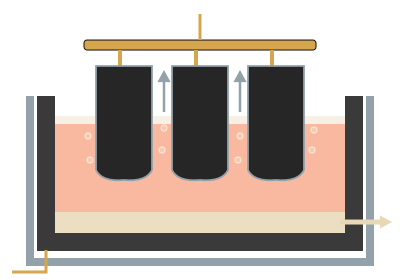
      The electrolytic cell for extracting aluminium, a metal too reactive for carbon, in the Label lab.
      9

      The League's test

      Pass the League's test

      Six exam-style questions from the League. Get all six right to earn your stamp. Three wrong and you resit.

      The League's badge

      League test · Metals: reactivity and extraction

      You: ♥♥♥

      Press Start when you're ready.

      Remember it

      Tap a card to flip it. Say the answer before you flip.

      Kay:That's the reactivity series. Next time someone says gold is "precious", remind them it's precious because it's lazy.
      Metals: reactivity and extraction: Chemistry explained, with games

