15 wks to JAMB

L.O.E.P · ChemistryNo. 17

Explainer · Metals: iron, aluminium, copper and alloys · about 15 min

Every cutlass, roofing nail and building rod in the market started as a lump of red rock. How does rock become a cutlass?


Watch the lecture

Ash and Kay teach this lesson, start to finish.

⬇ Save for offline

Keeps it on this phone, so it plays with no signal and no data, at this same address.

In short

The key words in this lesson, in plain English:

Alloy:
A mixture of a metal with other elements, usually metals, made to be harder, stronger or more corrosion-resistant. Brass is copper and zinc.
Blast furnace:
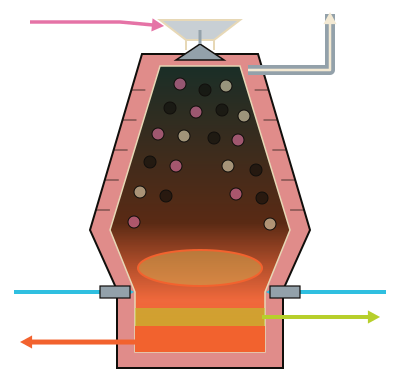
The tall furnace that extracts iron from haematite. Ore, coke and limestone go in at the top, hot air is blown in at the bottom, and carbon(II) oxide reduces the ore: Fe₂O₃ + 3CO → 2Fe + 3CO₂.
Ore:
A rock containing enough of a metal compound to be worth extracting: haematite for iron, bauxite for aluminium.
Steel and cast iron:
Iron with a little carbon. Pig or cast iron (about 4% C) is hard but brittle; mild steel (about 0.1–0.3% C) is tough and malleable; high-carbon steel (about 0.6–1.5% C) is very hard.

Free this month: 1 of 1 lessons. A free account gives you 3 a month.

Walk through any market: cutlasses, roofing nails, building rods, cooking pots, padlocks, wheelbarrows. Almost all of it is iron, and almost all of that iron started as a red-brown rock dug out of the ground. Turning rock into a cutlass takes a furnace the height of a building, a little carbon (not too much, not too little), and some care to stop it all turning back into rust. Copper and aluminium have their own stories, and a few drops of sodium hydroxide can tell you which metal is hiding in a solution.

Kay:How does a rock become a cutlass?
1

Ash's lab

The blast furnace

Load the blast furnace with the three solids it needs, then blow in the hot air. Pick carefully: some of these belong to other metals.

Load the furnace

Fe₂O₃ + 3CO → 2Fe + 3CO₂CO₂ + C → 2COCaCO₃ → CaO + CO₂CaO + SiO₂ → CaSiO₃C + O₂ → CO₂← slag← molten iron
Loaded0 / 3

Extracting iron

Where you see it: the Ajaokuta ChemistrySteel and cast ironIron with a little carbon. Pig or cast iron (about 4% C) is hard but brittle; mild steel (about 0.1–0.3% C) is tough and malleable; high-carbon steel (about 0.6–1.5% C) is very hard.Steel is made by blowing oxygen through molten pig iron to burn off most of the carbon.Science dictionary ▶ plant in Kogi State was designed to smelt ChemistryOreA rock containing enough of a metal compound to be worth extracting: haematite for iron, bauxite for aluminium.Science dictionary ▶ mined at nearby Itakpe in a ChemistryBlast furnaceThe tall furnace that extracts iron from haematite. Ore, coke and limestone go in at the top, hot air is blown in at the bottom, and carbon(II) oxide reduces the ore: Fe₂O₃ + 3CO → 2Fe + 3CO₂.Molten iron is tapped from the bottom, with the slag floating on it.Science dictionary ▶, using coke and limestone. Iron is extracted from haematite (iron(III) oxide, Fe₂O₃) in a blast furnace, loaded at the top with ore, coke (carbon) and limestone, with hot air blasted in near the bottom. The coke burns, C + O₂ → CO₂, which makes the furnace very hot; higher up, the CO₂ meets more hot coke and becomes ChemistryCarbon(II) oxide (carbon monoxide)CO, a colourless, odourless, poisonous gas from fuel burnt in too little oxygen. It binds to haemoglobin far more strongly than oxygen, so the blood can't carry oxygen.Never run a generator indoors or near a window: it's a common cause of death in blackouts.Science dictionary ▶: CO₂ + C → 2CO. Carbon(II) oxide is the main ChemistryOxidation and reduction (redox)Oxidation is loss of electrons (or gain of oxygen); reduction is gain of electrons (or loss of oxygen). They always happen together.Rusting oxidises iron; a blast furnace reduces iron ore back to iron.Science dictionary ▶: Fe₂O₃ + 3CO → 2Fe + 3CO₂. The limestone removes the sandy impurities: it decomposes to CaO, which reacts with silica (SiO₂) to make ChemistrySlagThe molten waste from a blast furnace, mainly calcium silicate (CaSiO₃), formed when limestone's calcium oxide reacts with the sandy impurities (silica) in the ore.It floats on the molten iron and is used for road-making and cement.Science dictionary ▶, calcium silicate (CaSiO₃). Molten iron sinks to the bottom; the lighter slag floats on it, and each is tapped off separately. Slag is used for road-making and cement. Bauxite and cryolite are for aluminium, which is too reactive to be reduced by carbon and needs ChemistryElectrolysisSplitting a compound that is molten or dissolved by passing a direct current through it. Ions move to the electrodes and are discharged.Shiny chrome on motorcycle parts is put there by electroplating, a use of electrolysis.Science dictionary ▶.
2

Work it out

How much iron from a tonne of ore?

A tonne (1000 kg) of iron ore is 80% Fe₂O₃. How much iron can the blast furnace get from it? (Fe = 56, O = 16)

Step 1

    Iron from its ore

    Find the fraction of the ChemistryCompoundTwo or more elements chemically joined in a fixed ratio, with properties different from the elements, such as water (H2O) or salt (NaCl).Poisonous chlorine and reactive sodium combine into the salt you eat.Science dictionary ▶ that's iron from its formula: Fe₂O₃ has M = 2 × 56 + 3 × 16 = 160, of which 112 is iron, so 112/160 = 70% of pure haematite is iron. Then allow for the impurities in the rock. The equation gives the same answer: Fe₂O₃ → 2Fe, so 160 g of oxide gives 2 × 56 = 112 g of iron.
    3

    Play · the blacksmith

    Iron and steel: it's the carbon

    Iron straight from the furnace (pig iron) has about 4% carbon. Set the carbon for each job, hammer-test it, and use it.

    Set the carbon

    –

    Carbon4%It'scast (pig) ironJobs0 / 3

    Cast iron and the steels

    Where you see it: a welder bends and welds ChemistrySteel and cast ironIron with a little carbon. Pig or cast iron (about 4% C) is hard but brittle; mild steel (about 0.1–0.3% C) is tough and malleable; high-carbon steel (about 0.6–1.5% C) is very hard.Steel is made by blowing oxygen through molten pig iron to burn off most of the carbon.Science dictionary ▶ bars into window burglar-proofs and gates, because mild steel bends without ChemistryCrackingBreaking long-chain hydrocarbons into shorter, more useful ones with heat and a catalyst, making petrol and alkenes such as ethene.Science dictionary ▶ where cast iron would snap. Pig iron from the furnace has about 4% carbon: hard but ChemistryMalleable and ductileMalleable metals can be hammered into sheets and ductile ones drawn into wires, because their layers of ions slide without breaking. Brittle solids, like salt crystals, shatter instead.Science dictionary ▶, so a hammer blow cracks it. Melted and cast in BiologyFungusAn organism with no chlorophyll that feeds by absorbing food from dead or living matter. Bodies of thread-like hyphae; includes moulds, mushrooms and yeast.Science dictionary ▶ it's cast iron, used where shape matters and knocks don't: manhole covers, engine blocks, heavy pots. Blowing oxygen through molten pig iron burns off most of the carbon (as CO₂) and impurities such as sulphur and phosphorus, making steel. Mild steel (about 0.1–0.3% carbon) is tough, malleable and ductile: building rods, roofing nails, car bodies, wire. High-carbon steel (about 0.6–1.5%) is very hard and holds an edge: cutlasses, knives, chisels, springs. Wrought iron, almost pure, is soft and easily worked. Small changes in carbon make a big difference.
    4

    Play · quick rounds

    The right metal, or alloy, for the job

    Press Next

    Five right to pass.

    Right0 / 5

    Alloys and uses

    Where you see it: jewellery sold as 18-carat gold is three-quarters gold mixed with metals such as copper and silver, because pure gold is too soft to keep its shape when worn. An ChemistryAlloyA mixture of a metal with other elements, usually metals, made to be harder, stronger or more corrosion-resistant. Brass is copper and zinc.Stainless steel pots are an alloy of iron with chromium and nickel.Science dictionary ▶ is a metal mixed with other ChemistryElementA substance made of only one kind of atom, which cannot be split into simpler substances by chemical means, such as iron, oxygen or carbon.The iron in a cooking pot and the oxygen you breathe are elements.Science dictionary ▶, made to be harder, stronger, more resistant to corrosion, or to melt at a lower temperature than the pure metal. Brass is copper and zinc (taps, padlocks, trumpets); bronze is copper and tin (medals, statues, bells); solder is lead and tin (it melts low, for joining wires); stainless ChemistrySteel and cast ironIron with a little carbon. Pig or cast iron (about 4% C) is hard but brittle; mild steel (about 0.1–0.3% C) is tough and malleable; high-carbon steel (about 0.6–1.5% C) is very hard.Steel is made by blowing oxygen through molten pig iron to burn off most of the carbon.Science dictionary ▶ is iron with chromium and nickel (cutlery, sinks, surgical tools); duralumin is aluminium with copper, magnesium and manganese (aircraft). Copper is chosen for house wiring because it's an excellent conductor and very ChemistryMalleable and ductileMalleable metals can be hammered into sheets and ductile ones drawn into wires, because their layers of ions slide without breaking. Brittle solids, like salt crystals, shatter instead.Science dictionary ▶. Aluminium is chosen for overhead cables because it's light, conducts well and doesn't corrode (a thin, tough oxide layer seals it), and for cooking pots, foil and window frames.
    5

    Play · quick rounds

    Scratched tin cans and galvanised sheets: protecting iron

    Press Next

    Five right to pass.

    Right0 / 5

    Coatings and sacrificial protection

    Where you see it: ChemistryGalvanisingCoating iron with zinc. Zinc is more reactive, so it is oxidised instead of the iron, protecting it even where scratched.Science dictionary ▶ roofing sheets are ChemistrySteel and cast ironIron with a little carbon. Pig or cast iron (about 4% C) is hard but brittle; mild steel (about 0.1–0.3% C) is tough and malleable; high-carbon steel (about 0.6–1.5% C) is very hard.Steel is made by blowing oxygen through molten pig iron to burn off most of the carbon.Science dictionary ▶ coated with zinc, so where a nail pierces the sheet the zinc around the hole corrodes first and the steel is spared. ChemistryRustingThe corrosion of iron into hydrated iron(III) oxide. A redox reaction that needs both oxygen and water, and goes faster with salt. Stopped by paint, oil, tin plating or galvanising.Science dictionary ▶ needs both air and water, so most protection keeps them out: paint (gates, cars), oil or grease (moving parts like a bicycle chain), plastic coating, or tin-plating (food cans: tin is unreactive and non-poisonous). But once a tin coat is scratched, the iron rusts faster than bare iron, because iron is more reactive than tin. Galvanising (coating with zinc) is better: zinc is more reactive than iron, so even where it's scratched the zinc corrodes instead. That's sacrificial protection. Buried pipelines and ships' hulls are protected the same way, with blocks of magnesium or zinc bolted on and replaced as they corrode away (cathodic protection).
    6

    Ash's lab

    Copper(II) sulphate: blue, white, blue

    Heat some blue copper(II) sulphate crystals in a test tube. Then let the powder cool and add a few drops of water.

    Heat the crystals

    The solidblue crystalsYou see–

    Copper and its compounds

    Where you see it: cocoa farmers fight black pod disease with copper fungicides; the old blue Bordeaux ChemistryMixtureTwo or more substances mixed but not chemically joined, in any proportion. Their parts keep their own properties and can be separated physically.Air, sea water and garri with sugar are mixtures.Science dictionary ▶ is copper(II) sulphate mixed with lime. Blue copper(II) sulphate crystals are CuSO₄·5H₂O: the blue colour needs the ChemistryWater of crystallisationWater that is part of a salt's crystal structure, as in blue CuSO₄·5H₂O. Heating drives it off, leaving the anhydrous salt.White anhydrous copper(II) sulphate turns blue with water, so it's used to test for water.Science dictionary ▶. Heat them and the water is driven off as steam, leaving white anhydrous copper(II) sulphate. Add water and it turns blue again and gets hot, which makes white anhydrous copper(II) sulphate a test for water. Copper is a ChemistryTransition metalsThe block of metals in the middle of the periodic table, such as iron, copper, chromium and nickel. They form coloured compounds, show more than one oxidation state (Fe²⁺ and Fe³⁺, Cu⁺ and Cu²⁺) and often act as catalysts.Copper(II) salts are blue; iron(II) salts pale green; iron(III) yellow-brown.Science dictionary ▶: like iron, it forms coloured ChemistryCompoundTwo or more elements chemically joined in a fixed ratio, with properties different from the elements, such as water (H2O) or salt (NaCl).Poisonous chlorine and reactive sodium combine into the salt you eat.Science dictionary ▶ (copper(II) ChemistrySalt (in chemistry)The compound formed when the hydrogen of an acid is replaced by a metal or ammonium ion, as when an acid neutralises a base: sodium chloride, copper(II) sulfate.Science dictionary ▶ are usually blue or green), has variable oxidation states (Cu⁺ and Cu²⁺, as iron has Fe²⁺ and Fe³⁺), and it and its compounds are often good ChemistryCatalystA substance that speeds up a reaction by giving it an easier route (lower activation energy), and is unchanged at the end.Car exhausts contain catalytic converters; your saliva contains enzyme catalysts.Science dictionary ▶. Copper is unreactive enough not to corrode much, so it's used for water pipes as well as wiring.
    7

    Ash's lab

    Which metal ion is it?

    Five unlabelled solutions. Add sodium hydroxide solution a few drops at a time, then in excess. Name the metal ion in all five.

    Choose a solution

    Precipitate–Named0 / 5

    Tests for metal ions

    Where you see it: water from some boreholes comes out clear but turns brown and stains buckets on standing, as air oxidises the dissolved iron(II) to iron(III), the same change that turns the dirty green ChemistryPrecipitateAn insoluble solid that forms when two solutions are mixed, such as white silver chloride from silver trioxonitrate(V) and a chloride.Science dictionary ▶ brown. Sodium hydroxide solution precipitates most metal ChemistryIonAn atom or group of atoms with an electric charge, formed by losing electrons (positive cation) or gaining them (negative anion).Sports drinks replace sodium and potassium ions lost in sweat.Science dictionary ▶ as their hydroxides, and the colour gives them away. Fe²⁺: a dirty green precipitate, which slowly turns brown at the surface as air oxidises it. Fe³⁺: reddish-brown. Cu²⁺: blue (from a blue solution). Al³⁺ and Zn²⁺: white, which dissolves in excess NaOH, because their hydroxides are ChemistryAcidic, basic and amphoteric oxidesNon-metal oxides (CO₂, SO₂) are usually acidic and give acids in water; metal oxides (Na₂O, CaO) are basic. Amphoteric oxides (ZnO, Al₂O₃) react with both acids and alkalis.Science dictionary ▶ (aqueous ammonia tells them apart: zinc's precipitate dissolves in excess ammonia, aluminium's doesn't). Ca²⁺: white, which does not dissolve in excess. Flame tests help too: sodium golden-yellow, potassium lilac, ChemistryCalciumA metal element (Ca) that our bones and teeth are built from. We get it from milk, beans and green vegetables.Chalk and limestone are calcium carbonate.Science dictionary ▶ brick-red, copper blue-green.
    8

    Exam corner

    How the exam asks it

    The blast furnace question, every part of it. Tap each step to reveal it.

    In the extraction of iron: (a) name the main ore; (b) write equations for the formation of the reducing agent and the reduction of the ore; (c) state the function of limestone, with an equation; (d) how are the iron and the slag separated?

    Now try the real ones

    Real JAMB, WAEC and NECO past questions on this lesson (the JAMB and WAEC ones in LOEP's words). Answer them one at a time: each is marked, with the worked answer.

    Start the 10 real questions ▶
    1. JAMB 2023Which metals are mixed with iron to make stainless steel, which resists rusting?
    2. WAEC 2021Dilute ammonia solution is added drop by drop, and then in excess, to blue copper(II) sulphate solution. What is observed?
    3. JAMB 2023Which ore of iron is mainly iron(III) oxide, Fe₂O₃?
    4. WAEC 2015Which of these ions is colourless in aqueous solution?
    5. JAMB 2023Strontium is in the same group as calcium. To which family do these metals belong?
    6. WAEC 2006Aqueous ammonia is added drop by drop to a solution. A pale blue precipitate forms, which dissolves in excess ammonia to give a deep blue solution. The solution
    7. JAMB 2020Aluminium hydroxide is applied to cloth before dyeing so that the dye holds firmly to the fibres. In this use it acts as a?
    8. WAEC 2012Transition metal ions are drawn into a magnetic field (paramagnetism) because they have
    9. JAMB 2019Brass is made of copper and zinc, while bronze is made of copper and tin. Which metal is the main component of both alloys?
    10. JAMB 2022Molten cast iron is turned into wrought iron by heating it in a furnace with which substance, which oxidizes away the carbon?

    Label it

    The blast furnace, with its charge, tuyères, slag and iron tap holes, in the Label lab.
    9

    The League's test

    Pass the League's test

    Six exam-style questions from the League. Get all six right to earn your stamp. Three wrong and you resit.

    The League's badge

    League test · Iron, aluminium, copper and alloys

    You: ♥♥♥

    Press Start when you're ready.

    Remember it

    Tap a card to flip it. Say the answer before you flip.

    Ash:That's iron, aluminium and copper. Kay: red rock, coke and limestone into the furnace, oxygen through the pig iron, then the smith sets the carbon. Not too much, or the cutlass snaps; not too little, or it won't hold an edge.
    Metals: iron, aluminium, copper and alloys: Chemistry explained…
