15 wks to JAMB

L.O.E.P · ChemistryNo. 05

Explainer · Hydrocarbons · about 15 min

Cooking gas, petrol, kerosene and candle wax are made of the same two elements. How can they be so different?


Watch the lecture

Ash and Kay teach this lesson, start to finish.

⬇ Save for offline

Keeps it on this phone, so it plays with no signal and no data, at this same address.

In short

The key words in this lesson, in plain English:

Hydrocarbon:
A compound of hydrogen and carbon only, such as methane, petrol and kerosene. Most fuels are hydrocarbons.
Alkane:
A saturated hydrocarbon with only single C-C bonds and the general formula CnH2n+2: methane, ethane, propane, butane.
Isomer:
Compounds with the same molecular formula but a different arrangement of atoms. C₅H₁₂ has three: pentane, 2-methylbutane and 2,2-dimethylpropane.
Cracking:
Breaking long-chain hydrocarbons into shorter, more useful ones with heat and a catalyst, making petrol and alkenes such as ethene.

Free this month: 1 of 1 lessons. A free account gives you 3 a month.

The gas in your cooking-gas cylinder, the petrol in a keke, the kerosene in a lantern and the wax in a candle look nothing alike. Yet they're all made of just two elements, carbon and hydrogen. They're hydrocarbons, and most of them come out of the ground in the Niger Delta as crude oil. What makes them different is how many carbons are joined up, and how.

Kay:Ash called crude oil "hydrocarbon soup". I've asked him not to say soup near my lunch.
1

Play · build it

Build an alkane

Carbon always makes four bonds. Join carbons in a chain and fill every spare bond with hydrogen. Build each alkane you're asked for. Get 3.

Add carbons, then press This one

–
NamemethaneFormulaCH₄Boils at−162 °CBuilt0 / 3

Alkanes

Where you see it: the natural gas burned off in flares at oil fields in the Niger Delta is mainly methane, CH₄, the smallest ChemistryAlkaneA saturated hydrocarbon with only single C-C bonds and the general formula CnH2n+2: methane, ethane, propane, butane.Candle wax is a mixture of long-chain alkanes.Science dictionary ▶; its molecules are so small that it is a gas even on a cold night. The alkanes are the simplest ChemistryHydrocarbonA compound of hydrogen and carbon only, such as methane, petrol and kerosene. Most fuels are hydrocarbons.Cooking gas is a mixture of the hydrocarbons propane and butane.Science dictionary ▶: carbon atoms joined by single bonds only, every other bond taken by hydrogen. Methane CH₄, ethane C₂H₆, propane C₃H₈, butane C₄H₁₀, pentane C₅H₁₂: each adds CH₂. A family like this, with one general formula, similar chemistry and steadily changing physical properties, is a ChemistryHomologous seriesA family of organic compounds with the same general formula and similar chemistry, each member differing from the next by CH₂: the alkanes, the alkenes, the alkanols.Science dictionary ▶; for the alkanes the formula is CₙH₂ₙ₊₂. The longer the chain, the higher the PhysicsBoiling pointThe temperature at which a liquid boils, where its saturated vapour pressure equals the pressure above it. Water: 100 °C at sea level, lower up a mountain, higher in a pressure cooker or with salt in it.Science dictionary ▶: the first four are gases at room temperature.
2

Play · flip the bond

Single, double, triple

Tap the bond between two carbons to make it double, then triple. Watch the hydrogens leave to keep every carbon at four bonds. Make one of each family.

Tap the bond between the carbons

NameethaneFormulaC₂H₆Familyalkane · saturated

Alkenes and alkynes

Where you see it: plantain ripens faster wrapped in a sack: ripe fruit gives off ChemistryEthene (ethylene)C₂H₄, the simplest alkene: a gas with a C=C double bond that decolourises bromine water and is made into polythene. Plants give it off as the hormone that ripens fruit.Science dictionary ▶, C₂H₄, an ChemistryAlkeneAn unsaturated hydrocarbon with a C=C double bond, general formula CnH2n. Alkenes decolourise bromine water.Ethene, the simplest alkene, is made into polythene.Science dictionary ▶, which PhysicsSpeedHow fast something moves: distance travelled ÷ time taken, in metres per second. Speed has no direction; velocity does.Science dictionary ▶ up ripening in the fruit around it. A ChemistryHydrocarbonA compound of hydrogen and carbon only, such as methane, petrol and kerosene. Most fuels are hydrocarbons.Cooking gas is a mixture of the hydrocarbons propane and butane.Science dictionary ▶ with only single C–C bonds is ChemistrySaturated and unsaturatedA saturated compound has only single carbon–carbon bonds and holds all the hydrogen it can; an unsaturated one has double or triple bonds and decolourises bromine water.Science dictionary ▶: it holds all the hydrogen it can. One with a double or triple bond is unsaturated. Alkenes have a C=C double bond (ethene C₂H₄, propene C₃H₆; general formula CₙH₂ₙ). ChemistryAlkyneA hydrocarbon with a carbon–carbon triple bond, general formula CₙH₂ₙ₋₂. Ethyne burns in oxygen with the very hot flame used for welding.Science dictionary ▶ have a C≡C triple bond (ethyne C₂H₂; CₙH₂ₙ₋₂). Ethyne burned in oxygen gives the very hot flame used for welding.
3

Ash's lab

The bromine water test

Four gas jars. Add orange-brown bromine water to each and shake. Which ones turn it colourless?

Tap a jar to add bromine water

Cooking gasC₄H₁₀EtheneC₂H₄MethaneCH₄EthyneC₂H₂
Tested0 / 4

Testing for unsaturation

Bromine water is orange-brown. An ChemistryAlkeneAn unsaturated hydrocarbon with a C=C double bond, general formula CnH2n. Alkenes decolourise bromine water.Ethene, the simplest alkene, is made into polythene.Science dictionary ▶ decolourises it quickly at room temperature: the bromine adds across the double or triple bond (ChemistryEthene (ethylene)C₂H₄, the simplest alkene: a gas with a C=C double bond that decolourises bromine water and is made into polythene. Plants give it off as the hormone that ripens fruit.Science dictionary ▶ + bromine → 1,2-dibromoethane). ChemistryAlkaneA saturated hydrocarbon with only single C-C bonds and the general formula CnH2n+2: methane, ethane, propane, butane.Candle wax is a mixture of long-chain alkanes.Science dictionary ▶ have no spare bond to open, so the colour stays (they react only slowly, by ChemistrySubstitution and additionIn substitution, one atom in a molecule is swapped for another (alkanes with chlorine in sunlight). In addition, atoms add across a double or triple bond (alkenes with bromine).Science dictionary ▶, in sunlight). Acidified potassium tetraoxomanganate(VII) works the same way: ChemistrySaturated and unsaturatedA saturated compound has only single carbon–carbon bonds and holds all the hydrogen it can; an unsaturated one has double or triple bonds and decolourises bromine water.Science dictionary ▶ ChemistryCompoundTwo or more elements chemically joined in a fixed ratio, with properties different from the elements, such as water (H2O) or salt (NaCl).Poisonous chlorine and reactive sodium combine into the salt you eat.Science dictionary ▶ take away its purple colour. Alkenes also add hydrogen over a nickel ChemistryCatalystA substance that speeds up a reaction by giving it an easier route (lower activation energy), and is unchanged at the end.Car exhausts contain catalytic converters; your saliva contains enzyme catalysts.Science dictionary ▶, which is how vegetable oils become ChemistryHydrogenationAdding hydrogen across C=C double bonds, using a finely divided nickel catalyst at about 150–200 °C. It turns liquid vegetable oils into solid fats such as margarine.An unsaturated oil decolourises bromine water; the hardened fat doesn't.Science dictionary ▶, and join up in their thousands by addition ChemistryPolymerA very large molecule made by joining many small molecules (monomers). Polythene, nylon, rubber, starch and proteins are polymers.Plastic chairs, nylon bags and cotton clothes are all made of polymers.Science dictionary ▶: ethene to polythene.
4

Play · spot the impostor

Isomers of pentane

C₅H₁₂ can be built three different ways, the isomers of pentane. But a chain drawn bent is still the same chain. Which isomer is each drawing? Get 6 right.

Press Start

hydrogens not shown
Right0 / 6

Isomerism

Where you see it: the fuel in a disposable lighter is often a mix of butane and its branched ChemistryIsomerCompounds with the same molecular formula but a different arrangement of atoms. C₅H₁₂ has three: pentane, 2-methylbutane and 2,2-dimethylpropane.Science dictionary ▶, 2-methylpropane: both are C₄H₁₀, but their different shapes give them different PhysicsBoiling pointThe temperature at which a liquid boils, where its saturated vapour pressure equals the pressure above it. Water: 100 °C at sea level, lower up a mountain, higher in a pressure cooker or with salt in it.Science dictionary ▶. Isomers have the same ChemistryMolecular formulaThe actual number of each kind of atom in one molecule: a whole-number multiple of the empirical formula.Science dictionary ▶ but different structures. To tell them apart, find the longest continuous chain of carbons, however it's drawn: five in a row is pentane, even with a bend in it. A four-carbon chain with a CH₃ branch on the second carbon is 2-methylbutane; three in a row with two branches on the middle one is 2,2-dimethylpropane. Branching lowers the boiling point, and branched chains burn more smoothly in engines: a higher ChemistryOctane numberA measure of how smoothly a petrol burns in an engine without knocking. Branched hydrocarbons have higher octane numbers.Science dictionary ▶.
5

Play · the refinery

Refine the crude

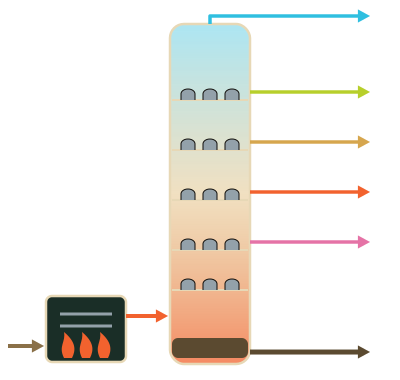
Crude oil is heated to about 400 °C and its vapour rises up a tower that gets cooler towards the top. Small molecules boil low and rise high. Put each fraction where it condenses.

Drag each fraction onto its level (or tap it, then tap the level)

coolhot
below 40 °C
40–75 °C
75–150 °C
150–250 °C
250–350 °C
above 350 °C: the residue

Crude oil vapour in, heated to about 400 °C

Fractional distillation of crude oil

Where you see it: the refineries at Port Harcourt, Warri and Kaduna, and the Dangote refinery at Lekki, all begin by separating crude oil into fractions in tall ChemistryFractionating columnThe tall tower in which crude oil vapour is separated into fractions: cooler at the top, where the smallest molecules condense.Science dictionary ▶. Crude oil is a ChemistryMixtureTwo or more substances mixed but not chemically joined, in any proportion. Their parts keep their own properties and can be separated physically.Air, sea water and garri with sugar are mixtures.Science dictionary ▶ of hundreds of ChemistryHydrocarbonA compound of hydrogen and carbon only, such as methane, petrol and kerosene. Most fuels are hydrocarbons.Cooking gas is a mixture of the hydrocarbons propane and butane.Science dictionary ▶. In the fractionating column it is separated into fractions, each a mixture with a range of PhysicsBoiling pointThe temperature at which a liquid boils, where its saturated vapour pressure equals the pressure above it. Water: 100 °C at sea level, lower up a mountain, higher in a pressure cooker or with salt in it.Science dictionary ▶. The top of the column is coolest, so the smallest molecules (lowest boiling points) come off at the top and the biggest at the bottom. Smaller fractions are also more volatile, flow more easily and catch fire more readily.
6

Play · crack it

Cracking

There's more heavy oil than anyone wants, and never enough petrol. Heat a long alkane with a catalyst and it breaks. Tap a bond to crack this C₁₀ chain. Find two different ways.

Tap a bond between two carbons

EquationC₁₀H₂₂ →Found0 / 2

Cracking

Where you see it: the woven plastic sacks that rice, garri and fertiliser come in are polypropene, a plastic made from propene, one of the ChemistryAlkeneAn unsaturated hydrocarbon with a C=C double bond, general formula CnH2n. Alkenes decolourise bromine water.Ethene, the simplest alkene, is made into polythene.Science dictionary ▶ that ChemistryCrackingBreaking long-chain hydrocarbons into shorter, more useful ones with heat and a catalyst, making petrol and alkenes such as ethene.Science dictionary ▶ produces. Cracking breaks long-chain ChemistryAlkaneA saturated hydrocarbon with only single C-C bonds and the general formula CnH2n+2: methane, ethane, propane, butane.Candle wax is a mixture of long-chain alkanes.Science dictionary ▶ into shorter, more useful ones, using heat and a ChemistryCatalystA substance that speeds up a reaction by giving it an easier route (lower activation energy), and is unchanged at the end.Car exhausts contain catalytic converters; your saliva contains enzyme catalysts.Science dictionary ▶ (catalytic cracking). There aren't enough hydrogens to go round, so at least one product is an alkene. That's two wins: more petrol, and ChemistryEthene (ethylene)C₂H₄, the simplest alkene: a gas with a C=C double bond that decolourises bromine water and is made into polythene. Plants give it off as the hormone that ripens fruit.Science dictionary ▶ and propene for making plastics. A related process, reforming, rearranges straight chains into branched ones to raise petrol's ChemistryOctane numberA measure of how smoothly a petrol burns in an engine without knocking. Branched hydrocarbons have higher octane numbers.Science dictionary ▶.
7

Work it out

Burning cooking gas

The gas in a cooking-gas cylinder is mostly butane, C₄H₁₀. Write the equation for it burning in plenty of air.

Step 1

    Combustion

    Where you see it: the thick black smoke from a poorly tuned lorry or PhysicsGenerator (dynamo)A machine that turns mechanical energy into electrical energy by turning a coil in a magnetic field (or a magnet near a coil). Slip rings give a.c.; a split-ring commutator gives d.c.The petrol generator outside a shop in a blackout, and the huge turbines at Kainji, work the same way.Science dictionary ▶ exhaust is soot, a sign of incomplete ChemistryCombustionBurning: a fast reaction between a fuel and oxygen that gives out heat and light.Fire needs fuel, oxygen and heat: remove one and it goes out.Science dictionary ▶: there was not enough air to burn all the fuel to carbon(IV) oxide and water. In plenty of air, ChemistryHydrocarbonA compound of hydrogen and carbon only, such as methane, petrol and kerosene. Most fuels are hydrocarbons.Cooking gas is a mixture of the hydrocarbons propane and butane.Science dictionary ▶ burn completely to carbon(IV) oxide and water, giving out a lot of heat; that's why they're fuels. In too little air, combustion is incomplete: ChemistryCarbon(II) oxide (carbon monoxide)CO, a colourless, odourless, poisonous gas from fuel burnt in too little oxygen. It binds to haemoglobin far more strongly than oxygen, so the blood can't carry oxygen.Never run a generator indoors or near a window: it's a common cause of death in blackouts.Science dictionary ▶ (carbon monoxide) and soot form. Carbon monoxide is colourless, odourless and deadly: it stops blood carrying oxygen. Never run a generator indoors or in a closed space.
    8

    Exam corner

    How the exam asks it

    Naming and a reaction. Tap each step to reveal it.

    Give the IUPAC name of CH₃–CH=CH–CH₃, and the name of the product when it reacts with bromine.

    Now try the real ones

    Real JAMB, WAEC and NECO past questions on this lesson (the JAMB and WAEC ones in LOEP's words). Answer them one at a time: each is marked, with the worked answer.

    Start the 10 real questions ▶
    1. JAMB 2023Ethene reacts with steam in the presence of phosphoric acid to form ethanol. What type of reaction is this?
    2. WAEC 2020But-2-ene exists as cis and trans forms. What type of isomerism is this?
    3. JAMB 2023Which of the following is a straight-chain alkane?
    4. WAEC 2020Which of these compounds has the lowest boiling point?
    5. JAMB 2020A welder burns ethyne, obtained from calcium carbide and water, in a stream of pure oxygen to produce a very hot flame. This flame is called
    6. WAEC 2020Why does hexane boil at a higher temperature than butane?
    7. JAMB 2022Which hydrocarbon will turn brown bromine water colourless?
    8. WAEC 2016A fruit seller at Mile 12 market puts unripe bananas in a closed sack with a gas that speeds up ripening. Which gas is it?
    9. JAMB 2022Alkanes such as propane, butane, petrol and kerosene are mainly used?
    10. JAMB 2019Terminal alkynes give a precipitate with ammoniacal silver nitrate. What is the general formula of the family they belong to?

    Label it

    The fractionating tower, in the Label lab.
    9

    The League's test

    Pass the League's test

    Six exam-style questions from the League. Get all six right to earn your stamp. Three wrong and you resit.

    The League's badge

    League test · Hydrocarbons

    You: ♥♥♥

    Press Start when you're ready.

    Remember it

    Tap a card to flip it. Say the answer before you flip.

    Kay:That's hydrocarbons. Next time the gas runs out mid-jollof, you'll know exactly which alkane let you down.
    Hydrocarbons: Chemistry explained, with games · L.O.E.P
