L.O.E.P · ChemistryNo. 04
Explainer · Formulae and equations · about 15 min
Turn the gas cooker down to a sooty yellow flame and your pot blackens: not enough oxygen for the fuel. Every reaction has a fixed recipe. Can you read one, and balance it?



Watch the lecture
Ash and Kay teach this lesson, start to finish.
▶ In 2 minutesThe key ideas, quickly
⬇ Save for offline
Keeps it on this phone, so it plays with no signal and no data, at this same address.
- 🔒 Full lessonSign in to save the full lesson
- 2-minute summary
In short
The key words in this lesson, in plain English:
Free this month: 1 of 1 lessons. A free account gives you 3 a month.
A jollof recipe tells you what goes in and how much: rice, tomatoes, pepper, stock. Get the amounts wrong and it isn't jollof any more. Chemistry writes its recipes the same way. The symbols are the ingredients, the formulae say how they're combined, and a balanced equation says exactly how much of each reacts.

Play · quick rounds
Symbol snap
Every element has a one- or two-letter symbol. Most are easy (O for oxygen). Some come from old Latin names, and those are the ones exams love. Get 8 right.
Press Start
Symbols
Play · build it
Read a formula
A formula tells you which atoms are in a compound and how many of each. Build each one from atoms. Watch the brackets: the number outside multiplies everything inside. Build 4.
Press Next formula
Formulae
Play · balance the charges
Formulae from valency
The valency is how many bonds an atom or group makes. In an ionic compound it shows up as a charge. Add ions until the plus and minus charges cancel, using as few as possible. Get 4.
Press Next compound
Valency and ionic formulae
Ash's lab
Does a reaction lose mass?
Baking soda in the flask, vinegar in the tube. Weigh it, tip the vinegar in, weigh it again. Try it with the flask open, then sealed with a balloon.
Choose open or sealed, then react
The law of conservation of mass
Play · balance it
Balance the equation
Change the big numbers in front until every element has the same number of atoms on both sides. The rows of atoms will match up when you've got it. Balance 3.
Press Next equation
–
Balanced
Balancing equations
Ash's lab
Same compound, same recipe
Three samples of black copper(II) oxide, made three different ways. Heat each in hydrogen to strip out the oxygen, weigh the copper left, and compare.
Tap a sample to heat it in hydrogen
The laws of definite and multiple proportions
Play · arcade
Balanced or not?
Press Start
Swipe left for balanced, right for not balanced
Exam corner
How the exam asks it
Words to a balanced equation with state symbols. Tap each step to reveal it.
Write a balanced equation, with state symbols, for the reaction of solid calcium carbonate with dilute hydrochloric acid to give calcium chloride solution, water and carbon(IV) oxide.
Now try the real ones
Real JAMB, WAEC and NECO past questions on this lesson (the JAMB and WAEC ones in LOEP's words). Answer them one at a time: each is marked, with the worked answer.
Start the 10 real questions ▶- JAMB 1991Two samples of sodium chloride from different sources were analysed. The first contained 2.3 g of sodium and 3.55 g of chlorine; the second contained 4.6 g of s
- WAEC 2013What is the value of y that balances the equation C₆H₆ + yH₂ → C₆H₁₂?
- JAMB 2002A compound contains 29.11% sodium and 40.51% sulphur, the rest being oxygen. What is its empirical formula? [Na = 23, S = 32, O = 16]
- WAEC 2012Carbon forms two oxides, CO and CO₂. The masses of oxygen that combine with a fixed mass of carbon in these oxides are in the ratio 1 : 2. Which law does this i
- JAMB 1988A 3.0 g sample of an oxide of metal M gives 2.4 g of M on reduction. A 2.7 g sample of a second oxide of M gives 1.8 g of M. These results illustrate which law?
- WAEC 2012Balance the equation xC₂H₆ + yO₂ → 4CO₂ + zH₂O. What are the values of x, y and z in that order?
- JAMB 1988Element Q is a metal of valency 3 and element R is a non-metal of valency 2. What is the formula of the compound they form?
- NECO 2008Matter is neither created nor destroyed in the course of any chemical reactions is a statement of the law of ____________
- JAMB 1984Which equation correctly represents the neutralization of iron(III) hydroxide by hydrochloric acid to give iron(III) chloride and water?
- JAMB 1981Nitrogen reacts with hydrogen to form ammonia: N₂ + 3H₂ → 2NH₃. Which statement about this reaction is correct?
Label it
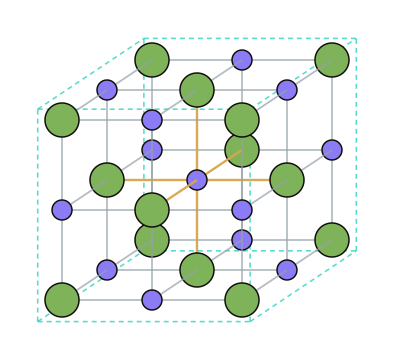
Why sodium chloride is NaCl, one to one: its crystal lattice, in the Label lab.
The League's test
Pass the League's test
Six exam-style questions from the League. Get all six right to earn your stamp. Three wrong and you resit.

League test · Formulae and equations
You: ♥♥♥
Press Start when you're ready.
Remember it
Tap a card to flip it. Say the answer before you flip.