15 wks to JAMB

L.O.E.P · ChemistryNo. 06

Explainer · Electrolysis · about 15 min

How does a cheap necklace from Balogun market get its coat of gold?

Watch the lecture

Ash and Kay teach this lesson, start to finish.

⬇ Save for offline

Keeps it on this phone, so it plays with no signal and no data, at this same address.

In short

The key words in this lesson, in plain English:

Electrolysis:
Splitting a compound that is molten or dissolved by passing a direct current through it. Ions move to the electrodes and are discharged.
Ion:
An atom or group of atoms with an electric charge, formed by losing electrons (positive cation) or gaining them (negative anion).

Free this month: 1 of 1 lessons. A free account gives you 3 a month.

A "gold" necklace from Balogun market for ₦2,000 isn't solid gold. It's cheap metal wearing a coat of gold a few thousandths of a millimetre thick, put there by electricity. Pass a current through the right liquid and you can pull metals out of compounds, split water into gases, and coat one metal with another. That's electrolysis.

Kay:So my "18-carat" chain is mostly brass in a very thin disguise. Relatable.
1

Play · test it

What conducts?

Put each sample between the electrodes. Does the bulb light? Test all eight.

Tap a sample to test it

Verdict–Tested0 / 8

Electrolytes

Where you see it: electricians warn never to touch a switch with wet hands: the water on your skin has ChemistrySalt (in chemistry)The compound formed when the hydrogen of an acid is replaced by a metal or ammonium ion, as when an acid neutralises a base: sodium chloride, copper(II) sulfate.Science dictionary ▶ dissolved in it, so it carries free ChemistryIonAn atom or group of atoms with an electric charge, formed by losing electrons (positive cation) or gaining them (negative anion).Sports drinks replace sodium and potassium ions lost in sweat.Science dictionary ▶ and conducts. An ChemistryElectrolysisSplitting a compound that is molten or dissolved by passing a direct current through it. Ions move to the electrodes and are discharged.Shiny chrome on motorcycle parts is put there by electroplating, a use of electrolysis.Science dictionary ▶ conducts electricity when molten or dissolved in water and is decomposed by it. It conducts because it has ions free to move. Solid salt has ions, but they're locked in the lattice. A non-electrolyte (sugar, ChemistryEthanolThe alcohol in alcoholic drinks (C₂H₅OH). It is also used as a fuel and a solvent.The liver breaks it down in steps.Science dictionary ▶) is made of molecules, with no ions. Metals conduct too, but by moving PhysicsElectronA tiny negatively charged particle that moves around the nucleus of an atom. Moving electrons are an electric current.Rubbing a balloon on your hair moves electrons onto the balloon.Science dictionary ▶, and they aren't decomposed. Strong electrolytes (salts, ChemistryStrong and weak acidsA strong acid ionises completely in water (hydrochloric, sulfuric, nitric); a weak acid only partly (ethanoic, citric). Strength is not the same as concentration.Science dictionary ▶) are fully ionised; weak ones (ChemistryAlkanoic acidsWeak organic acids with the −COOH (carboxyl) group: methanoic acid (ant stings), ethanoic acid (vinegar). They turn blue litmus red, neutralise alkalis and fizz with carbonates.Science dictionary ▶) only slightly.
2

Play · watch the ions

Molten lead(II) bromide

Switch on with the salt solid, then melt it and switch on again. Watch where the lead and the bromine end up.

Choose solid or molten, then switch on

cathode (−)anode (+)
Lead atoms0Bromine molecules0

What happens at each electrode

Where you see it: aluminium for roofing sheets and cooking pots is extracted by passing PhysicsElectric currentThe rate of flow of electric charge, measured in amperes (1 A = 1 coulomb per second).A phone charger supplies a current of about 1 to 2 A.Science dictionary ▶ through aluminium oxide dissolved in molten cryolite: Al³⁺ ChemistryIonAn atom or group of atoms with an electric charge, formed by losing electrons (positive cation) or gaining them (negative anion).Sports drinks replace sodium and potassium ions lost in sweat.Science dictionary ▶ gain PhysicsElectronA tiny negatively charged particle that moves around the nucleus of an atom. Moving electrons are an electric current.Rubbing a balloon on your hair moves electrons onto the balloon.Science dictionary ▶ at the ChemistryCathode and anodeThe two conductors that carry current into an electrolyte. The cathode is negative: cations go there and are reduced. The anode is positive: anions go there and are oxidised.Science dictionary ▶ and become the metal. Positive ions (cations) move to the cathode, the negative electrode, and gain electrons: ChemistryOxidation and reduction (redox)Oxidation is loss of electrons (or gain of oxygen); reduction is gain of electrons (or loss of oxygen). They always happen together.Rusting oxidises iron; a blast furnace reduces iron ore back to iron.Science dictionary ▶. Pb²⁺ + 2e⁻ → Pb. Negative ions (anions) move to the anode, the positive electrode, and lose electrons: oxidation. 2Br⁻ → Br₂ + 2e⁻. Remember OIL RIG: oxidation is loss, reduction is gain. ChemistryElectrolysisSplitting a compound that is molten or dissolved by passing a direct current through it. Ions move to the electrodes and are discharged.Shiny chrome on motorcycle parts is put there by electroplating, a use of electrolysis.Science dictionary ▶ uses electrical energy to drive a ChemistryPhysical and chemical changeA physical change makes no new substance and is usually easy to reverse (melting, dissolving). A chemical change makes a new substance, with heat given out or taken in, and is hard to reverse (burning, rusting).Ice melting is physical; kerosene burning is chemical.Science dictionary ▶.
3

Ash's lab

Splitting water

Water with a little acid added, inert platinum electrodes. Switch on, then test the gas in each tube to find out what it is.

Switch on first

ABcathode (−)anode (+)
Tube A0 cm³Tube B0 cm³

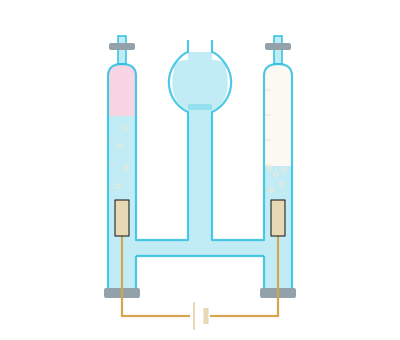
Electrolysis of acidified water

Where you see it: a ChemistryLead-acid accumulatorThe car battery: lead and lead(IV) oxide plates in dilute sulphuric acid. It is a secondary cell: passing a current back through it reverses the reaction and recharges it.Science dictionary ▶ left too long on the charger starts to bubble: the PhysicsElectric currentThe rate of flow of electric charge, measured in amperes (1 A = 1 coulomb per second).A phone charger supplies a current of about 1 to 2 A.Science dictionary ▶ is splitting the water in its ChemistryAcidA substance with a pH below 7 that releases hydrogen ions in water. Strong acids are corrosive; the stomach uses hydrochloric acid to digest food.Acids turn blue litmus paper red.Science dictionary ▶ into hydrogen and oxygen, which is why it needs topping up with ChemistryDistillationSeparating a liquid from a mixture by boiling it and condensing the vapour. Fractional distillation separates liquids with different boiling points.Refineries separate crude oil into petrol, kerosene and diesel by fractional distillation.Science dictionary ▶. Hydrogen ChemistryIonAn atom or group of atoms with an electric charge, formed by losing electrons (positive cation) or gaining them (negative anion).Sports drinks replace sodium and potassium ions lost in sweat.Science dictionary ▶ are discharged at the ChemistryCathode and anodeThe two conductors that carry current into an electrolyte. The cathode is negative: cations go there and are reduced. The anode is positive: anions go there and are oxidised.Science dictionary ▶: 4H⁺ + 4e⁻ → 2H₂. Hydroxide ions are discharged at the anode: 4OH⁻ → 2H₂O + O₂ + 4e⁻. For the same 4 PhysicsElectronA tiny negatively charged particle that moves around the nucleus of an atom. Moving electrons are an electric current.Rubbing a balloon on your hair moves electrons onto the balloon.Science dictionary ▶ you get two molecules of hydrogen for every one of oxygen, so twice the volume collects at the cathode. Tests: hydrogen burns with a squeaky pop; oxygen relights a glowing splint.
4

Play · pick the winner

Which ion is discharged?

In a solution there are always two kinds of ion competing at each electrode: the salt's, and the H⁺ and OH⁻ from water. Pick the winner at each. Get 4 right.

Press Next solution

–

At the cathode (−)

At the anode (+)

Right0 / 4

Selective discharge

Where you see it: the chlorine used to disinfect town water supplies and the caustic soda used in soap making are both made by electrolysing brine, where the concentrated Cl⁻ ChemistryIonAn atom or group of atoms with an electric charge, formed by losing electrons (positive cation) or gaining them (negative anion).Sports drinks replace sodium and potassium ions lost in sweat.Science dictionary ▶ are discharged instead of OH⁻. Three things decide which ion is discharged. Position in the ChemistryElectrochemical (reactivity) seriesThe metals (with carbon and hydrogen) in order of how readily they lose electrons: K, Na, Ca, Mg, Al, (C), Zn, Fe, Pb, (H), Cu, Ag, Au.Science dictionary ▶: at the ChemistryCathode and anodeThe two conductors that carry current into an electrolyte. The cathode is negative: cations go there and are reduced. The anode is positive: anions go there and are oxidised.Science dictionary ▶, the ion of the least reactive metal wins (Ag⁺ and Cu²⁺ before H⁺; H⁺ before K⁺, Na⁺, Ca²⁺). At the anode, OH⁻ is discharged before SO₄²⁻ and NO₃⁻. ChemistryConcentrationHow much solute is dissolved in each cubic decimetre of solution: moles ÷ volume in dm³ (mol/dm³), or grams per dm³.Science dictionary ▶: a high concentration of Cl⁻ (as in brine) gets discharged instead of OH⁻. The electrodes: an active electrode like copper can dissolve instead of any ion being discharged.
5

Play · swap the electrodes

Carbon or copper?

Copper(II) sulfate solution, ten minutes of current. Run it with carbon electrodes, then with copper ones, and compare.

Choose the electrodes, then run

cathode (−)anode (+)
Cathode10.00 gAnode10.00 gSolutionblue

Inert and active electrodes

Where you see it: the copper wire in a house's wiring must be very pure to conduct well; it is refined by ChemistryElectrolysisSplitting a compound that is molten or dissolved by passing a direct current through it. Ions move to the electrodes and are discharged.Shiny chrome on motorcycle parts is put there by electroplating, a use of electrolysis.Science dictionary ▶, with blocks of impure copper as the ChemistryCathode and anodeThe two conductors that carry current into an electrolyte. The cathode is negative: cations go there and are reduced. The anode is positive: anions go there and are oxidised.Science dictionary ▶. With inert carbon or platinum electrodes, copper is deposited at the cathode and oxygen is given off at the anode (from OH⁻). Cu²⁺ ChemistryIonAn atom or group of atoms with an electric charge, formed by losing electrons (positive cation) or gaining them (negative anion).Sports drinks replace sodium and potassium ions lost in sweat.Science dictionary ▶ are used up, so the blue colour fades and the solution turns ChemistryAcidA substance with a pH below 7 that releases hydrogen ions in water. Strong acids are corrosive; the stomach uses hydrochloric acid to digest food.Acids turn blue litmus paper red.Science dictionary ▶. With copper electrodes, the anode dissolves (Cu → Cu²⁺ + 2e⁻) as fast as copper is deposited on the cathode, so the colour stays the same. That is how copper is purified: impure copper as the anode, pure copper builds up on the cathode, and the impurities fall as anode sludge.
6

Play · wire it up

Silver-plate a key

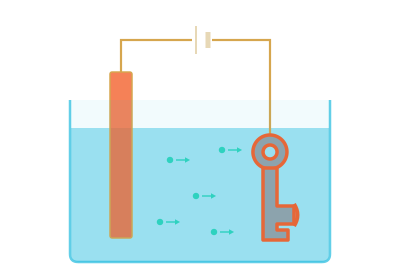
You have a brass key, a bar of silver and three solutions. Wire it up so the key comes out silver.

Choose the wiring and the solution, then switch on

− terminal+ terminal

Electroplating

Where you see it: many of the shiny cups and trophies handed out at a school prize-giving are a cheaper metal ChemistryElectrolysisSplitting a compound that is molten or dissolved by passing a direct current through it. Ions move to the electrodes and are discharged.Shiny chrome on motorcycle parts is put there by electroplating, a use of electrolysis.Science dictionary ▶ with a thin coat of silver. To plate an object, make it the ChemistryCathode and anodeThe two conductors that carry current into an electrolyte. The cathode is negative: cations go there and are reduced. The anode is positive: anions go there and are oxidised.Science dictionary ▶, make the plating metal the anode, and use a solution of a ChemistrySalt (in chemistry)The compound formed when the hydrogen of an acid is replaced by a metal or ammonium ion, as when an acid neutralises a base: sodium chloride, copper(II) sulfate.Science dictionary ▶ of the plating metal as the electrolyte. Metal ChemistryIonAn atom or group of atoms with an electric charge, formed by losing electrons (positive cation) or gaining them (negative anion).Sports drinks replace sodium and potassium ions lost in sweat.Science dictionary ▶ are deposited on the object; the anode dissolves to replace them. It is used for decoration (silver and gold plating), and to stop corrosion (chromium on bicycle handlebars, tin on food cans).
7

Work it out

How much copper?

A current of 5.0 A flows through copper(II) sulfate solution for 32 minutes 10 seconds. What mass of copper is deposited? (Cu = 64; 1 faraday = 96 500 C)

Step 1

    Faraday's laws

    First law: the PhysicsMassThe amount of matter in something, measured in kilograms. It doesn't change from place to place.Your mass is the same on the Moon, but your weight there is about a sixth.Science dictionary ▶ of a substance deposited is proportional to the quantity of electricity passed, Q = It (coulombs = PhysicsElectric currentThe rate of flow of electric charge, measured in amperes (1 A = 1 coulomb per second).A phone charger supplies a current of about 1 to 2 A.Science dictionary ▶ × seconds). Second law: to deposit one ChemistryMoleThe amount of substance containing 6.02 × 10^23 particles (Avogadro's number). One mole's mass in grams equals the relative formula mass.18 g of water, about a tablespoon, is one mole of water molecules.Science dictionary ▶ of an ChemistryElementA substance made of only one kind of atom, which cannot be split into simpler substances by chemical means, such as iron, oxygen or carbon.The iron in a cooking pot and the oxygen you breathe are elements.Science dictionary ▶ takes as many faradays as the charge on its ChemistryIonAn atom or group of atoms with an electric charge, formed by losing electrons (positive cation) or gaining them (negative anion).Sports drinks replace sodium and potassium ions lost in sweat.Science dictionary ▶. One ChemistryFaraday's lawsThe mass deposited in electrolysis is proportional to the charge passed (Q = It). One faraday, 96 500 C, is one mole of electrons.Science dictionary ▶ (96 500 C) is one mole of PhysicsElectronA tiny negatively charged particle that moves around the nucleus of an atom. Moving electrons are an electric current.Rubbing a balloon on your hair moves electrons onto the balloon.Science dictionary ▶. So Ag⁺ needs 1 F per mole, Cu²⁺ needs 2 F, Al³⁺ needs 3 F.
    8

    Exam corner

    How the exam asks it

    Ions, electrodes, products, and what's left behind. Tap each step to reveal it.

    Dilute sodium hydroxide solution is electrolysed using platinum electrodes. Name the products at each electrode, write the electrode equations, and say what happens to the solution.

    Now try the real ones

    Real JAMB, WAEC and NECO past questions on this lesson (the JAMB and WAEC ones in LOEP's words). Answer them one at a time: each is marked, with the worked answer.

    Start the 10 real questions ▶
    1. JAMB 2023Concentrated sodium chloride solution (brine) is electrolysed using inert electrodes. What forms at each electrode?
    2. NECO 2009Which of the following metals is NOT extracted by electrolysis?
    3. JAMB 2023Approximately how much electric charge is carried by one mole of electrons?
    4. WAEC 2020What mass of silver is deposited when 19 300 C of electricity passes through a solution of a silver salt? [Ag = 108, 1 F = 96 500 C]
    5. JAMB 2022From solutions of equal concentration, which ion is discharged most readily at the cathode, based on the electrochemical series?
    6. WAEC 2006Which of these industrial processes does not involve electrolysis?
    7. JAMB 2018Aqueous copper(II) sulphate is electrolysed between platinum electrodes. A little blue litmus solution is added around the anode. What is observed?
    8. WAEC 2017What always happens at the anode during electrolysis?
    9. JAMB 2005A solution of silver trioxonitrate (V) is electrolysed between platinum electrodes. Which ion is discharged at the cathode?
    10. JAMB 2020How much electricity is needed to liberate 0.05 mole of oxygen molecules during the electrolysis of dilute sulphuric acid?

    Label it

    The water voltameter and an electroplating cell, in the Label lab.
    9

    The League's test

    Pass the League's test

    Six exam-style questions from the League. Get all six right to earn your stamp. Three wrong and you resit.

    The League's badge

    League test · Electrolysis

    You: ♥♥♥

    Press Start when you're ready.

    Remember it

    Tap a card to flip it. Say the answer before you flip.

    Kay:That's electrolysis. Next time someone flexes a "gold" chain, ask politely about the thickness of the cathode deposit.
    Electrolysis: Chemistry explained, with games · L.O.E.P