15 wks to JAMB

L.O.E.P · ChemistryNo. 01

Explainer · Atomic structure · about 15 min

The neon sign at the barbing salon and the colours of New Year fireworks both come from electrons jumping inside atoms. So what's inside an atom?


Watch the lecture

Ash and Kay teach this lesson, start to finish.

⬇ Save for offline

Keeps it on this phone, so it plays with no signal and no data, at this same address.

In short

The key words in this lesson, in plain English:

Ion:
An atom or group of atoms with an electric charge, formed by losing electrons (positive cation) or gaining them (negative anion).
Isotope:
Atoms of the same element with the same number of protons but different numbers of neutrons, such as carbon-12 and carbon-14.

Free this month: 1 of 1 lessons. A free account gives you 3 a month.

Blow an atom up to the size of a football stadium. The nucleus would be a peppercorn on the centre spot, the electrons specks of dust in the top seats, and everything in between: empty space. Yet almost all the atom's mass is in that peppercorn.

Kay:So I'm mostly empty space. Ash says that explains a lot.
1

Play · Rutherford's experiment

Fire at the gold foil

In 1909, Rutherford's team fired alpha particles (tiny, positive and fast) at gold foil a few atoms thick. Most people expected them all to sail through. Fire away and see what happens.

Fire alpha particles at the foil

DETECTOR SCREENα SOURCEGOLD FOIL
Straight through0Deflected0Bounced back0

The bounce-backs are made more common here so you see some. In the real experiment it was about 1 in 8,000.

The models of the atom, in order

Dalton (1803): atoms are tiny solid balls that can't be split. Thomson (1897): he found the PhysicsElectronA tiny negatively charged particle that moves around the nucleus of an atom. Moving electrons are an electric current.Rubbing a balloon on your hair moves electrons onto the balloon.Science dictionary ▶, and pictured a positive ball with electrons stuck in it, the "plum pudding". Rutherford (1911): the gold foil showed a tiny, dense, positive BiologyNucleusA centre. In an atom, the tiny dense core of protons and neutrons that holds nearly all its mass. In a cell, the part that holds the chromosomes and controls the cell.Science dictionary ▶ with electrons around it, and the atom mostly empty space. Bohr (1913): electrons move in fixed ChemistryEnergy level (shell)One of the fixed distances (energies) at which electrons can orbit a nucleus: 2 in the first shell, then up to 8 in the next for the first 20 elements.Science dictionary ▶ (shells). Chadwick (1932) found the PhysicsNeutronAn uncharged particle in the nucleus, with about the same mass as a proton.In a nuclear power station, neutrons split uranium nuclei and keep the chain reaction going.Science dictionary ▶.
Ash:Rutherford said it was like firing a shell at tissue paper and having it come back and hit you. Most quotable surprise in science.
2

Play · build it

Build an atom

Three particles

Where you see it: in the dry harmattan, a comb pulled through hair crackles and picks up bits of paper: light, loosely held PhysicsElectronA tiny negatively charged particle that moves around the nucleus of an atom. Moving electrons are an electric current.Rubbing a balloon on your hair moves electrons onto the balloon.Science dictionary ▶ have been rubbed from one surface onto the other, while the heavy ChemistryProtonA positively charged particle in the nucleus of every atom. The number of protons is the atomic number and decides the element.Every carbon atom has 6 protons; every gold atom has 79.Science dictionary ▶ stay locked in their BiologyNucleusA centre. In an atom, the tiny dense core of protons and neutrons that holds nearly all its mass. In a cell, the part that holds the chromosomes and controls the cell.Science dictionary ▶. Protons: charge +1, PhysicsMassThe amount of matter in something, measured in kilograms. It doesn't change from place to place.Your mass is the same on the Moon, but your weight there is about a sixth.Science dictionary ▶ 1, in the nucleus. PhysicsNeutronAn uncharged particle in the nucleus, with about the same mass as a proton.In a nuclear power station, neutrons split uranium nuclei and keep the chain reaction going.Science dictionary ▶: no charge, mass 1, in the nucleus. Electrons: charge −1, mass about 1/1840 (almost nothing), in shells around it. The number of protons is the ChemistryAtomic (proton) numberThe number of protons in an atom's nucleus, Z. It decides which element the atom is.Science dictionary ▶ (Z) and decides the ChemistryElementA substance made of only one kind of atom, which cannot be split into simpler substances by chemical means, such as iron, oxygen or carbon.The iron in a cooking pot and the oxygen you breathe are elements.Science dictionary ▶. Protons + neutrons is the ChemistryMass (nucleon) numberThe number of protons plus neutrons in a nucleus, A. Neutrons = A − Z.Science dictionary ▶ (A). Lose or gain electrons and you have an ChemistryIonAn atom or group of atoms with an electric charge, formed by losing electrons (positive cation) or gaining them (negative anion).Sports drinks replace sodium and potassium ions lost in sweat.Science dictionary ▶.

Add particles to make each one on the list

00?nothing yet
Carbon-12 atomOxide ion, O²⁻Sodium ion, Na⁺Hydrogen-2 (deuterium)
Kay:Add a proton and the whole element changes. One proton! I add one jollof and nothing changes. Science is dramatic.
3

Play · platform jumper

Kay versus the giant atom

A giant oxygen atom floats over the field: 8 protons and 8 neutrons in the nucleus, electrons in two shells. Ash calls a particle; run, climb and jump Kay into it. You have 75 seconds for all eight.

Press Start

Ash says–Hits0 / 8Time75

Keyboard: arrow keys to run, space or up to jump.

Kay:Finally, a level built for me. Ex-track star. Ash asked for a version where you sit and think. I said that's every other level.
4

Play · fill the shells

Electron arrangement

Shells fill from the inside out

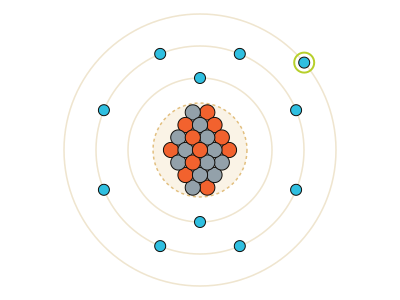
Where you see it: an old-style filament bulb is filled with argon, whose shells are full at 2, 8, 8; with no PhysicsElectronA tiny negatively charged particle that moves around the nucleus of an atom. Moving electrons are an electric current.Rubbing a balloon on your hair moves electrons onto the balloon.Science dictionary ▶ to gain or lose, it does not react with the white-hot filament the way oxygen would. The first shell (K) holds up to 2 electrons, the second (L) up to 8, and for the first 20 ChemistryElementA substance made of only one kind of atom, which cannot be split into simpler substances by chemical means, such as iron, oxygen or carbon.The iron in a cooking pot and the oxygen you breathe are elements.Science dictionary ▶ the third (M) takes 8 before the fourth (N) starts. Sodium (11): 2, 8, 1. The number of shells is the element's period; the electrons in the outer shell give its group.

Tap a shell to add an electron

KLMN?
Element–Arrangement–Correct0 / 4
5

Play · arcade

Atom or ion?

An atom has as many electrons as protons, so it's neutral. An ion doesn't. Metals lose electrons and become positive ions; non-metals gain them and become negative ions.

Press Start

Swipe left for atom, right for ion

Score0Streak0Lives♥♥♥
6

Play · mix it

Isotopes and relative atomic mass

Isotopes

Where you see it: a hospital radiotherapy unit treats cancer with cobalt-60, a ChemistryRadioisotopeA radioactive isotope of an element, such as cobalt-60, iodine-131 or carbon-14. Used in medicine, industry, farming and dating, often as a tracer that can be followed by its radiation.Cobalt-60's gamma rays treat cancer and show cracks in welds.Science dictionary ▶ of cobalt: it has the same 27 ChemistryProtonA positively charged particle in the nucleus of every atom. The number of protons is the atomic number and decides the element.Every carbon atom has 6 protons; every gold atom has 79.Science dictionary ▶ as ordinary cobalt-59 but one extra PhysicsNeutronAn uncharged particle in the nucleus, with about the same mass as a proton.In a nuclear power station, neutrons split uranium nuclei and keep the chain reaction going.Science dictionary ▶. ChemistryIsotopeAtoms of the same element with the same number of protons but different numbers of neutrons, such as carbon-12 and carbon-14.Carbon-14, a radioactive isotope, is used to date ancient wood and bone.Science dictionary ▶ are atoms of the same ChemistryElementA substance made of only one kind of atom, which cannot be split into simpler substances by chemical means, such as iron, oxygen or carbon.The iron in a cooking pot and the oxygen you breathe are elements.Science dictionary ▶ with the same number of protons but different numbers of neutrons, so different ChemistryMass (nucleon) numberThe number of protons plus neutrons in a nucleus, A. Neutrons = A − Z.Science dictionary ▶. They react the same way. An element's relative atomic PhysicsMassThe amount of matter in something, measured in kilograms. It doesn't change from place to place.Your mass is the same on the Moon, but your weight there is about a sixth.Science dictionary ▶ is the average mass of its atoms, weighted by how common each isotope is.

Pick an element, then slide until the average matches the real one

lighterheavier–AVERAGE MASS
Real value–Working–
Ash:That's why chlorine's relative atomic mass is 35.5, not a whole number. No atom weighs 35.5. It's an average, like a class's average score.
7

Play · fill the boxes

Orbitals: the rules

Shells are made of orbitals

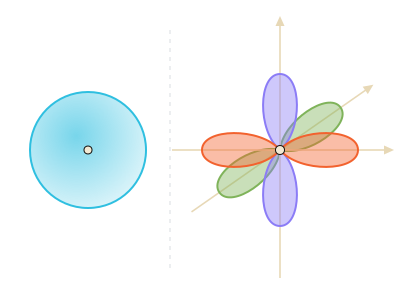
Each shell splits into sub-shells: s (one orbital, a sphere) and p (three orbitals, dumbbells along x, y and z). Each orbital holds at most 2 PhysicsElectronA tiny negatively charged particle that moves around the nucleus of an atom. Moving electrons are an electric current.Rubbing a balloon on your hair moves electrons onto the balloon.Science dictionary ▶. They fill by three rules. Aufbau: lowest energy first (1s, 2s, 2p, 3s, 3p, 4s). Pauli: two electrons in one orbital must spin opposite ways. Hund: in a sub-shell, fill each orbital singly, spins the same way, before pairing up.
sp

Tap a box to add electrons: ↑, then ↑↓

1s
2s
2p
3s
3p
Element–Electrons0Correct0 / 3
Kay:Hund's rule is the bus rule: everyone takes an empty seat before anyone sits next to a stranger. Ash says that's "surprisingly accurate".
8

Exam corner

How the exam asks it

Ions trip people up. Tap each step to reveal it.

An aluminium ion is written ²⁷₁₃Al³⁺. How many protons, neutrons and electrons does it have, and what is its electron arrangement?

Now try the real ones

Real JAMB, WAEC and NECO past questions on this lesson (the JAMB and WAEC ones in LOEP's words). Answer them one at a time: each is marked, with the worked answer.

Start the 10 real questions ▶
  1. JAMB 2023Chlorine-35 and chlorine-37 are isotopes. In what way do their atoms differ?
  2. WAEC 2019How many electrons are in the 3d subshell of an iron atom, ₂₆Fe?
  3. JAMB 2022Which two particles account for almost the whole mass of an atom?
  4. WAEC 2021Bohr's model of the hydrogen atom introduced the idea that electrons
  5. JAMB 2020An element has the electron configuration 1s²2s²2p⁶3s²3p⁴. How many unpaired electrons does one atom have?
  6. WAEC 2018Which electron configuration correctly represents copper (atomic number 29)?
  7. JAMB 2023How many protons are in the nucleus of an aluminium atom?
  8. WAEC 2021The following ions have the same electron configuration except one: ₇N, ₉F, ₁₁Na, ₁₆S. Which ion is the exception?
  9. JAMB 2021Which two particles together make up the nucleus of a carbon atom?
  10. JAMB 2022An atom has atomic number 26 and mass number 56. How many neutrons does it contain?

Label it

The structure of an atom, and the shapes of s and p orbitals, in the Label lab.
9

The League's test

Pass the League's test

Six exam-style questions from the League. Get all six right to earn your stamp. Three wrong and you resit.

The League's badge

League test · Atomic structure

You: ♥♥♥

Press Start when you're ready.

Remember it

Tap a card to flip it. Say the answer before you flip.

Kay:That's the atom. Next: what happens when atoms start sharing and stealing electrons. Bonding. Ash calls it "chemistry". I call it drama.
Atomic structure: Chemistry explained, with games · L.O.E.P