15 wks to JAMB

L.O.E.P · ChemistryNo. 13

Explainer · Alcohols, acids and esters · about 15 min

Fresh palm wine is sweet, by evening it's strong, and in a few days it's vinegar. What happened?

Watch the lecture

Ash and Kay teach this lesson, start to finish.

⬇ Save for offline

Keeps it on this phone, so it plays with no signal and no data, at this same address.

In short

The key words in this lesson, in plain English:

Alkanols (alcohols):
Carbon compounds with the −OH (hydroxyl) group, CₙH₂ₙ₊₁OH: methanol, ethanol. Primary, secondary or tertiary by the number of carbons on the −OH carbon. They react with sodium to give hydrogen.
Acid:
A substance with a pH below 7 that releases hydrogen ions in water. Strong acids are corrosive; the stomach uses hydrochloric acid to digest food.
Esters (alkanoates):
Sweet-smelling compounds made from an alkanoic acid and an alkanol, with concentrated H₂SO₄ as catalyst: acid + alkanol ⇌ ester + water. Named alkanol part first: ethyl ethanoate. Used in flavours and perfumes.
Alkanoic acids:
Weak organic acids with the −COOH (carboxyl) group: methanoic acid (ant stings), ethanoic acid (vinegar). They turn blue litmus red, neutralise alkalis and fizz with carbonates.

Free this month: 1 of 1 lessons. A free account gives you 3 a month.

Tap a palm tree at dawn and the sap is sweet. By evening it's frothing palm wine: yeast has turned its sugar into ethanol. Leave the calabash open for a few days and it goes sour like vinegar: the ethanol has become ethanoic acid. Boil the palm wine and catch the vapour, and you have ogogoro. Three families of carbon compounds, one tree: the alkanols, the alkanoic acids, and, when the two meet, the sweet-smelling esters.

Kay:My grandfather says fresh palm wine is the best drink in the world. He also says the sour one "has character". Ash says it has ethanoic acid.
1

Play · the calabash

From sap to palm wine to vinegar

Fresh sap in a calabash. Move through the days, with the calabash covered or open to the air. Find the day it's strongest, then let it turn sour.

Move through the days

Day 0
Sugar100%Ethanol0%Ethanoic acid0%Tastesweet

Fermentation, and why it sours

Where you see it: in a bakery, yeast in the bread dough ferments some of the sugar; the carbon(IV) oxide it makes puffs up the loaf, and the little ChemistryEthanolThe alcohol in alcoholic drinks (C₂H₅OH). It is also used as a fuel and a solvent.The liver breaks it down in steps.Science dictionary ▶ formed is driven off in the oven. BiologyFermentationAnaerobic respiration by micro-organisms such as yeast or bacteria, making products like alcohol, carbon(IV) oxide or lactic acid.Palm wine, ogi, garri, bread and yoghurt all depend on fermentation.Science dictionary ▶: in the absence of air, the BiologyEnzymeA protein that speeds up a chemical reaction in living things without being used up, like the enzymes that break down food.Most enzymes stop working if they get too hot.Science dictionary ▶ zymase in yeast turns sugar into ethanol and carbon(IV) oxide (the froth): C₆H₁₂O₆ → 2C₂H₅OH + 2CO₂. It slows as the ethanol builds up, which kills the yeast. In air, BiologyBacteriumA tiny single-celled organism with no true nucleus. Some cause disease (cholera, typhoid); many are useful, making yoghurt, fixing nitrogen and rotting dead matter.Science dictionary ▶ oxidise the ethanol to ChemistryAlkanoic acidsWeak organic acids with the −COOH (carboxyl) group: methanoic acid (ant stings), ethanoic acid (vinegar). They turn blue litmus red, neutralise alkalis and fizz with carbonates.Science dictionary ▶: that's why open palm wine sours, and how vinegar is made. Ethanol boils at 78 °C, below water, so distilling palm wine gives the much stronger ogogoro. Ethanol is also made industrially by adding steam to ChemistryEthene (ethylene)C₂H₄, the simplest alkene: a gas with a C=C double bond that decolourises bromine water and is made into polythene. Plants give it off as the hormone that ripens fruit.Science dictionary ▶ (with a ChemistryCatalystA substance that speeds up a reaction by giving it an easier route (lower activation energy), and is unchanged at the end.Car exhausts contain catalytic converters; your saliva contains enzyme catalysts.Science dictionary ▶).
2

Play · quick rounds

Primary, secondary or tertiary?

Press Next

Which kind of alkanol is it?

–

Right0 / 5

The alkanols

Where you see it: the hand sanitiser at a hospital entrance is mostly ChemistryEthanolThe alcohol in alcoholic drinks (C₂H₅OH). It is also used as a fuel and a solvent.The liver breaks it down in steps.Science dictionary ▶ or propan-2-ol (isopropyl ChemistryAlkanols (alcohols)Carbon compounds with the −OH (hydroxyl) group, CₙH₂ₙ₊₁OH: methanol, ethanol. Primary, secondary or tertiary by the number of carbons on the −OH carbon. They react with sodium to give hydrogen.Science dictionary ▶); propan-2-ol is a secondary alkanol, with its −OH on the middle carbon. Alkanols have the hydroxyl group, −OH, and the general formula CₙH₂ₙ₊₁OH: methanol, ethanol, propanol… Count the carbons joined to the carbon that carries the −OH. One (or none, in methanol): primary, RCH₂OH. Two: secondary, R₂CHOH. Three: tertiary, R₃COH. Alkanols are neutral to ChemistryIndicatorA dye whose colour shows whether a solution is acidic or alkaline. Litmus turns red in acid and blue in alkali; universal indicator shows the whole pH scale.Science dictionary ▶ but react with sodium, giving off hydrogen. With hot concentrated tetraoxosulphate(VI) ChemistryAcidA substance with a pH below 7 that releases hydrogen ions in water. Strong acids are corrosive; the stomach uses hydrochloric acid to digest food.Acids turn blue litmus paper red.Science dictionary ▶ (about 170 °C) they lose water to give ChemistryAlkeneAn unsaturated hydrocarbon with a C=C double bond, general formula CnH2n. Alkenes decolourise bromine water.Ethene, the simplest alkene, is made into polythene.Science dictionary ▶: ethanol gives ChemistryEthene (ethylene)C₂H₄, the simplest alkene: a gas with a C=C double bond that decolourises bromine water and is made into polythene. Plants give it off as the hormone that ripens fruit.Science dictionary ▶. Glycerol (propane-1,2,3-triol) has three −OH groups.
3

Ash's lab

Oxidising the alkanols

Warm an alkanol with orange acidified potassium heptaoxodichromate(VI). Either distil the product off at once, or reflux with excess oxidant. Make ethanal, ethanoic acid and propanone, and find the one that won't react.

Choose an alkanol and a method

Product–Found0 / 4

What oxidation gives

Where you see it: drinks laced with methanol are deadly because the liver oxidises it, as a ChemistryAlkanols (alcohols)Carbon compounds with the −OH (hydroxyl) group, CₙH₂ₙ₊₁OH: methanol, ethanol. Primary, secondary or tertiary by the number of carbons on the −OH carbon. They react with sodium to give hydrogen.Science dictionary ▶, first to methanal and then to ChemistryAlkanoic acidsWeak organic acids with the −COOH (carboxyl) group: methanoic acid (ant stings), ethanoic acid (vinegar). They turn blue litmus red, neutralise alkalis and fizz with carbonates.Science dictionary ▶, which damage the eyes and can kill. A primary alkanol is ChemistryOxidation and reduction (redox)Oxidation is loss of electrons (or gain of oxygen); reduction is gain of electrons (or loss of oxygen). They always happen together.Rusting oxidises iron; a blast furnace reduces iron ore back to iron.Science dictionary ▶ first to an ChemistryAlkanals and alkanonesCompounds with the C=O group: at the end of the chain in an alkanal (−CHO, from oxidising a primary alkanol), inside it in an alkanone (from a secondary one). Only alkanals reduce Fehling's solution.Science dictionary ▶ (aldehyde, −CHO), then on to an alkanoic acid (−COOH). ChemistryDistillationSeparating a liquid from a mixture by boiling it and condensing the vapour. Fractional distillation separates liquids with different boiling points.Refineries separate crude oil into petrol, kerosene and diesel by fractional distillation.Science dictionary ▶ the alkanal off as it forms to stop there; reflux with excess oxidant to go all the way: ChemistryEthanolThe alcohol in alcoholic drinks (C₂H₅OH). It is also used as a fuel and a solvent.The liver breaks it down in steps.Science dictionary ▶ → ethanal → ethanoic acid. A secondary alkanol gives an alkanone (ketone, C=O inside the chain), which goes no further: propan-2-ol → propanone. A tertiary alkanol isn't oxidised at all. Each time the orange dichromate turns green (and purple KMnO₄ goes colourless): the ChemistryBreathalyserA device that tests a driver's breath for ethanol: the ethanol reduces orange acidified potassium heptaoxodichromate(VI) to green chromium(III).Science dictionary ▶ test.
4

Ash's lab

Which one is it?

A mystery liquid: ethanol, ethanal, propanone or ethanoic acid. Use as few tests as you can, then name it. Get three right.

Press New liquid

    Tests used0Right0 / 3

    Telling them apart

    Sodium fizzes (hydrogen) with anything that has an −OH: ChemistryAlkanols (alcohols)Carbon compounds with the −OH (hydroxyl) group, CₙH₂ₙ₊₁OH: methanol, ethanol. Primary, secondary or tertiary by the number of carbons on the −OH carbon. They react with sodium to give hydrogen.Science dictionary ▶ and ChemistryAcidA substance with a pH below 7 that releases hydrogen ions in water. Strong acids are corrosive; the stomach uses hydrochloric acid to digest food.Acids turn blue litmus paper red.Science dictionary ▶. Sodium hydrogentrioxocarbonate(IV) fizzes (carbon(IV) oxide) only with an acid. Fehling's or BiologyReducing sugarA sugar, such as glucose, that turns blue Benedict's solution green, orange or brick-red when heated with it.Science dictionary ▶, warmed, gives a brick-red ChemistryPrecipitateAn insoluble solid that forms when two solutions are mixed, such as white silver chloride from silver trioxonitrate(V) and a chloride.Science dictionary ▶ (copper(I) oxide) with an ChemistryAlkanals and alkanonesCompounds with the C=O group: at the end of the chain in an alkanal (−CHO, from oxidising a primary alkanol), inside it in an alkanone (from a secondary one). Only alkanals reduce Fehling's solution.Science dictionary ▶, not an alkanone; so does ChemistryFehling's solutionA blue copper(II) reagent that an alkanal (or a reducing sugar such as glucose) turns to a brick-red precipitate of copper(I) oxide when warmed. Tollens' reagent gives a silver mirror instead.Science dictionary ▶, as a silver mirror. Warm acidified dichromate turns green with things that can still be ChemistryOxidation and reduction (redox)Oxidation is loss of electrons (or gain of oxygen); reduction is gain of electrons (or loss of oxygen). They always happen together.Rusting oxidises iron; a blast furnace reduces iron ore back to iron.Science dictionary ▶: primary and secondary alkanols and alkanals, but not alkanones or acids.
    5

    Play · the flavour lab

    Make an ester

    Warm an alkanoic acid with an alkanol and a few drops of concentrated tetraoxosulphate(VI) acid, pour it into water and smell it. Then name the ester you made. Name three.

    Choose an acid and an alkanol

    acid + alkanol ⇌ ester + water

    Smell–Named0 / 3

    Esterification

    Where you see it: the banana smell of many flavoured sweets and drinks comes from an ChemistryEsters (alkanoates)Sweet-smelling compounds made from an alkanoic acid and an alkanol, with concentrated H₂SO₄ as catalyst: acid + alkanol ⇌ ester + water. Named alkanol part first: ethyl ethanoate. Used in flavours and perfumes.Science dictionary ▶, 3-methylbutyl ethanoate, made from ChemistryAlkanoic acidsWeak organic acids with the −COOH (carboxyl) group: methanoic acid (ant stings), ethanoic acid (vinegar). They turn blue litmus red, neutralise alkalis and fizz with carbonates.Science dictionary ▶ and an ChemistryAlkanols (alcohols)Carbon compounds with the −OH (hydroxyl) group, CₙH₂ₙ₊₁OH: methanol, ethanol. Primary, secondary or tertiary by the number of carbons on the −OH carbon. They react with sodium to give hydrogen.Science dictionary ▶. An alkanoic acid and an alkanol react, with concentrated tetraoxosulphate(VI) ChemistryAcidA substance with a pH below 7 that releases hydrogen ions in water. Strong acids are corrosive; the stomach uses hydrochloric acid to digest food.Acids turn blue litmus paper red.Science dictionary ▶ as ChemistryCatalystA substance that speeds up a reaction by giving it an easier route (lower activation energy), and is unchanged at the end.Car exhausts contain catalytic converters; your saliva contains enzyme catalysts.Science dictionary ▶ (it also takes up the water), to give an ester (alkanoate) and water: CH₃COOH + C₂H₅OH ⇌ CH₃COOC₂H₅ + H₂O. It's slow and reversible. Name the alkanol part first, as an ChemistryAlkyl groupAn alkane with one hydrogen removed, general formula CₙH₂ₙ₊₁: methyl CH₃–, ethyl C₂H₅–, propyl C₃H₇–.Science dictionary ▶, then the acid as -oate: ChemistryEthanolThe alcohol in alcoholic drinks (C₂H₅OH). It is also used as a fuel and a solvent.The liver breaks it down in steps.Science dictionary ▶ + ethanoic acid gives ethyl ethanoate. Esters have fruity smells and make food flavours and perfumes; ethyl ethanoate is a ChemistrySolute and solventIn a solution, the solute is the substance dissolved and the solvent is the liquid it dissolves in: sugar is the solute and water the solvent in sugar solution.Like dissolves like: polar solvents such as water dissolve ionic and polar substances; non-polar ones such as kerosene dissolve grease and wax.Science dictionary ▶ in nail-polish remover. Boiling an ester with water and acid or ChemistryAlkaliA base that dissolves in water, giving hydroxide ions, such as sodium hydroxide. Alkalis turn red litmus blue and have pH above 7.Caustic soda used in soap-making is a strong alkali.Science dictionary ▶ reverses it: ChemistryHydrolysisBreaking a compound apart by reaction with water, often helped by an acid, alkali or enzyme: an ester back into an acid and an alkanol, starch into glucose.Science dictionary ▶ (with alkali on a fat, that's soap-making).
    6

    Play · arcade

    Alkanol or alkanoic acid?

    Press Start

    Swipe left for an alkanol, right for an alkanoic acid

    Score0Streak0Lives♥♥♥

    The alkanoic acids

    Where you see it: the label on a loaf of sliced bread often lists ChemistryCalciumA metal element (Ca) that our bones and teeth are built from. We get it from milk, beans and green vegetables.Chalk and limestone are calcium carbonate.Science dictionary ▶ propanoate, a ChemistrySalt (in chemistry)The compound formed when the hydrogen of an acid is replaced by a metal or ammonium ion, as when an acid neutralises a base: sodium chloride, copper(II) sulfate.Science dictionary ▶ of propanoic ChemistryAcidA substance with a pH below 7 that releases hydrogen ions in water. Strong acids are corrosive; the stomach uses hydrochloric acid to digest food.Acids turn blue litmus paper red.Science dictionary ▶, added to slow the growth of BiologyFungusAn organism with no chlorophyll that feeds by absorbing food from dead or living matter. Bodies of thread-like hyphae; includes moulds, mushrooms and yeast.Science dictionary ▶. ChemistryAlkanoic acidsWeak organic acids with the −COOH (carboxyl) group: methanoic acid (ant stings), ethanoic acid (vinegar). They turn blue litmus red, neutralise alkalis and fizz with carbonates.Science dictionary ▶ have the carboxyl group, −COOH, and the formula CₙH₂ₙ₊₁COOH: methanoic acid (the sting of an ant bite), ethanoic acid (vinegar). They are ChemistryStrong and weak acidsA strong acid ionises completely in water (hydrochloric, sulfuric, nitric); a weak acid only partly (ethanoic, citric). Strength is not the same as concentration.Science dictionary ▶: they turn blue ChemistryIndicatorA dye whose colour shows whether a solution is acidic or alkaline. Litmus turns red in acid and blue in alkali; universal indicator shows the whole pH scale.Science dictionary ▶ red, give a salt and water with ChemistryAlkaliA base that dissolves in water, giving hydroxide ions, such as sodium hydroxide. Alkalis turn red litmus blue and have pH above 7.Caustic soda used in soap-making is a strong alkali.Science dictionary ▶ (sodium ethanoate), and fizz with trioxocarbonates(IV), giving carbon(IV) oxide. Ethanedioic acid (oxalic acid), HOOC−COOH, has two carboxyl groups. Citric acid gives lime its sourness.
    7

    Work it out

    How much ethanol from the sugar?

    A brewer ferments 90 g of glucose. What mass of ethanol can it give, and what volume of carbon(IV) oxide at s.t.p.? (C = 12, H = 1, O = 16; 1 mole of gas = 22.4 dm³ at s.t.p.)

    Step 1

      Ash:Half the glucose's mass ends up as ethanol, and the rest is bubbled away as gas. That's why palm wine froths.
      8

      Exam corner

      How the exam asks it

      An ester question, every part of it. Tap each step to reveal it.

      Methanoic acid is warmed with ethanol and a few drops of concentrated tetraoxosulphate(VI) acid. Write the equation, name the product, give two jobs of the concentrated acid, and say how you would know the product had formed.

      Now try the real ones

      Real JAMB, WAEC and NECO past questions on this lesson (the JAMB and WAEC ones in LOEP's words). Answer them one at a time: each is marked, with the worked answer.

      Start the 10 real questions ▶
      1. JAMB 2023Ethanoic acid is warmed with ethanol and a little concentrated sulphuric acid to form ethyl ethanoate. What is this type of reaction called?
      2. WAEC 2019Which test gives a yellow precipitate with propan-2-ol but no precipitate with propan-1-ol?
      3. JAMB 2021Yeast cells convert glucose into ethanol and carbon(IV) oxide when palm wine is brewed. Which enzyme in yeast catalyses this change?
      4. WAEC 2018The removal of a molecule of water from ethanol to form ethene is called
      5. JAMB 2020Which formula represents propanal?
      6. WAEC 2019Ethanoic acid and ethanol are warmed with a few drops of concentrated sulphuric acid to give ethyl ethanoate and water. This reversible reaction is called
      7. JAMB 2023What is the IUPAC name of the acid that gives vinegar its sour taste?
      8. WAEC 2016Which of the following alkanols is a secondary alkanol?
      9. JAMB 2019Propan-2-ol is warmed with acidified potassium dichromate(VI). Which compound is formed?
      10. JAMB 2018Which of the following compounds is an alkanone?

      Label it

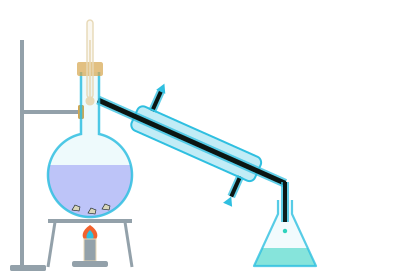
      Simple and fractional distillation, the way palm wine becomes ogogoro, in the Label lab.
      9

      The League's test

      Pass the League's test

      Six exam-style questions from the League. Get all six right to earn your stamp. Three wrong and you resit.

      The League's badge

      League test · Alcohols, acids and esters

      You: ♥♥♥

      Press Start when you're ready.

      Remember it

      Tap a card to flip it. Say the answer before you flip.

      Kay:That's alcohols, acids and esters. Next time Grandpa's palm wine goes sour I'll tell him it's been oxidised. Ash says I should tell him from a distance.
      Alcohols, acids and esters: Chemistry explained, with games · L.O.E.P