15 wks to JAMB

L.O.E.P · ChemistryNo. 03

Explainer · Acids, bases and salts · about 19 min

Why does an antacid tablet stop heartburn?

Watch the lecture

Ash and Kay teach this lesson, start to finish.

⬇ Save for offline

Keeps it on this phone, so it plays with no signal and no data, at this same address.

In short

The key words in this lesson, in plain English:

Acid:
A substance with a pH below 7 that releases hydrogen ions in water. Strong acids are corrosive; the stomach uses hydrochloric acid to digest food.
Salt (in chemistry):
The compound formed when the hydrogen of an acid is replaced by a metal or ammonium ion, as when an acid neutralises a base: sodium chloride, copper(II) sulfate.
Alkali:
A base that dissolves in water, giving hydroxide ions, such as sodium hydroxide. Alkalis turn red litmus blue and have pH above 7.
pH:
A scale from 0 to 14 for how acidic or alkaline a solution is: below 7 acidic, 7 neutral, above 7 alkaline.

Free this month: 1 of 1 lessons. A free account gives you 3 a month.

Heartburn is your own stomach acid (hydrochloric acid) creeping up where it shouldn't. Chew an antacid tablet and the burning stops in minutes. The tablet is a base: it reacts with the acid and cancels it out. That reaction, neutralisation, is the heart of this whole topic.

Kay:My stomach makes hydrochloric acid. On purpose. Ash says that's normal. I'm still not comfortable about it.
1

Play · kitchen detective

Acid, alkali or neutral?

The definitions

Where you see it: lime juice and vinegar taste sour because they release hydrogen ChemistryIonAn atom or group of atoms with an electric charge, formed by losing electrons (positive cation) or gaining them (negative anion).Sports drinks replace sodium and potassium ions lost in sweat.Science dictionary ▶ in water, while the water drained through wood ash for making local black soap is ChemistryAlkaliA base that dissolves in water, giving hydroxide ions, such as sodium hydroxide. Alkalis turn red litmus blue and have pH above 7.Caustic soda used in soap-making is a strong alkali.Science dictionary ▶: it gives hydroxide ions in water. An ChemistryAcidA substance with a pH below 7 that releases hydrogen ions in water. Strong acids are corrosive; the stomach uses hydrochloric acid to digest food.Acids turn blue litmus paper red.Science dictionary ▶ produces hydrogen ions (H⁺, really H₃O⁺, the hydroxonium ion) in water. A base ChemistryNeutralisationThe reaction between an acid and a base that produces a salt and water, cancelling out the acid.Acid + base → salt + water.Science dictionary ▶ an acid to give a ChemistrySalt (in chemistry)The compound formed when the hydrogen of an acid is replaced by a metal or ammonium ion, as when an acid neutralises a base: sodium chloride, copper(II) sulfate.Science dictionary ▶ and water; a base that dissolves in water is an alkali, and it produces hydroxide ions (OH⁻). In the newer view, an acid is a ChemistryProtonA positively charged particle in the nucleus of every atom. The number of protons is the atomic number and decides the element.Every carbon atom has 6 protons; every gold atom has 79.Science dictionary ▶ donor and a base is a proton acceptor. An ChemistryIndicatorA dye whose colour shows whether a solution is acidic or alkaline. Litmus turns red in acid and blue in alkali; universal indicator shows the whole pH scale.Science dictionary ▶ changes colour to show which you have.

Pick a liquid, add an indicator, then call it

Pick a liquid
Solved0 / 8

The three indicators

Where you see it: the deep red of zobo comes from a natural ChemistryIndicatorA dye whose colour shows whether a solution is acidic or alkaline. Litmus turns red in acid and blue in alkali; universal indicator shows the whole pH scale.Science dictionary ▶ in dried hibiscus flowers: the drink is red because it is ChemistryAcidA substance with a pH below 7 that releases hydrogen ions in water. Strong acids are corrosive; the stomach uses hydrochloric acid to digest food.Acids turn blue litmus paper red.Science dictionary ▶, and stirring in an ChemistryAlkaliA base that dissolves in water, giving hydroxide ions, such as sodium hydroxide. Alkalis turn red litmus blue and have pH above 7.Caustic soda used in soap-making is a strong alkali.Science dictionary ▶ such as baking soda changes the colour. Litmus: red in acid, blue in alkali. Methyl orange: red in acid, yellow in alkali (and already yellow in pure water). Phenolphthalein: colourless in acid and in pure water, pink in alkali.
Ash:Zobo works as an indicator too: add baking soda to it and the red turns greenish. The colour comes from the hibiscus. Don't drink the experiment.
2

Play · place it

The pH scale

pH

Where you see it: farmers test the ChemistrypHA scale from 0 to 14 for how acidic or alkaline a solution is: below 7 acidic, 7 neutral, above 7 alkaline.Farmers test soil pH before adding lime to acidic soil.Science dictionary ▶ of their soil before planting; when it is too ChemistryAcidA substance with a pH below 7 that releases hydrogen ions in water. Strong acids are corrosive; the stomach uses hydrochloric acid to digest food.Acids turn blue litmus paper red.Science dictionary ▶, spreading agricultural lime raises the pH so crops such as maize grow better. pH runs from 0 to 14. Below 7 is acidic, 7 is neutral, above 7 is ChemistryAlkaliA base that dissolves in water, giving hydroxide ions, such as sodium hydroxide. Alkalis turn red litmus blue and have pH above 7.Caustic soda used in soap-making is a strong alkali.Science dictionary ▶. Each step down is ten times more H⁺: pH 3 is ten times as acidic as pH 4. Precisely, pH = −log[H⁺], so [H⁺] = 1 × 10⁻⁵ ChemistryMoleThe amount of substance containing 6.02 × 10^23 particles (Avogadro's number). One mole's mass in grams equals the relative formula mass.18 g of water, about a tablespoon, is one mole of water molecules.Science dictionary ▶ dm⁻³ means pH 5. ChemistryIndicatorA dye whose colour shows whether a solution is acidic or alkaline. Litmus turns red in acid and blue in alkali; universal indicator shows the whole pH scale.Science dictionary ▶ shows the whole range in colours.

Drag each one onto its part of the scale

Very acidicpH 0–3
Slightly acidicpH 4–6
NeutralpH 7
Slightly alkalinepH 8–10
Very alkalinepH 11–14
3

Play · arcade

Strong or weak?

Two acids of exactly the same concentration, each wired to a bulb. Why does one glow so much brighter?

H⁺Cl⁻H⁺Cl⁻H⁺Cl⁻H⁺Cl⁻H⁺Cl⁻H⁺Cl⁻HYDROCHLORIC (STRONG)HAHAHAHAH⁺A⁻HAETHANOIC ACID (WEAK)

Strength is not concentration

Where you see it: kitchen vinegar is a dilute solution of a ChemistryStrong and weak acidsA strong acid ionises completely in water (hydrochloric, sulfuric, nitric); a weak acid only partly (ethanoic, citric). Strength is not the same as concentration.Science dictionary ▶, ChemistryAlkanoic acidsWeak organic acids with the −COOH (carboxyl) group: methanoic acid (ant stings), ethanoic acid (vinegar). They turn blue litmus red, neutralise alkalis and fizz with carbonates.Science dictionary ▶, while the ChemistryAcidA substance with a pH below 7 that releases hydrogen ions in water. Strong acids are corrosive; the stomach uses hydrochloric acid to digest food.Acids turn blue litmus paper red.Science dictionary ▶ in a ChemistryLead-acid accumulatorThe car battery: lead and lead(IV) oxide plates in dilute sulphuric acid. It is a secondary cell: passing a current back through it reverses the reaction and recharges it.Science dictionary ▶ is sulphuric acid, a strong acid that ionises completely, which is why it conducts so well inside the battery. A strong acid or ChemistryAlkaliA base that dissolves in water, giving hydroxide ions, such as sodium hydroxide. Alkalis turn red litmus blue and have pH above 7.Caustic soda used in soap-making is a strong alkali.Science dictionary ▶ ionises completely in water: every HCl molecule splits into H⁺ and Cl⁻, so it's full of ChemistryIonAn atom or group of atoms with an electric charge, formed by losing electrons (positive cation) or gaining them (negative anion).Sports drinks replace sodium and potassium ions lost in sweat.Science dictionary ▶ and conducts well. A weak one ionises only partly: most ethanoic acid molecules stay whole. ChemistryConcentrationHow much solute is dissolved in each cubic decimetre of solution: moles ÷ volume in dm³ (mol/dm³), or grams per dm³.Science dictionary ▶ is something else: how much acid is dissolved in each dm³. You can have a dilute strong acid or a concentrated weak one.

Press Start

Swipe left for strong, right for weak

Score0Streak0Lives♥♥♥
4

Play · the salt factory

Making salts

Three ways to make a salt

Where you see it: the white scale inside a kettle is ChemistryCalciumA metal element (Ca) that our bones and teeth are built from. We get it from milk, beans and green vegetables.Chalk and limestone are calcium carbonate.Science dictionary ▶ carbonate; soak it in vinegar and it fizzes away as the ChemistryAcidA substance with a pH below 7 that releases hydrogen ions in water. Strong acids are corrosive; the stomach uses hydrochloric acid to digest food.Acids turn blue litmus paper red.Science dictionary ▶ turns it into a soluble ChemistrySalt (in chemistry)The compound formed when the hydrogen of an acid is replaced by a metal or ammonium ion, as when an acid neutralises a base: sodium chloride, copper(II) sulfate.Science dictionary ▶, water and carbon dioxide. A salt forms when the hydrogen of an acid is replaced by a metal (or ammonium). Acid + base → salt + water. Acid + metal → salt + hydrogen. Acid + carbonate → salt + water + carbon dioxide. The acid names the salt: hydrochloric gives chlorides, sulphuric gives sulphates, nitric gives nitrates.

Press Next order

acid + ?
Orders filled0 / 5
Kay:Table salt is just one salt out of thousands. Ash says "salt" in chemistry is like "car": there's a lot of them, and most of them you shouldn't eat.
5

Ash's lab

The titration

The flask holds 25.0 cm³ of sodium hydroxide (0.200 mol dm⁻³) with phenolphthalein, so it's pink. Run in the acid until the pink just disappears: that's the end point. Go too far and you've overshot.

Hold the tap open, then slow down

01020304050BURETTE: HCl(concentration unknown)25.0 cm³ NaOH0.200 mol dm⁻³+ phenolphthalein
Acid added0.00 cm³Flaskpink
Ash:Swirl the flask after every drop, and read the burette at eye level, at the bottom of the meniscus. Do it three times and average the ones that agree.
6

Work it out

What was the acid's concentration?

The end point came at 20.0 cm³ of acid. Work out the acid's concentration with Ash, one step at a time.

Step 1

    The titration recipe

    ChemistryMoleThe amount of substance containing 6.02 × 10^23 particles (Avogadro's number). One mole's mass in grams equals the relative formula mass.18 g of water, about a tablespoon, is one mole of water molecules.Science dictionary ▶ = ChemistryConcentrationHow much solute is dissolved in each cubic decimetre of solution: moles ÷ volume in dm³ (mol/dm³), or grams per dm³.Science dictionary ▶ × volume (in dm³). Find the moles of the substance you know, use the mole ratio from the balanced equation, then divide by the other volume. Watch the ratio: sulphuric ChemistryAcidA substance with a pH below 7 that releases hydrogen ions in water. Strong acids are corrosive; the stomach uses hydrochloric acid to digest food.Acids turn blue litmus paper red.Science dictionary ▶, H₂SO₄, has a ChemistryBasicityThe number of replaceable hydrogen ions in one molecule of an acid: HCl is monobasic, H₂SO₄ dibasic, H₃PO₄ tribasic.Science dictionary ▶ of 2, so it needs two NaOH for every one H₂SO₄.
    7

    Play · sort it

    Salts in water

    Salt hydrolysis

    Where you see it: washing soda, sodium carbonate, dissolved in a laundry bucket gives an ChemistryAlkaliA base that dissolves in water, giving hydroxide ions, such as sodium hydroxide. Alkalis turn red litmus blue and have pH above 7.Caustic soda used in soap-making is a strong alkali.Science dictionary ▶ solution that helps lift grease from clothes, because it is the ChemistrySalt (in chemistry)The compound formed when the hydrogen of an acid is replaced by a metal or ammonium ion, as when an acid neutralises a base: sodium chloride, copper(II) sulfate.Science dictionary ▶ of a ChemistryStrong and weak acidsA strong acid ionises completely in water (hydrochloric, sulfuric, nitric); a weak acid only partly (ethanoic, citric). Strength is not the same as concentration.Science dictionary ▶ and a strong base. Not every salt solution is neutral. A salt of a strong acid and a weak base (ammonium chloride) reacts with water to make the solution ChemistryAcidA substance with a pH below 7 that releases hydrogen ions in water. Strong acids are corrosive; the stomach uses hydrochloric acid to digest food.Acids turn blue litmus paper red.Science dictionary ▶. A salt of a weak acid and a strong base (sodium carbonate) makes it alkaline. A salt of a strong acid and a strong base (sodium chloride) stays neutral. Salts are also normal (all the acid's hydrogen replaced: NaCl), acid salts (some left: NaHSO₄, NaHCO₃) or basic salts (some hydroxide left: Mg(OH)Cl).

    Drag each salt to how its solution turns out

    Acidic
    Neutral
    Alkaline
    8

    Play · work it out

    pH, pOH and [OH⁻]

    Hydrogen ions, hydroxide ions and the two scales that measure them, with fresh numbers each time. Get 5.

    Press Next

    Right0 / 5

    pOH, and why pH + pOH = 14

    Water ionises very slightly: H₂O ⇌ H⁺ + OH⁻. At 25 °C, [H⁺] × [OH⁻] = 1 × 10⁻¹⁴ (the ChemistrypOHpOH = −log[OH⁻]. At 25 °C, [H⁺][OH⁻] = 1 × 10⁻¹⁴ (the ionic product of water), so pH + pOH = 14: a solution of pH 4 has pOH 10.Science dictionary ▶, Kw) in every water solution, ChemistryAcidA substance with a pH below 7 that releases hydrogen ions in water. Strong acids are corrosive; the stomach uses hydrochloric acid to digest food.Acids turn blue litmus paper red.Science dictionary ▶ or ChemistryAlkaliA base that dissolves in water, giving hydroxide ions, such as sodium hydroxide. Alkalis turn red litmus blue and have pH above 7.Caustic soda used in soap-making is a strong alkali.Science dictionary ▶. Pure water has 1 × 10⁻⁷ of each: ChemistrypHA scale from 0 to 14 for how acidic or alkaline a solution is: below 7 acidic, 7 neutral, above 7 alkaline.Farmers test soil pH before adding lime to acidic soil.Science dictionary ▶ 7. Just as pH = −log[H⁺], pOH = −log[OH⁻], and taking logs of Kw gives pH + pOH = 14. So a solution of pH 4 has pOH 10 and [OH⁻] = 1 × 10⁻¹⁰ ChemistryMoleThe amount of substance containing 6.02 × 10^23 particles (Avogadro's number). One mole's mass in grams equals the relative formula mass.18 g of water, about a tablespoon, is one mole of water molecules.Science dictionary ▶ dm⁻³. For a ChemistryStrong and weak acidsA strong acid ionises completely in water (hydrochloric, sulfuric, nitric); a weak acid only partly (ethanoic, citric). Strength is not the same as concentration.Science dictionary ▶, [H⁺] is its ChemistryConcentrationHow much solute is dissolved in each cubic decimetre of solution: moles ÷ volume in dm³ (mol/dm³), or grams per dm³.Science dictionary ▶ (times its ChemistryBasicityThe number of replaceable hydrogen ions in one molecule of an acid: HCl is monobasic, H₂SO₄ dibasic, H₃PO₄ tribasic.Science dictionary ▶ for H₂SO₄): 0.01 mol dm⁻³ HCl has pH 2. For a strong alkali, find pOH first: 0.001 mol dm⁻³ NaOH has pOH 3, so pH 11. With logs: −log(0.02) = 1.70. Diluting a strong acid ten times raises its pH by one.
    9

    Play · drop by drop

    Buffer solutions

    Two beakers: pure water, and a buffer. Add a few drops of acid, a few of alkali, then pour in a flood of acid and see what finally beats the buffer.

    Add a drop

    Water pH7.00Buffer pH4.76

    How a buffer works

    Where you see it: your blood is a ChemistryBuffer solutionA solution that keeps its pH almost unchanged when a little acid or alkali is added: a weak acid with one of its salts (ethanoic acid + sodium ethanoate) or a weak base with one of its salts (ammonia + ammonium chloride).Science dictionary ▶: carbonic ChemistryAcidA substance with a pH below 7 that releases hydrogen ions in water. Strong acids are corrosive; the stomach uses hydrochloric acid to digest food.Acids turn blue litmus paper red.Science dictionary ▶ and hydrogencarbonate ChemistryIonAn atom or group of atoms with an electric charge, formed by losing electrons (positive cation) or gaining them (negative anion).Sports drinks replace sodium and potassium ions lost in sweat.Science dictionary ▶ hold it close to ChemistrypHA scale from 0 to 14 for how acidic or alkaline a solution is: below 7 acidic, 7 neutral, above 7 alkaline.Farmers test soil pH before adding lime to acidic soil.Science dictionary ▶ 7.4, which is why drinking a sour soft drink does not make your blood acidic. A buffer solution keeps its pH almost the same when a small amount of acid or ChemistryAlkaliA base that dissolves in water, giving hydroxide ions, such as sodium hydroxide. Alkalis turn red litmus blue and have pH above 7.Caustic soda used in soap-making is a strong alkali.Science dictionary ▶ is added, or when it is diluted. It is a ChemistryStrong and weak acidsA strong acid ionises completely in water (hydrochloric, sulfuric, nitric); a weak acid only partly (ethanoic, citric). Strength is not the same as concentration.Science dictionary ▶ with one of its ChemistrySalt (in chemistry)The compound formed when the hydrogen of an acid is replaced by a metal or ammonium ion, as when an acid neutralises a base: sodium chloride, copper(II) sulfate.Science dictionary ▶ (ChemistryAlkanoic acidsWeak organic acids with the −COOH (carboxyl) group: methanoic acid (ant stings), ethanoic acid (vinegar). They turn blue litmus red, neutralise alkalis and fizz with carbonates.Science dictionary ▶ + sodium ethanoate, pH about 4.8) or a weak base with one of its salts (ammonia + ammonium chloride, pH about 9.2). Added H⁺ is mopped up by the salt's ion: CH₃COO⁻ + H⁺ → CH₃COOH. Added OH⁻ is mopped up by the weak acid: CH₃COOH + OH⁻ → CH₃COO⁻ + H₂O. Pure water has nothing to do this, so one drop of acid drops its pH by about three units. A buffer isn't magic: add more acid than it has salt to mop it up and the pH crashes. Blood is buffered at pH 7.4; buffers also calibrate pH meters and keep shampoos and medicines at the right pH.
    10

    Exam corner

    How the exam asks it

    The trap is the mole ratio. Tap each step to reveal it.

    20.0 cm³ of 0.10 mol dm⁻³ H₂SO₄ exactly neutralises 25.0 cm³ of NaOH. What is the concentration of the NaOH?

    Now try the real ones

    Real JAMB, WAEC and NECO past questions on this lesson (the JAMB and WAEC ones in LOEP's words). Answer them one at a time: each is marked, with the worked answer.

    Start the 10 real questions ▶
    1. JAMB 2023Which property is typical of acids?
    2. WAEC 2021Ada titrates 25 cm³ of sodium carbonate solution with 0.1 mol dm⁻³ HCl using methyl orange. Bola repeats it with phenolphthalein. Which statement is true?
    3. JAMB 2023Distilled water is added to a beaker of dilute hydrochloric acid. What happens to the pH of the acid?
    4. WAEC 2020A technician dilutes 20 cm³ of a concentrated acid with water to a final volume of 500 cm³. What is the dilution factor?
    5. JAMB 2023Which statement describes a strong electrolyte such as sodium hydroxide solution?
    6. WAEC 2021Dilute sulphuric acid is added to a colourless solution of lead(II) trioxonitrate(V). What is observed?
    7. JAMB 2021Sodium carbonate dissolves in water to give an alkaline solution because its ions react slightly with water molecules. This reaction is called?
    8. WAEC 2016A student tests four salt solutions with blue litmus paper. Which solution will turn the paper red?
    9. JAMB 2023A student dips blue litmus paper into lime juice and it turns red. What does this show?
    10. JAMB 2020A few drops of concentrated hydrochloric acid are added to 10 cm³ of a solution with pH 5.2. The pH of the resulting mixture will be

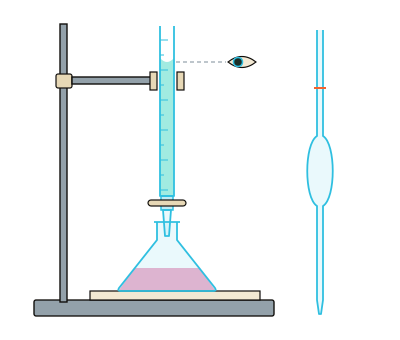
    Label it

    The titration set-up, in the Label lab.
    11

    The League's test

    Pass the League's test

    Six exam-style questions from the League. Get all six right to earn your stamp. Three wrong and you resit.

    The League's badge

    League test · Acids, bases and salts

    You: ♥♥♥

    Press Start when you're ready.

    Remember it

    Tap a card to flip it. Say the answer before you flip.

    Kay:That's acids, bases and salts. Next time you have heartburn, you'll know you're running a neutralisation. Bring the antacid anyway.
    Acids, bases and salts: Chemistry explained, with games · L.O.E.P


