15 wks to JAMB

L.O.E.P · BiologyNo. 02

Explainer · Living things and the cell · about 15 min

You're about 30 trillion cells. How did one cell become all of you?

Watch the lecture

Ash and Kay teach this lesson, start to finish.

⬇ Save for offline

Keeps it on this phone, so it plays with no signal and no data, at this same address.

In short

The key words in this lesson, in plain English:

Diffusion:
The spreading of particles from where they are more concentrated to where they are less concentrated, until evenly spread. It needs no energy.
Osmosis:
The movement of water from a dilute solution to a more concentrated one through a selectively permeable membrane.

Free this month: 1 of 1 lessons. A free account gives you 3 a month.

You are made of about 30 trillion cells. Skin cells, nerve cells, blood cells, each one alive on its own, each doing a job. And every one of them came from a single cell: the one you started as.

Kay:30 trillion of me, working together. Ash says most of them do more work than I do.
1

Play · arcade

Alive or not?

Seven signs of life: MRS GREN

Every living thing shows all seven: Movement, Respiration (releasing energy from food), Sensitivity (responding to changes), Growth, Reproduction, Excretion (getting rid of waste made inside it) and Nutrition. And every living thing is made of cells. Something that shows only some of them isn't alive.

Press Start

Swipe left for living, right for non-living

Score0Streak0Lives♥♥♥
Ash:A car moves, takes in fuel, burns it and gives out waste gases. But it doesn't grow, it can't make baby cars, and it isn't made of cells. Not alive. Kay's minivan included.
2

Play · sort it

Plant, animal, or both?

Plant cells and animal cells share most of their parts. Drag each part to where it belongs.

Drag each part into a box (or tap it, then the box)

Plant cells only
Both
Animal cells only
3

Play · find it

Inside a plant cell

Ash names a job; tap the part that does it. First tap counts.

Tap Start for Ash's first question

CELL WALLCELL MEMBRANECYTOPLASMVACUOLENUCLEUSCHLOROPLASTMITOCHONDRIONRIBOSOMES
Found0 / 8First try0

Two kinds of cell

Where you see it: the BiologyBacteriumA tiny single-celled organism with no true nucleus. Some cause disease (cholera, typhoid); many are useful, making yoghurt, fixing nitrogen and rotting dead matter.Science dictionary ▶ that turn milk into yoghurt are BiologyProkaryoteA cell or organism with no true nucleus and no membrane-bound organelles, such as a bacterium.The bacteria that turn milk into yoghurt are prokaryotes.Science dictionary ▶, while the yeast that makes bread dough rise is a BiologyEukaryoteA cell or organism whose cells have a true nucleus and membrane-bound organelles: plants, animals, fungi and protists.You, a mango tree and a mushroom are all eukaryotes.Science dictionary ▶ with a true BiologyNucleusA centre. In an atom, the tiny dense core of protons and neutrons that holds nearly all its mass. In a cell, the part that holds the chromosomes and controls the cell.Science dictionary ▶. Prokaryotic cells (bacteria) have no true nucleus and no membrane-bound organelles: their BiologyDNAThe double-helix molecule that carries hereditary information. Its bases pair A with T and G with C, so it can copy itself.DNA tests used in hospitals and courts read the order of these bases.Science dictionary ▶ lies loose in the cytoplasm. Eukaryotic cells (plants, animals, BiologyFungusAn organism with no chlorophyll that feeds by absorbing food from dead or living matter. Bodies of thread-like hyphae; includes moulds, mushrooms and yeast.Science dictionary ▶, BiologyProtistA single-celled organism with a nucleus, in the kingdom Protista: Amoeba (moves by pseudopodia), Paramecium (cilia) and Euglena (a flagellum and chloroplasts).Science dictionary ▶) have a nucleus wrapped in a membrane, and organelles like BiologyMitochondrionThe organelle where most of the energy from aerobic respiration is released as ATP: the cell's powerhouse.Muscle and liver cells, which need lots of energy, have many mitochondria.Science dictionary ▶.
4

Play · the microscope

Seeing cells

In 1665, Robert Hooke looked at a thin slice of cork and saw tiny empty boxes. He called them cells, after the small rooms monks lived in. Focus the microscope on three specimens at the highest power.

Pick a specimen, choose ×400, then focus

× 40
ImageblurrySpecimens0 / 3

Who found what

Hooke (1665) saw and named cells in cork. Leeuwenhoek (1670s) saw living microbes with his own PhysicsLensA curved piece of glass or plastic that bends light to focus it, as in glasses, cameras and your eye.Convex lenses bring light together; concave lenses spread it out.Science dictionary ▶. Robert Brown (1831) described the BiologyNucleusA centre. In an atom, the tiny dense core of protons and neutrons that holds nearly all its mass. In a cell, the part that holds the chromosomes and controls the cell.Science dictionary ▶. Dujardin (1835) described the living jelly inside cells. Schleiden and Schwann (1838–39) said all plants and animals are made of cells. Virchow (1855): all cells come from cells. Together that's the cell theory.
5

Play · build up

From cell to you

Put them in order, smallest and simplest first.

Drag each one into its place in the order

  1. 1?
  2. 2?
  3. 3?
  4. 4?
  5. 5?

Levels of organisation

Where you see it: at the meat market, a goat's heart or liver sold whole is an organ built from several tissues, while lean meat is mostly one tissue: muscle. Cell → tissue → organ → system → organism. A tissue is a group of similar cells doing one job; an organ is several tissues working together; a system is organs working together. A unicellular organism, like BiologyProtistA single-celled organism with a nucleus, in the kingdom Protista: Amoeba (moves by pseudopodia), Paramecium (cilia) and Euglena (a flagellum and chloroplasts).Science dictionary ▶, is all of this in one cell. BiologyCnidarians (coelenterates)Water animals with a body wall of two cell layers, a ring of tentacles with stinging cells, and radial symmetry: Hydra, jellyfish, sea anemones, corals.Science dictionary ▶ stops at tissues: it has no true organs.
6

Ash's lab

Into the solution

Put a cell into a solution, predict what happens, then watch.

Pick a cell and a solution

→←Pick a cell and a solution
Right0 / 4

Diffusion, osmosis, active transport

Where you see it: the smell of frying akara spreads through the whole ChemistryCompoundTwo or more elements chemically joined in a fixed ratio, with properties different from the elements, such as water (H2O) or salt (NaCl).Poisonous chlorine and reactive sodium combine into the salt you eat.Science dictionary ▶ by BiologyDiffusionThe spreading of particles from where they are more concentrated to where they are less concentrated, until evenly spread. It needs no energy.The smell of fried plantain fills the whole house by diffusion.Science dictionary ▶, and ChemistrySalt (in chemistry)The compound formed when the hydrogen of an acid is replaced by a metal or ammonium ion, as when an acid neutralises a base: sodium chloride, copper(II) sulfate.Science dictionary ▶ sprinkled on sliced cabbage draws water out of its cells by BiologyOsmosisThe movement of water from a dilute solution to a more concentrated one through a selectively permeable membrane.Salt sprinkled on sliced garden egg draws water out of its cells by osmosis.Science dictionary ▶. Diffusion: PhysicsParticleA tiny piece of matter or energy, such as an atom, an electron or a photon.Light can behave like a stream of particles.Science dictionary ▶ spread from where they're more concentrated to where they're less. Osmosis: water moves through a partially permeable membrane from a dilute solution to a more concentrated one. Active transport: the cell uses energy from BiologyRespirationThe breakdown of food (glucose) in every living cell to release energy. Aerobic respiration uses oxygen; anaerobic respiration does not.Breathing is not respiration: breathing brings in the oxygen that respiration in your cells uses.Science dictionary ▶ to move substances the other way, against the ChemistryConcentrationHow much solute is dissolved in each cubic decimetre of solution: moles ÷ volume in dm³ (mol/dm³), or grams per dm³.Science dictionary ▶ gradient (root hairs taking in minerals).
Ash:A plant cell can't burst: its wall pushes back, and the cell goes firm, or turgid. A red blood cell has no wall, so in pure water it swells and bursts. That's why drips in hospital are salty, not plain water.
7

Play · arcade

Diffusion or osmosis?

Press Start

Swipe left for diffusion, right for osmosis

Score0Streak0Lives♥♥♥
Kay:The trick: osmosis is always water, always through a membrane. If it isn't water, it isn't osmosis. Ash made me write that on my hand.
8

Exam corner

How the exam asks it

The potato strip experiment. Tap each step to reveal it.

Three equal potato strips sit for an hour in pure water, in a weak sugar solution and in a strong sugar solution. The first grows longer, the second stays the same, the third gets shorter. Explain.

Now try the real ones

Real JAMB, WAEC and NECO past questions on this lesson (the JAMB and WAEC ones in LOEP's words). Answer them one at a time: each is marked, with the worked answer.

Start the 10 real questions ▶
  1. JAMB 2023Irritability in a living organism is the ability to
  2. NECO 2001Which scientist did NOT contribute to the formulation of the cell theory?
  3. JAMB 2023The membrane that surrounds the vacuole of a plant cell is called the
  4. WAEC 2019Which of the following is an organ?
  5. JAMB 2023Which sequence correctly shows levels of organisation from smallest to largest?
  6. WAEC 1994In 1665 a scientist looked at a thin slice of cork under his microscope and saw tiny box-like compartments, which he named cells. Who was he?
  7. JAMB 2021A marine fish placed in a tank of fresh water soon dies. The reason is that
  8. WAEC 2020Which cell structure is a system of membrane-bound channels that carries materials through the cytoplasm?
  9. JAMB 2019Which process is carried out by every living organism?
  10. JAMB 2022Which mature human cell has no nucleus?

Label it

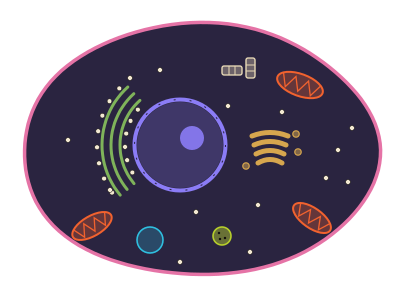
The animal cell and the plant cell, in the Label lab.
9

The League's test

Pass the League's test

Six exam-style questions from the League. Get all six right to earn your stamp. Three wrong and you resit.

The League's badge

League test · The cell

You: ♥♥♥

Press Start when you're ready.

Remember it

Tap a card to flip it. Say the answer before you flip.

Kay:That's the cell. 30 trillion of them reading this right now. Tell them thank you.
Living things and the cell: Biology explained, with games · L.O.E.P