15 wks to JAMB

L.O.E.P · BiologyNo. 18

Explainer · Support and movement · about 15 min

You lift a full bucket from the well and your arm bends. A muscle can only pull, so what lets it down again?


Watch the lecture

Ash and Kay teach this lesson, start to finish.

⬇ Save for offline

Keeps it on this phone, so it plays with no signal and no data, at this same address.

In short

The key words in this lesson, in plain English:

Arthropods:
The biggest animal phylum: jointed legs, a segmented body and a hard outer skeleton of chitin, shed as they grow. Insects, arachnids, crustaceans and myriapods.
Exoskeleton and endoskeleton:
An exoskeleton is a hard outer covering (chitin in insects) that must be moulted to grow; an endoskeleton is inside the body (bone and cartilage in vertebrates); a hydrostatic skeleton is fluid under pressure (earthworms).
Synovial joint:
A freely movable joint: the bone ends are capped with cartilage and enclosed in a capsule of synovial fluid, held by ligaments. Hinge joints (elbow, knee) move in one plane; ball-and-socket joints (shoulder, hip) in all directions.
Antagonistic muscles:
Muscles that work in pairs, pulling a bone in opposite directions, because a muscle can only contract and pull. The biceps bends the arm (flexor); the triceps straightens it (extensor).

Free this month: 1 of 1 lessons. A free account gives you 3 a month.

Lift a full bucket of water from the well. Your arm bends at the elbow and the bucket comes up. Something pulled it: a muscle, shortening. But a muscle can only pull, never push, so what lowers the bucket again, slowly instead of letting it crash down? And what stops your arm bending backwards, or your skull from wobbling? Every animal needs something to hold its shape, protect its soft insides and give its muscles something to pull on: a skeleton. Plants stand up too, with no bones at all.

Kay:So when I put the bucket down, a different muscle is doing that?
1

Play · quick rounds

Exoskeleton, endoskeleton or hydrostatic skeleton?

Press Next

Five right to pass.

Right0 / 5

Skeletons

Where you see it: at the fish market, crabs and prawns are sold in their hard outer shells, while the fish beside them carry their bones inside the body. A skeleton supports the body and gives it shape, protects delicate organs (the skull round the brain, the ribs round the heart and lungs), and gives muscles something to pull on for movement; bone also stores ChemistryCalciumA metal element (Ca) that our bones and teeth are built from. We get it from milk, beans and green vegetables.Chalk and limestone are calcium carbonate.Science dictionary ▶ and makes blood cells in its marrow. There are three kinds. An BiologyArthropodsThe biggest animal phylum: jointed legs, a segmented body and a hard outer skeleton of chitin, shed as they grow. Insects, arachnids, crustaceans and myriapods.Science dictionary ▶ is a hard outer covering, made of chitin in BiologyInsectsArthropods with three body parts (head, thorax, abdomen), three pairs of legs on the thorax, one pair of antennae and usually wings: housefly, mosquito, cockroach, grasshopper.Science dictionary ▶, spiders and crabs: it can't grow, so the animal must moult (BiologyExoskeleton and endoskeletonAn exoskeleton is a hard outer covering (chitin in insects) that must be moulted to grow; an endoskeleton is inside the body (bone and cartilage in vertebrates); a hydrostatic skeleton is fluid under pressure (earthworms).All support the body, protect soft organs and give muscles something to pull on.Science dictionary ▶) to get bigger. An endoskeleton is inside the body, made of bone and cartilage in BiologyVertebrates and invertebratesVertebrates have a backbone (vertebral column): fish, amphibians, reptiles, birds, mammals, in the phylum Chordata. Invertebrates have none: sponges, worms, molluscs, arthropods and the rest.Science dictionary ▶, and grows with the animal. A hydrostatic skeleton is fluid under PhysicsPressureHow hard a force presses on each square metre of a surface: pressure = force ÷ area, measured in pascals (Pa).A sharp knife cuts because its thin edge puts the force on a tiny area. Tractors and camels have wide tyres or feet so they don't sink.Science dictionary ▶ inside the body, pushed on by muscles: earthworms and other soft-bodied animals.
2

Play · sort the bones

Axial and appendicular

The mammal skeleton has two parts. As each bone lights up, say which part it belongs to. Get eight right.

Press Next

–

Right0 / 8

The mammalian skeleton

Where you see it: at the butcher's stall, a cow is cut up by its parts, the head, neck, ribs, shoulder and legs, and each cut is built round a different bone. The BiologyAxial and appendicular skeletonTwo parts of a vertebrate skeleton: the central column of skull, vertebral column, ribs and sternum (axial), and the limbs with the girdles that join them to it (appendicular).The pectoral girdle is the scapula and clavicle; the pelvic girdle is the hip bones.Science dictionary ▶ is the central column: the skull, the BiologyVertebrates and invertebratesVertebrates have a backbone (vertebral column): fish, amphibians, reptiles, birds, mammals, in the phylum Chordata. Invertebrates have none: sponges, worms, molluscs, arthropods and the rest.Science dictionary ▶ (backbone), the ribs and the sternum (breastbone). The appendicular skeleton is the limbs and the girdles that join them to the axial skeleton: the pectoral girdle (scapula, the shoulder blade, and clavicle, the collar bone) with the arms (humerus, radius and ulna), and the pelvic girdle with the legs (femur, tibia and fibula). The vertebral column is a chain of vertebrae: cervical in the neck, thoracic carrying the ribs, then lumbar, sacral and caudal.
3

Play · move the joints

Joints

Move each joint as far as it will go, then name the kind of joint it is. Name four.

Choose a joint

Named0 / 4

Types of joint

Where you see it: a carpenter hangs a door on hinges so it swings one way only, as your knee bends, while the ball-and-socket hip lets a footballer swing a leg in many directions. A joint is where two bones meet. Fixed (immovable) joints allow no movement: the sutures between the skull bones. Slightly movable ones allow a little: between the vertebrae, cushioned by discs of cartilage. Freely movable (synovial) joints come in kinds: the hinge joint (elbow, knee) moves in one plane, like a door; the ball-and-socket joint (shoulder, hip) moves in all directions and rotates; the PhysicsMoment of a forceThe turning effect of a force: force × its distance from the pivot. Something balances when the clockwise and anticlockwise moments are equal.A door handle sits far from the hinges so a small push turns it. A seesaw balances a light child far out against a heavy one close in.Science dictionary ▶ joint (atlas on axis, at the top of the neck) lets one bone rotate on another, as when you shake your head; the gliding joint (wrist and ankle bones) lets flat surfaces slide over each other.
4

Ash's lab

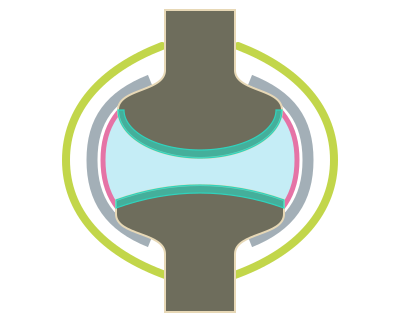
Inside a synovial joint

Tap each part of the knee joint to find out its job. Then see what happens when the cartilage wears away.

Tap a part

Parts0 / 4

The synovial joint

Where you see it: older patients at a clinic often have stiff, painful knees, and doctors may explain that the smooth cartilage capping the bones in the joint has worn thin. In a freely movable joint the ends of the bones are capped with smooth, slippery cartilage, which reduces PhysicsFrictionA force that opposes the sliding of surfaces in contact. It lets us walk and brake, but wastes energy as heat in machines.Worn tyres on a wet road have too little friction to stop safely.Science dictionary ▶ and absorbs shocks. The joint is enclosed in a capsule lined by the BiologySynovial jointA freely movable joint: the bone ends are capped with cartilage and enclosed in a capsule of synovial fluid, held by ligaments. Hinge joints (elbow, knee) move in one plane; ball-and-socket joints (shoulder, hip) in all directions.Cartilage and synovial fluid cut friction; when the cartilage wears away, it's arthritis.Science dictionary ▶, which secretes synovial fluid to lubricate it, like oil in an engine. Tough, slightly elastic BiologyLigaments and tendonsA ligament joins bone to bone at a joint and is slightly elastic. A tendon joins muscle to bone and doesn't stretch.So a tendon passes the muscle's whole pull on to the bone.Science dictionary ▶ hold bone to bone and stop the joint dislocating. Muscles are joined to bones by tendons, which don't stretch. When the cartilage wears away with age or injury, bone grinds on bone, which is painful and stiff: arthritis.
5

Play · the bucket from the well

Antagonistic muscles: biceps and triceps

Lift the bucket: bend the arm at the elbow. Then lower it. Find out which muscle does each.

Contract a muscle

bicepstriceps
BicepsrelaxedTricepsrelaxedThe armstraight

Muscles work in pairs

Where you see it: pounding yam in a mortar, the arm bends to raise the pestle and straightens to drive it down, the BiologyAntagonistic musclesMuscles that work in pairs, pulling a bone in opposite directions, because a muscle can only contract and pull. The biceps bends the arm (flexor); the triceps straightens it (extensor).When one contracts, the other relaxes.Science dictionary ▶ and triceps taking turns to pull. A muscle can only contract (shorten and pull); it can't push. So muscles work in antagonistic pairs, each pulling the bone the opposite way. To bend (flex) the arm, the biceps at the front contracts and the triceps at the back relaxes: the biceps is the flexor. To straighten (extend) it, the triceps contracts and the biceps relaxes: the triceps is the extensor. Each is fixed to the bones by BiologyLigaments and tendonsA ligament joins bone to bone at a joint and is slightly elastic. A tendon joins muscle to bone and doesn't stretch.So a tendon passes the muscle's whole pull on to the bone.Science dictionary ▶. The forearm works as a PhysicsLeverA rigid bar that turns about a pivot (the fulcrum). First class: fulcrum in the middle (scissors, crowbar). Second class: load in the middle (wheelbarrow). Third class: effort in the middle (forearm, tongs).It balances when effort × its distance from the fulcrum = load × its distance.Science dictionary ▶ with the elbow as the PhysicsMoment of a forceThe turning effect of a force: force × its distance from the pivot. Something balances when the clockwise and anticlockwise moments are equal.A door handle sits far from the hinges so a small push turns it. A seesaw balances a light child far out against a heavy one close in.Science dictionary ▶. Lowering a heavy bucket slowly is the biceps relaxing gradually while still taking the PhysicsWeightThe pull of gravity on a mass, measured in newtons: W = mg, about 10 N for every kilogram on Earth.A 50 kg student weighs about 500 N.Science dictionary ▶. Contract both at once and the arm goes stiff, held still.
6

Ash's lab

How plants stand up

A young amaranth (green) plant in a pot. Stop watering it on a hot afternoon, then water it. Then compare a tree trunk.

Stop watering it

cells, magnified
Its cellsturgid

Support in plants

Where you see it: a potted plant that droops on a hot afternoon stands up again within an hour of watering, as its cells fill with water and press out against their walls. A soft, non-woody (herbaceous) plant is held up by water. Its cells take in water by BiologyOsmosisThe movement of water from a dilute solution to a more concentrated one through a selectively permeable membrane.Salt sprinkled on sliced garden egg draws water out of its cells by osmosis.Science dictionary ▶ until they're swollen and firm, pressing against their cell walls: they're BiologyTurgorThe pressure of a plant cell's contents pushing out against its cell wall when it has taken in plenty of water. Turgid cells hold up soft stems and leaves.When the cells lose water they go flaccid and the plant wilts.Science dictionary ▶. Thousands of turgid cells together hold the stem and leaves up, like a ball pumped hard. Lose more water than the roots can replace and the cells become flaccid: the plant wilts. Water it and it recovers. Woody plants don't depend on this: their stems are strengthened by lignin in the walls of BiologyXylemThe plant tissue that carries water and mineral salts up from the roots. Its walls are strengthened with lignin.The tough threads left after chewing sugar cane are mostly xylem and other vascular tissue.Science dictionary ▶ vessels and BiologyPlant tissuesMeristem divides; parenchyma packs and stores; collenchyma, living and thickened at the corners, supports young stems; sclerenchyma, lignified and dead, gives strength; xylem and phloem transport.The epidermis covers them all, often with a waxy cuticle.Science dictionary ▶ fibres, which are dead and stiff (wood), and young stems by collenchyma, cells with thickened corners. So a tree stands firm in the driest harmattan.
7

Play · quick rounds

Tropism, taxis or nastic movement?

Press Next

Five right to pass.

Right0 / 5

How plants and simple organisms move

Where you see it: seedlings in a tin on the classroom windowsill bend towards the window, and the leaflets of groundnut plants on a farm fold together at dusk. A BiologyTropismA growth movement of part of a plant towards or away from a stimulus that comes from one direction, such as light or gravity.Seedlings on a window ledge lean towards the glass by phototropism.Science dictionary ▶ is a growth movement of part of a plant towards or away from a stimulus coming from one direction: shoots towards light (positive phototropism), roots down with PhysicsGravityThe force that pulls masses towards each other. On Earth it pulls objects down at about 9.8 m/s².The Moon's gravity causes the tides.Science dictionary ▶ (positive geotropism), tendrils curling round a support (thigmotropism), roots towards water (hydrotropism). A BiologyNastic movement and taxisA nastic movement is a plant's response whatever the stimulus's direction, like Mimosa folding when touched. Taxis is a whole organism moving towards or away from a stimulus, like Euglena swimming to light.Science dictionary ▶ (tactic movement) is the movement of a whole organism towards or away from a stimulus: BiologyProtistA single-celled organism with a nucleus, in the kingdom Protista: Amoeba (moves by pseudopodia), Paramecium (cilia) and Euglena (a flagellum and chloroplasts).Science dictionary ▶ and Chlamydomonas swimming to light (phototaxis), sperm swimming to an egg (chemotaxis). A nastic movement is a response of part of a plant whose direction doesn't depend on the direction of the stimulus: the "touch-me-not" (Mimosa) folding its leaves when touched, flowers closing at night, legume leaves folding at night (sleep movements).
8

Exam corner

How the exam asks it

The arm question, every part of it. Tap each step to reveal it.

(a) Explain how the arm is bent and straightened at the elbow. (b) Name the type of joint at the elbow and one other place it is found. (c) State the function of a tendon and of a ligament.

Now try the real ones

Real JAMB, WAEC and NECO past questions on this lesson (the JAMB and WAEC ones in LOEP's words). Answer them one at a time: each is marked, with the worked answer.

Start the 10 real questions ▶
  1. JAMB 2022Euglena swims towards a bright window. This response is called
  2. WAEC 2013Which of the following is NOT a supporting (skeletal) tissue in animals?
  3. JAMB 2021Which set of bones belongs to the appendicular skeleton?
  4. WAEC 2010The outer ear flap (pinna) keeps its shape yet remains flexible because it is supported by
  5. JAMB 2018Which of these is NOT a material that forms part of the skeleton?
  6. WAEC 2018Which vertebra has a peg-like projection around which the atlas turns, letting the head rotate from side to side?
  7. JAMB 2021The leaves of a Mimosa plant fold when touched from any direction. This is an example of a
  8. WAEC 2009Which of these materials forms the hard outer skeleton of an insect?
  9. JAMB 2019The ribs are attached to which vertebrae?
  10. JAMB 2018A root bends towards a damp patch of soil. This growth response to water is known as

Label it

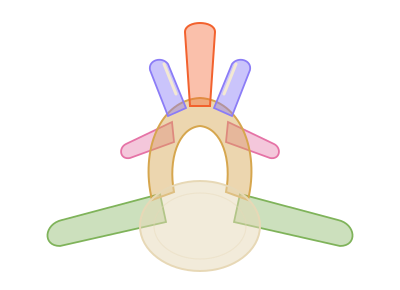
The synovial joint and a lumbar vertebra, in the Label lab.
9

The League's test

Pass the League's test

Six exam-style questions from the League. Get all six right to earn your stamp. Three wrong and you resit.

The League's badge

League test · Support and movement

You: ♥♥♥

Press Start when you're ready.

Remember it

Tap a card to flip it. Say the answer before you flip.

Ash:That's support and movement. Kay, half right: the biceps lifts the bucket, and when you lower it gently it's still the biceps, letting go slowly. To push your arm straight against something, that's the triceps' job.
Support and movement: Biology explained, with games · L.O.E.P