15 wks to JAMB

L.O.E.P · BiologyNo. 05

Explainer · Reproduction · about 15 min

Why does a cassava cutting grow into a copy of its parent, but a mango seed doesn't?

Watch the lecture

Ash and Kay teach this lesson, start to finish.

⬇ Save for offline

Keeps it on this phone, so it plays with no signal and no data, at this same address.

In short

The key words in this lesson, in plain English:

Insects:
Arthropods with three body parts (head, thorax, abdomen), three pairs of legs on the thorax, one pair of antennae and usually wings: housefly, mosquito, cockroach, grasshopper.
Menstrual cycle:
The roughly 28-day cycle in which the uterus lining builds up and an egg is released from an ovary (ovulation, around day 14). If no egg is fertilised the lining is shed (menstruation).

Free this month: 1 of 1 lessons. A free account gives you 3 a month.

Plant a piece of cassava stem and you get a new cassava plant, exactly like the old one. Plant a mango seed and the tree that grows may give mangoes nothing like its parent's. Both are reproduction: living things making more of their own kind. One way copies; the other way mixes. Each has its reasons.

Kay:Ash planted a mango seed from the best mango he ever ate. Eight years later: a tree of extremely average mangoes. He calls it "sexual reproduction". I call it a scam.
1

Play · breed them

Copy or mix?

Breed a population asexually (one parent, copies) and sexually (two parents, mixed). Then let a disease that kills only blue ones strike each population.

Choose a way to breed

Survivors–

Asexual and sexual reproduction

Where you see it: farmers plant short pieces of sugarcane stem, and each grows into a copy of the parent plant; maize grown from seed gives plants that differ slightly from one another. BiologyAsexual reproductionReproduction from one parent with no gametes, giving offspring identical to the parent: binary fission, budding, spores, vegetative propagation.Science dictionary ▶ reproduction needs one parent and no gametes; the offspring are identical copies (clones). It is fast and needs no partner: BiologyBinary fissionAsexual reproduction in which one cell divides into two equal daughter cells, as in Amoeba and bacteria.Science dictionary ▶ (BiologyProtistA single-celled organism with a nucleus, in the kingdom Protista: Amoeba (moves by pseudopodia), Paramecium (cilia) and Euglena (a flagellum and chloroplasts).Science dictionary ▶ splits in two), BiologyBuddingAsexual reproduction in which a new individual grows out of the parent and breaks away, as in yeast and Hydra.Science dictionary ▶ (yeast, BiologyCnidarians (coelenterates)Water animals with a body wall of two cell layers, a ring of tentacles with stinging cells, and radial symmetry: Hydra, jellyfish, sea anemones, corals.Science dictionary ▶), BiologySporeA tiny reproductive cell that can grow into a new organism on its own. Fungi make them in sporangia; ferns under their leaves.Science dictionary ▶ (Rhizopus), fragmentation (BiologySpirogyraA green alga made of long threads (filaments) of cells, each with a spiral chloroplast. It forms slimy green mats in ponds.Science dictionary ▶) and BiologyVegetative propagationGrowing new plants from part of a parent plant: cassava stem cuttings, yam tubers, banana suckers. The new plants are clones.Science dictionary ▶ (cassava stem cuttings, yam tubers, banana suckers). Sexual reproduction joins a male and a female gamete; the offspring vary, so some may survive a new disease or a changing environment. That BiologyVariationThe differences between individuals of the same species. Continuous variation has every in-between value (height, mass); discontinuous variation falls into distinct groups (blood group, tongue rolling).Morphological variations are in visible structure; physiological ones are in how the body works, such as blood group.Science dictionary ▶ is the raw material of BiologyEvolutionThe slow change in the inherited features of living things over many generations, by which new species arise from earlier ones.Darwin explained it by natural selection; the evidence includes fossils, homologous organs and DNA.Science dictionary ▶.
2

Play · label it

Inside a flower

A flower is a reproductive organ. Put each label on its part.

Drag each label onto the flower (or tap a label, then a part)

The parts of a flower

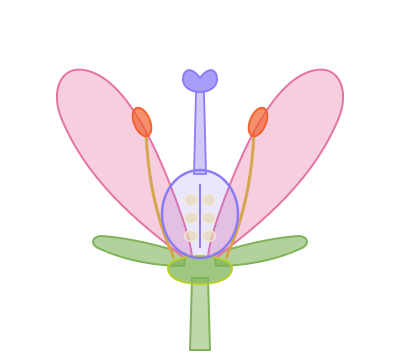
Where you see it: a hibiscus flower in the school garden shows the parts clearly: green BiologySepalOne of the small leaf-like parts that protect a flower while it is a bud.Science dictionary ▶, large red BiologyPetalOne of the often brightly coloured, scented parts of a flower that attract insects.Science dictionary ▶, a long column carrying the BiologyStamenThe male part of a flower: an anther, which makes pollen, held up on a stalk called the filament.Science dictionary ▶, and the BiologyCarpel (pistil)The female part of a flower: the stigma, which catches pollen, the style, and the ovary, which holds the ovules.Science dictionary ▶ at its tip. Sepals protect the bud; petals attract BiologyInsectsArthropods with three body parts (head, thorax, abdomen), three pairs of legs on the thorax, one pair of antennae and usually wings: housefly, mosquito, cockroach, grasshopper.Science dictionary ▶. The male part is the stamen: an anther (makes pollen) on a filament. The female part is the carpel (pistil): the stigma (catches pollen), the style, and the BiologyOvaryWhere eggs are made. In a woman, one of the two organs that release an egg each month; in a flower, the base of the carpel that holds the ovules and becomes the fruit.Science dictionary ▶, which holds the BiologyOvuleThe structure in a flower's ovary that contains the egg cell. After fertilisation it becomes the seed; the pollen tube enters it through a tiny gap, the micropyle.Science dictionary ▶. A flower with both is bisexual; a plant with separate male and female flowers on the same plant, like maize, is BiologyMonoecious and dioeciousA monoecious plant (maize) has separate male and female flowers on the same plant; a dioecious plant (pawpaw) has them on different plants.Science dictionary ▶; with them on different plants, like pawpaw, dioecious.
3

Play · arcade

Insect or wind?

Pollination moves pollen from an anther to a stigma. Insects do it for some flowers, the wind for others, and each kind of flower is built for its carrier.

Press Start

Swipe left for insect-pollinated, right for wind-pollinated

Score0Streak0Lives♥♥♥

Pollination

Where you see it: most pawpaw grown from seed has separate male and female trees, so growers keep a few male trees among the female ones for BiologyInsectsArthropods with three body parts (head, thorax, abdomen), three pairs of legs on the thorax, one pair of antennae and usually wings: housefly, mosquito, cockroach, grasshopper.Science dictionary ▶ to carry pollen across. Self-BiologyPollinationThe transfer of pollen from an anther to a stigma. Self-pollination stays on one plant; cross-pollination moves to another.Bees visiting orange and pawpaw flowers carry pollen from flower to flower.Science dictionary ▶ moves pollen to a BiologyCarpel (pistil)The female part of a flower: the stigma, which catches pollen, the style, and the ovary, which holds the ovules.Science dictionary ▶ on the same flower or plant; cross-pollination to a different plant of the same kind, giving more BiologyVariationThe differences between individuals of the same species. Continuous variation has every in-between value (height, mass); discontinuous variation falls into distinct groups (blood group, tongue rolling).Morphological variations are in visible structure; physiological ones are in how the body works, such as blood group.Science dictionary ▶. Plants encourage cross-pollination: BiologyStamenThe male part of a flower: an anther, which makes pollen, held up on a stalk called the filament.Science dictionary ▶ and stigma ripening at different times, or the stigma held above the anthers. Insects, birds, bats, wind and water all carry pollen.
4

Play · grow it

From pollen to seed

A pollen grain has landed on the stigma. Hold the button to grow its tube down to the ovule. Then say what each part of the flower becomes.

Hold Grow the tube

Parts0 / 5

Fertilisation and after

Where you see it: a tomato or garden egg cut open in the kitchen shows many seeds, each a BiologyFertilisationThe fusion of a male and a female gamete to form a zygote. In flowering plants a second male nucleus also forms the endosperm: double fertilisation.Science dictionary ▶ BiologyOvuleThe structure in a flower's ovary that contains the egg cell. After fertilisation it becomes the seed; the pollen tube enters it through a tiny gap, the micropyle.Science dictionary ▶, packed inside the swollen BiologyOvaryWhere eggs are made. In a woman, one of the two organs that release an egg each month; in a flower, the base of the carpel that holds the ovules and becomes the fruit.Science dictionary ▶ that became the fruit. The pollen tube grows down the style and enters the ovule through the micropyle. One male BiologyNucleusA centre. In an atom, the tiny dense core of protons and neutrons that holds nearly all its mass. In a cell, the part that holds the chromosomes and controls the cell.Science dictionary ▶ PhysicsFuseA thin wire of low melting point fitted in the live wire. Too much current melts it and breaks the circuit before the cables overheat. Its rating should be just above the normal current.Science dictionary ▶ with the egg cell: fertilisation, making a zygote, which grows into the embryo. In flowering plants a second male nucleus fuses with the polar nuclei to make the BiologyParts of a seedA seed holds an embryo, the radicle (young root), plumule (young shoot) and one or two cotyledons (seed leaves), with a food store, inside a coat, the testa. The hilum is its scar of attachment.A bean keeps its food in two cotyledons; a maize grain in its endosperm.Science dictionary ▶, the seed's food store (double fertilisation). Then the ovule becomes the seed, its integuments the seed coat (testa), the ovary becomes the fruit, and the BiologyPetalOne of the often brightly coloured, scented parts of a flower that attract insects.Science dictionary ▶, BiologyStamenThe male part of a flower: an anther, which makes pollen, held up on a stalk called the filament.Science dictionary ▶ and style wither away.
5

Play · send them off

Seeds on the move

A seedling under its parent fights it for light and water. Send each fruit or seed off by the agent it's built for.

Drag each one to its carrier (or tap it, then tap the carrier)

Wind
Animals
Water
Explosion (self)

Dispersal

Where you see it: in the dry season, kapok (silk-cotton) tree pods split open and the wind carries off seeds wrapped in fluffy fibre; birds that eat ripe pepper fruits drop the seeds far from the plant. Wind: light seeds with hairs (Tridax, cotton) or wings (Combretum). Animals: fleshy, sweet fruits that are eaten, the seeds passing out unharmed in droppings (mango, pawpaw); or hooks that catch on fur and clothes. Water: fibrous, air-filled fruits that float (coconut). Explosive (self-dispersal): pods that dry out and split suddenly, flinging the seeds (crotalaria, flamboyant, beans).
6

Play · the 28 days

The menstrual cycle

Slide through a typical 28-day cycle and watch the ovary and the lining of the uterus. Then mark the period and ovulation.

Slide through the days

OVARYUTERUS LINING
Day1Happening–

The menstrual cycle

Where you see it: clinic nurses and school health clubs encourage girls to mark the first day of each period on a calendar, which helps them notice when a cycle is longer or shorter than usual. Roughly every 28 days, controlled by BiologyHormoneA chemical messenger made by an endocrine gland and carried in the blood to a target organ, which it changes.Adrenaline makes your heart pound when you are frightened.Science dictionary ▶ from the BiologyPituitary glandThe pea-sized master gland under the brain. It makes growth hormone and hormones (such as TSH) that control the other endocrine glands, and is itself controlled by the hypothalamus.Science dictionary ▶ (FSH, LH) and the BiologyOvaryWhere eggs are made. In a woman, one of the two organs that release an egg each month; in a flower, the base of the carpel that holds the ovules and becomes the fruit.Science dictionary ▶ (BiologySex hormonesTestosterone from the testes and oestrogen and progesterone from the ovaries bring the changes of puberty; oestrogen and progesterone also run the menstrual cycle and pregnancy.Science dictionary ▶, progesterone). Days 1 to 5: the old uterus lining breaks down and leaves the body, BiologyMenstrual cycleThe roughly 28-day cycle in which the uterus lining builds up and an egg is released from an ovary (ovulation, around day 14). If no egg is fertilised the lining is shed (menstruation).Science dictionary ▶. Then the lining rebuilds while an egg ripens in a follicle. Around day 14 the egg is released, ovulation, and travels down the oviduct, where BiologyFertilisationThe fusion of a male and a female gamete to form a zygote. In flowering plants a second male nucleus also forms the endosperm: double fertilisation.Science dictionary ▶ can happen. If it isn't fertilised, progesterone falls and the cycle starts again. Cycles vary from person to person, which is why counting days is an unreliable way to avoid pregnancy.
7

Play · in order

Life cycles

Many animals change shape as they grow. Tap the stages in order, for three animals.

Press Start

–

    Animals0 / 3

    Metamorphosis

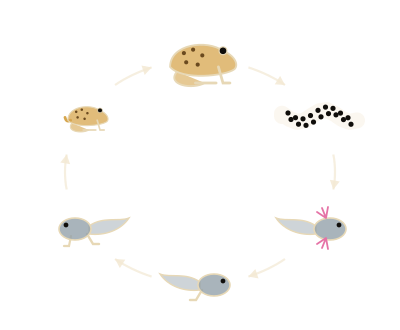
    Where you see it: mosquito larvae wriggle in water left standing in old tyres and blocked gutters, which is why health workers ask households to empty such water before the adults emerge. Complete BiologyMetamorphosisA big change of body form during development, as from caterpillar to pupa to butterfly, or from tadpole to frog.Maggots in a refuse dump are housefly larvae that will become flies.Science dictionary ▶ (housefly, butterfly, mosquito): egg → larva → pupa → adult; the larva looks nothing like the adult, and the pupa is a resting stage where the body is rebuilt. Incomplete metamorphosis (grasshopper, cockroach): egg → nymph → adult; the nymph is a small wingless adult that moults as it grows. Toads and frogs: egg → tadpole (gills, tail, in water) → young toad → adult (lungs, legs, on land).
    8

    Exam corner

    How the exam asks it

    A short-answer favourite. Tap each step to reveal it.

    State three functions of the placenta, and one function of the amniotic fluid.

    Now try the real ones

    Real JAMB, WAEC and NECO past questions on this lesson (the JAMB and WAEC ones in LOEP's words). Answer them one at a time: each is marked, with the worked answer.

    Start the 10 real questions ▶
    1. JAMB 2023Which statement best describes courtship behaviour?
    2. WAEC 2019The main function of the amniotic fluid around a developing foetus is to
    3. JAMB 2023Metamorphosis means
    4. NECO 2009Which of these is NOT part of a seed?
    5. JAMB 2023Which of these is NOT a method of reproduction in animals?
    6. WAEC 2014A farmer plants a cassava stem cutting in moist soil and it grows into a new plant. This new plant was produced
    7. JAMB 2023Which of these is part of the male reproductive system?
    8. NECO 2009Which of these is a simple dehiscent fruit?
    9. JAMB 2023Pollination is the transfer of pollen grains from
    10. JAMB 2015Which of these fruits develops from a whole cluster of flowers and is therefore not a simple true fruit?

    Label it

    A half flower and the toad's life cycle, in the Label lab.
    9

    The League's test

    Pass the League's test

    Six exam-style questions from the League. Get all six right to earn your stamp. Three wrong and you resit.

    The League's badge

    League test · Reproduction

    You: ♥♥♥

    Press Start when you're ready.

    Remember it

    Tap a card to flip it. Say the answer before you flip.

    Kay:That's reproduction. If you want your mangoes exactly like the parent tree, graft it. Ash has finally learned this.
    Reproduction: Biology explained, with games · L.O.E.P