15 wks to JAMB

L.O.E.P · BiologyNo. 01

Explainer · Photosynthesis and plant nutrition · about 15 min

How does a mango tree get heavier every year without eating?

Watch the lecture

Ash and Kay teach this lesson, start to finish.

⬇ Save for offline

Keeps it on this phone, so it plays with no signal and no data, at this same address.

In short

The key words in this lesson, in plain English:

Photosynthesis:
How green plants make food: chlorophyll traps light energy to turn carbon(IV) oxide and water into glucose, giving off oxygen.

Free this month: 1 of 1 lessons. A free account gives you 3 a month.

A mango seed is lighter than a pencil. Thirty years later it's a tree weighing tonnes, and the soil around it has hardly gone down. So where did all that tree come from? Mostly out of the air.

Kay:So trees are built out of air. I checked twice. Then I hugged one, out of respect.
1

Play · against the clock

Save the dying plant

This plant is starving. Give it what it needs to make its own food, in the right places, before the timer runs out. Not everything on the list is food for a plant.

Press Start, then drag each one to where it goes

ROOTSLEAF UNDERSIDEO₂O₂O₂O₂glucose → stored as starch

What a plant needs to make food

Where you see it: farmers weed around young maize because weeds compete with the crop for the same water and light it needs to make its food. Carbon dioxide (in through the BiologyStomataTiny pores, mostly on the underside of leaves, opened and closed by guard cells. Gases and water vapour pass through them.Many plants close their stomata in the midday heat to save water.Science dictionary ▶), water (up from the roots) and light energy (caught by the green BiologyChlorophyllThe green pigment in chloroplasts that absorbs light energy for photosynthesis. Each molecule has a magnesium atom at its centre.Ugu and bitter leaf are green because of their chlorophyll.Science dictionary ▶ in the leaves). It makes glucose and gives off oxygen. The glucose is turned into starch to store.
Ash:Oxygen and sugar are what the plant makes, not what it eats. Salt would just dry it out. And the chlorophyll is already there: it's what makes leaves green.

Ways of getting food

Where you see it: mushrooms that spring up on rotting logs or old palm fruit bunches after the rains cannot make their own food; like animals, they are heterotrophs, feeding on dead material instead of using light. BiologyAutotrophAn organism that makes its own food from simple substances, usually by photosynthesis. Organisms that cannot are heterotrophs.Green plants on every farm are autotrophs that, through food chains, feed everyone else.Science dictionary ▶ make their own food from simple inorganic substances. Green plants do it with light: that's BiologyPhotosynthesisHow green plants make food: chlorophyll traps light energy to turn carbon(IV) oxide and water into glucose, giving off oxygen.Every grain of rice and garri you eat began as sugar made by photosynthesis in a leaf.Science dictionary ▶. A few BiologyBacteriumA tiny single-celled organism with no true nucleus. Some cause disease (cholera, typhoid); many are useful, making yoghurt, fixing nitrogen and rotting dead matter.Science dictionary ▶ use energy from chemical reactions instead: that's chemosynthesis. Heterotrophs (animals, BiologyFungusAn organism with no chlorophyll that feeds by absorbing food from dead or living matter. Bodies of thread-like hyphae; includes moulds, mushrooms and yeast.Science dictionary ▶, most bacteria) have to eat food that's already made. The sundew still photosynthesises; it catches BiologyInsectsArthropods with three body parts (head, thorax, abdomen), three pairs of legs on the thorax, one pair of antennae and usually wings: housefly, mosquito, cockroach, grasshopper.Science dictionary ▶ to get the nitrogen its boggy soil lacks.
2

Play · puzzle

Build the equation

Put each piece where it belongs. Then check the atoms: what goes in must come out.

Drag a piece into a box (or tap a piece, then a box)

?+??⟶??+?

Carbon0 → 0Hydrogen0 → 0Oxygen0 → 0
Kay:Six of everything except the sugar. I asked Ash why. She drew me a diagram. It had a diagram inside it.
3

Play · find it

Inside a leaf

A leaf is a food factory, built in layers. Ash asks; you tap the part she means. First tap counts.

Tap Start for Ash's first question

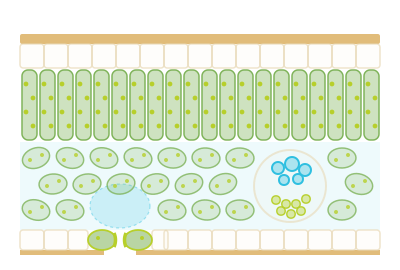
WAXY CUTICLEPALISADESPONGY + AIR SPACESXYLEMPHLOEMSTOMA + GUARD CELLS
Found0 / 6First try0

Where it happens

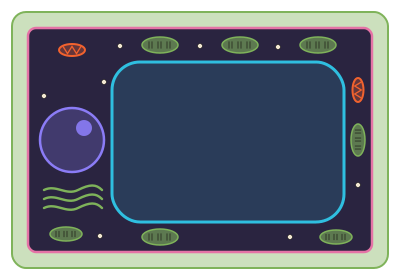
Where you see it: pick a cassava or cocoyam leaf and the upper side, facing the sun, is usually a deeper green than the underside, because the BiologyChloroplastThe organelle in plant cells where photosynthesis happens. It contains chlorophyll.Palisade cells just under the top of a leaf are packed with chloroplasts to catch the light.Science dictionary ▶-packed BiologyMesophyllThe tissue between a leaf's two epidermises: the palisade layer of tall cells packed with chloroplasts, where most photosynthesis happens, and the spongy layer of loose cells with air spaces.Gases reach the spongy cells through the stomata.Science dictionary ▶ lie just under that top surface. BiologyPhotosynthesisHow green plants make food: chlorophyll traps light energy to turn carbon(IV) oxide and water into glucose, giving off oxygen.Every grain of rice and garri you eat began as sugar made by photosynthesis in a leaf.Science dictionary ▶ happens in chloroplasts, packed most tightly in the palisade cells just under the upper surface, where the light is strongest. Inside a chloroplast, the BiologyChlorophyllThe green pigment in chloroplasts that absorbs light energy for photosynthesis. Each molecule has a magnesium atom at its centre.Ugu and bitter leaf are green because of their chlorophyll.Science dictionary ▶ sits in stacks called grana; the fluid around them is the stroma.
4

Play · arcade

Light stage or dark stage?

Two stages

Where you see it: a water plant in a sunny fish pond or aquarium gives off tiny bubbles of oxygen; that oxygen comes from water being split in the light stage. Light stage (in the grana): light energy splits water (photolysis), giving off oxygen and making BiologyATPAdenosine triphosphate: the molecule that stores the energy released in respiration and hands it to whatever the cell is doing.Every step you take is powered by ATP in your leg muscles.Science dictionary ▶ and hydrogen carried as NADPH. Dark stage (in the stroma, the Calvin cycle): the ATP and NADPH are used to turn carbon dioxide into glucose.

Press Start

Swipe left for light, right for dark

Score0Streak0Lives♥♥♥
Kay:The "dark" stage doesn't need darkness. It just doesn't need light directly. Scientists named it, not me. I'd have called it "the sequel".
Ash:And the oxygen comes from the water, not the carbon dioxide. Tracer experiments with heavy oxygen proved it. That one is a favourite with examiners.
5

Ash's lab

The starch test

Plants store the glucose they make as starch, so we test leaves for starch. Ash has shuffled her method cards. Tap them in the right order to run the test.

Tap the first step

BEAKERA fresh green leaf
Ash:Never heat ethanol over a flame. It catches fire. Heat water, turn the flame off, then stand the tube of ethanol in the hot water.

Why each step

Destarch in the dark for 48 hours, so any starch found was made during the experiment. Boiling water kills the cells and stops all reactions. Hot ChemistryEthanolThe alcohol in alcoholic drinks (C₂H₅OH). It is also used as a fuel and a solvent.The liver breaks it down in steps.Science dictionary ▶ takes out the BiologyChlorophyllThe green pigment in chloroplasts that absorbs light energy for photosynthesis. Each molecule has a magnesium atom at its centre.Ugu and bitter leaf are green because of their chlorophyll.Science dictionary ▶, so the colour change can be seen. Warm water softens the ChemistryMalleable and ductileMalleable metals can be hammered into sheets and ductile ones drawn into wires, because their layers of ions slide without breaking. Brittle solids, like salt crystals, shatter instead.Science dictionary ▶ leaf. Iodine: blue-black means starch; brown (iodine's own colour) means none.
6

Play · predict it

What will the iodine show?

Four experiments, each taking one thing away. Tap each band of the leaf to predict blue-black (starch) or brown (no starch), then test it.

Pick an experiment

???BAG + SODA LIME

What each one proves

No starch where there was no BiologyChlorophyllThe green pigment in chloroplasts that absorbs light energy for photosynthesis. Each molecule has a magnesium atom at its centre.Ugu and bitter leaf are green because of their chlorophyll.Science dictionary ▶, no light or no carbon dioxide: all three are needed. The control shows the leaf makes starch when nothing is taken away, so the test itself works.
7

Play · simulation

Push the pondweed

Pondweed under water gives off bubbles of oxygen as it photosynthesises. Count the bubbles and you're measuring the rate. Get it to 40 bubbles a minute.

Move the sliders

10 cm
Bubbles a minute–Holding it back–

Limiting factors

Where you see it: tomatoes grown in the shade of a big tree yield less than those in open sun; light is the factor in shortest supply there, so extra water or fertiliser does little. The rate is held back by whichever factor is in shortest supply: light, carbon dioxide or temperature. Raise that one and the rate goes up until something else runs short. Too hot (above about 40 °C) and the BiologyEnzymeA protein that speeds up a chemical reaction in living things without being used up, like the enzymes that break down food.Most enzymes stop working if they get too hot.Science dictionary ▶ of the dark stage are damaged, so the rate falls.
Kay:I put the lamp right next to the weed and nothing more happened. Ash said "carbon dioxide is your limiting factor." I said "my limiting factor is patience." We were both right.
8

Play · plant doctor

Cure the plants

Plants make sugar from air and water, but to build proteins and chlorophyll they need minerals from the soil. Four sick plants: give each the mineral it's missing.

Drag a mineral onto a plant (or tap one, then the plant)

  • Pale yellow leaves all over; small and stunted
  • Older leaves yellow between the veins
  • Poor roots; dull, purplish leaves
  • Leaf edges brown and curling; weak stems

Minerals to know

Where you see it: maize on poor, overworked soil often shows yellowing lower leaves, a sign of too little nitrogen, so farmers add manure or fertiliser before the crop suffers further. Macronutrients (needed in large amounts): nitrogen, phosphorus, potassium, ChemistryCalciumA metal element (Ca) that our bones and teeth are built from. We get it from milk, beans and green vegetables.Chalk and limestone are calcium carbonate.Science dictionary ▶, magnesium, sulphur. Micronutrients (trace ChemistryElementA substance made of only one kind of atom, which cannot be split into simpler substances by chemical means, such as iron, oxygen or carbon.The iron in a cooking pot and the oxygen you breathe are elements.Science dictionary ▶, tiny amounts): iron, manganese, zinc, copper, boron, molybdenum. Magnesium sits at the centre of every BiologyChlorophyllThe green pigment in chloroplasts that absorbs light energy for photosynthesis. Each molecule has a magnesium atom at its centre.Ugu and bitter leaf are green because of their chlorophyll.Science dictionary ▶ molecule, and nitrogen is in chlorophyll and every BiologyProteinLarge molecules made of chains of amino acids, used to build and repair the body. Beans, fish, eggs and meat are rich in them.Science dictionary ▶, so lacking either turns leaves yellow (chlorosis).
Ash:Farmers buy fertiliser labelled NPK. Now you know what the letters are for, and why the bag costs what it does.
9

Exam corner

How the exam asks it

A classic experiment question. Tap each step to reveal it.

A destarched potted plant has one leaf sealed in a flask containing soda lime. After six hours in bright light, that leaf stays brown with iodine; the other leaves turn blue-black. What does this show?

Now try the real ones

Real JAMB, WAEC and NECO past questions on this lesson (the JAMB and WAEC ones in LOEP's words). Answer them one at a time: each is marked, with the worked answer.

Start the 10 real questions ▶
  1. JAMB 2022Which process belongs to the dark stage of photosynthesis?
  2. WAEC 2020Plants need only tiny amounts of which of these elements?
  3. JAMB 2021In a water culture experiment on mineral salts, the bottle is wrapped in black paper mainly to
  4. WAEC 2019Which form of energy do green leaves change into chemical energy during photosynthesis?
  5. JAMB 2022Carbon dioxide from the air is changed into sugar that stores chemical energy. This happens in
  6. WAEC 2019A water culture jar is left uncovered in bright sunlight for a week. What is most likely to happen to the solution?
  7. JAMB 2018Cassava leaves use light energy to make sugars from carbon (IV) oxide and water. This process is called
  8. WAEC 2018Plants obtain the energy for making food directly from
  9. JAMB 2019A farmer's crops need some elements in only tiny amounts. Which of these is such a micronutrient?
  10. JAMB 2017In a leaf cell, the light-trapping reactions that make sugar take place inside which organelle?

Label it

The leaf in section, and the plant cell with its chloroplasts, in the Label lab.
10

The League's test

Pass the League's test

Six exam-style questions from the League. Get all six right to earn your stamp. Three wrong and you resit.

The League's badge

League test · Photosynthesis

You: ♥♥♥

Press Start when you're ready.

Remember it

Tap a card to flip it. Say the answer before you flip.

Kay:That's photosynthesis. Every breath you take, a plant made it. Say thank you to a tree on the way home. Quietly, so people don't stare.
Photosynthesis and plant nutrition: Biology explained, with games