15 wks to JAMB

L.O.E.P · BiologyNo. 08

Explainer · The nervous system and senses · about 15 min

Why does your hand jerk away from a hot pot before you even feel the pain?

Watch the lecture

Ash and Kay teach this lesson, start to finish.

⬇ Save for offline

Keeps it on this phone, so it plays with no signal and no data, at this same address.

In short

The key words in this lesson, in plain English:

Reflex action:
A fast, automatic response to a stimulus, made without thinking, through a pathway called a reflex arc.

Free this month: 1 of 1 lessons. A free account gives you 3 a month.

You touch a hot pot of stew and your hand jerks away before you even feel the pain. A football flies at your face and you blink without deciding to. Yet answering an exam question takes thought. Your body has a fast wiring system for both: the nervous system, fed by the sense organs that tell it what's going on.

Kay:So my hand is smarter than me when it comes to hot pots. Noted.
1

Play · test yourself

Reaction time

Tap the panel the moment it turns green. Do it 3 times. Don't tap early.

Tap the panel to start

Last–Average–Tries0 / 3

The nervous system

Where you see it: a goalkeeper sees the ball coming, the brain decides which way to go, and motor BiologyNeuroneA nerve cell: it carries electrical impulses. Sensory neurones bring messages in, motor neurones send instructions out.Some neurones run from your spine to your toes, about a metre long.Science dictionary ▶ fire the leg and arm muscles for the dive. The BiologyCentral nervous systemThe brain and spinal cord, which receive and coordinate messages. The nerves that link them to the rest of the body are the peripheral nervous system.Science dictionary ▶ (CNS) is the brain and spinal cord. The peripheral nervous system is the nerves that connect it to the rest of the body. Messages travel as electrical impulses along nerve cells, neurones. A voluntary action like your tap goes eye → sensory neurones → brain (you decide) → motor neurones → finger muscles: usually about 0.2 to 0.3 seconds.
2

Play · build it

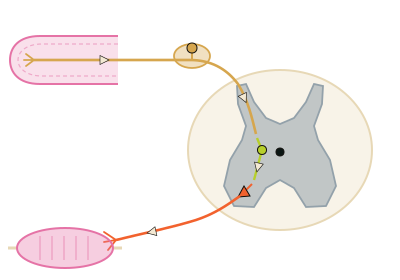
The reflex arc

Your finger touches a hot pot. Tap the parts of the reflex arc in the order the impulse passes through them.

Where does it start?

spinal cordfingermuscle

Reflex actions

Where you see it: when harmattan dust blows into your face, your eyes blink shut before you have decided anything at all. A BiologyReflex actionA fast, automatic response to a stimulus, made without thinking, through a pathway called a reflex arc.Pulling your hand from a hot pot happens before you even feel the pain.Science dictionary ▶ is a fast, automatic response to a stimulus that you don't think about: the impulse takes a short cut through the spinal cord (or the lower brain) and is only reported to the brain afterwards. The path is the reflex arc: receptor → sensory BiologyNeuroneA nerve cell: it carries electrical impulses. Sensory neurones bring messages in, motor neurones send instructions out.Some neurones run from your spine to your toes, about a metre long.Science dictionary ▶ → relay neurone (in the spinal cord) → motor neurone → effector (a muscle or gland). Reflexes protect you: blinking, coughing, pulling away from heat, the pupil shrinking in bright light. Neurones meet at tiny gaps called BiologySynapseThe tiny gap between two neurones. An impulse crosses it as a chemical messenger, which also makes impulses travel one way only.Science dictionary ▶, crossed by a chemical messenger.
3

Play · map it

Inside the brain

For each job, tap the part of the brain that does it. Get 5 right.

Press Start

–
Right0 / 5

The brain

Where you see it: a footballer who takes a hard knock to the head is checked for confusion, memory loss and unsteady balance before playing on, because different parts of the brain do each of those jobs. The BiologyCerebrumThe large wrinkled front part of the brain: thinking, memory, intelligence, speech, the senses and voluntary actions.Science dictionary ▶, the large wrinkled front part, handles thinking, memory, intelligence, speech, the senses and voluntary actions. The BiologyCerebellumThe part at the back of the brain that coordinates muscles for balance and smooth movement.Science dictionary ▶, at the back, coordinates muscles for balance and smooth movement. The BiologyMedulla oblongataThe part of the brain joining the spinal cord that controls automatic actions: breathing, heartbeat, blood pressure.Science dictionary ▶, joining the spinal cord, controls automatic actions such as breathing, heartbeat and blood PhysicsPressureHow hard a force presses on each square metre of a surface: pressure = force ÷ area, measured in pascals (Pa).A sharp knife cuts because its thin edge puts the force on a tiny area. Tractors and camels have wide tyres or feet so they don't sink.Science dictionary ▶. The BiologyHypothalamusA small region at the base of the brain that controls body temperature, thirst and hunger, and links the nervous system to the pituitary gland.Science dictionary ▶ controls body temperature, thirst and hunger, and links the nervous system to the BiologyPituitary glandThe pea-sized master gland under the brain. It makes growth hormone and hormones (such as TSH) that control the other endocrine glands, and is itself controlled by the hypothalamus.Science dictionary ▶.
4

Play · focus it

The eye

Change the lens's shape to bring each object into sharp focus on the retina. Then see what the pupil does in bright and dim light.

Choose what to look at

retina
Image–

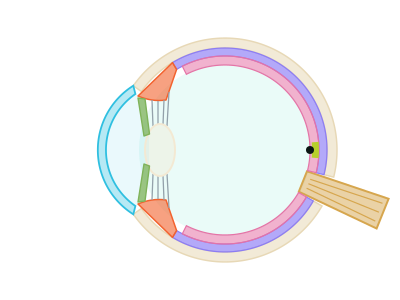
How the eye works

Where you see it: copying notes in class, your eyes switch between the exercise book and the board; at each switch the BiologyAccommodation (of the eye)The eye changing the shape of its lens to focus: the ciliary muscles contract and the lens fattens for near objects, and relax so it is pulled thin for far ones.Science dictionary ▶ change the PhysicsLensA curved piece of glass or plastic that bends light to focus it, as in glasses, cameras and your eye.Convex lenses bring light together; concave lenses spread it out.Science dictionary ▶'s shape so the new view comes into focus. Light is bent mostly by the BiologyCorneaThe clear, curved front of the eye, which does most of the bending of light.Science dictionary ▶, then fine-tuned by the lens to form an image on the BiologyRetinaThe light-sensitive layer at the back of the eye. Its cells turn light into nerve signals for the brain.Rods see in dim light; cones see colour.Science dictionary ▶, whose rods (dim light, black and white) and cones (bright light, colour) send impulses along the BiologyOptic nerveThe nerve that carries impulses from the retina to the brain.Science dictionary ▶. To focus on a near object the ciliary muscles contract, the suspensory ligaments slacken, and the lens becomes fatter (more powerful); for a far object they relax and the lens is pulled thin. This is accommodation. The BiologyIrisThe coloured ring of muscle in the eye that controls the size of the pupil: small in bright light, wide in dim light.Science dictionary ▶ controls the pupil: small in bright light, wide in dim light.
5

Play · fit the glasses

Fixing eyesight

Two patients. Try each kind of lens in front of the eye and pick the one that brings the image back onto the retina.

Choose a patient

Fixed0 / 2

Defects of vision

Where you see it: at an eye clinic, the optometrist asks you to read letters on a chart across the room, then tries PhysicsLensA curved piece of glass or plastic that bends light to focus it, as in glasses, cameras and your eye.Convex lenses bring light together; concave lenses spread it out.Science dictionary ▶ in front of each eye to find the one that makes them sharp. BiologyShort and long sightShort sight (myopia): far things blurred, image in front of the retina, corrected with a concave lens. Long sight (hypermetropia): near things blurred, image behind the retina, corrected with a convex lens.Science dictionary ▶ (myopia): distant objects are blurred because the eyeball is too long or the lens too strong, so the image forms in front of the BiologyRetinaThe light-sensitive layer at the back of the eye. Its cells turn light into nerve signals for the brain.Rods see in dim light; cones see colour.Science dictionary ▶; a concave (diverging) lens corrects it. Long sight (hypermetropia): near objects are blurred because the eyeball is too short or the lens too weak, so the image would form behind the retina; a convex (converging) lens corrects it. With age the lens stiffens (presbyopia), which is why many older people need reading glasses.
6

Play · follow the sound

The ear

A talking drum plays across the compound. Tap the parts of the ear in the order the sound passes through them, all the way to your brain.

Where does the sound go first?

    Hearing and balance

    Where you see it: your ears pop when driving down a steep hill road or as a plane lands; swallowing or yawning opens the BiologyParts of the earSound is collected by the pinna, vibrates the eardrum, is passed on by three tiny bones (the ossicles) to the oval window, and reaches the cochlea. The Eustachian tube keeps the air pressure equal on both sides of the eardrum.Science dictionary ▶ and evens out the PhysicsPressureHow hard a force presses on each square metre of a surface: pressure = force ÷ area, measured in pascals (Pa).A sharp knife cuts because its thin edge puts the force on a tiny area. Tractors and camels have wide tyres or feet so they don't sink.Science dictionary ▶ on both sides of the eardrum. The pinna collects sound down the ear canal to the eardrum, which vibrates. Three tiny bones, the ossicles (hammer, anvil and stirrup), pass and amplify the vibrations to the oval window of the inner ear. In the fluid-filled BiologyCochleaThe coiled, fluid-filled tube of the inner ear whose hair cells turn vibrations into nerve impulses, carried to the brain by the auditory nerve.Science dictionary ▶, sensory hair cells turn them into impulses that travel along the auditory nerve to the brain. The Eustachian tube links the middle ear to the throat to keep the air pressure equal on both sides of the eardrum. The BiologySemicircular canalsThree fluid-filled loops in the inner ear that sense movement of the head and help you keep your balance.Science dictionary ▶ sense movement of the head and help with balance; they aren't part of hearing.
    7

    Play · arcade

    Reflex or voluntary?

    Press Start

    Swipe left for a reflex, right for a voluntary action

    Score0Streak0Lives♥♥♥
    Ash:Your mouth watering at the smell of suya is a reflex too, but a learned one: a conditioned reflex. Pavlov did it with dogs and a bell. I do it with suya and the sight of a grill.
    8

    Exam corner

    How the exam asks it

    A reflex, step by step. Tap each step to reveal it.

    A doctor taps just below your kneecap and your leg kicks forward. Describe the pathway of the impulse, and explain why the response is so fast.

    Now try the real ones

    Real JAMB, WAEC and NECO past questions on this lesson (the JAMB and WAEC ones in LOEP's words). Answer them one at a time: each is marked, with the worked answer.

    Start the 10 real questions ▶
    1. JAMB 2023Which part of the ear contains the hair cells that change sound vibrations into nerve impulses?
    2. WAEC 2019A student looks up from her book at a bird sitting on a far tree. Which change takes place in her eye?
    3. JAMB 2021Which pair of ions moves across the nerve cell membrane to produce an action potential?
    4. WAEC 2018A very weak stimulus does not make a nerve cell send an impulse. This is because
    5. JAMB 2020The adjustment of the eye lens to focus on both near and far objects is called
    6. WAEC 2018Which habit is most likely to cause an eye infection?
    7. JAMB 2019Which part of the human brain controls conscious, voluntary movements such as writing?
    8. WAEC 2016Which of these actions is a reflex, rather than a voluntary action?
    9. JAMB 2019A school prefect deliberately reads out the names of prize winners at assembly. This is an example of a
    10. JAMB 2018Which part of the human ear has sensory cells that change sound vibrations into nerve impulses?

    Label it

    The reflex arc and the eye, in the Label lab.
    9

    The League's test

    Pass the League's test

    Six exam-style questions from the League. Get all six right to earn your stamp. Three wrong and you resit.

    The League's badge

    League test · Nervous system and senses

    You: ♥♥♥

    Press Start when you're ready.

    Remember it

    Tap a card to flip it. Say the answer before you flip.

    Kay:That's the nervous system. Next time you jerk away from a hot pot, thank your spinal cord. Your brain was still busy deciding what to watch.
    The nervous system and senses: Biology explained, with games · L.O.E.P