L.O.E.P · BiologyNo. 22
Explainer · Internal structure: stems, roots, leaves and the body cavity · about 15 min
Brooms from palm fronds, rope from sisal and planks from a mahogany trunk all come from the tough tubes inside stems and leaves. What's inside a stem, a leaf and a rat, and why is it arranged that way?



Watch the lecture
Ash and Kay teach this lesson, start to finish.
▶ In 2 minutesThe key ideas, quickly
⬇ Save for offline
Keeps it on this phone, so it plays with no signal and no data, at this same address.
- 🔒 Full lessonSign in to save the full lesson
- 2-minute summary
In short
The key words in this lesson, in plain English:
- Body cavities:
- In a mammal the diaphragm divides the body cavity: the thoracic cavity above holds the heart and lungs; the abdominal cavity below holds the liver, stomach, intestines, kidneys and more.
- Monocots and dicots:
- The two groups of flowering plants. Dicots (bean, sunflower) have two seed leaves, bundles in a ring with cambium, and a xylem star in the root. Monocots (maize, grasses) have one seed leaf, scattered bundles and no cambium.
- Secondary thickening:
- Growth in girth of a dicot stem: a ring of cambium makes new xylem (wood) inwards and phloem outwards each year, and a cork cambium makes the bark.
- Diaphragm and intercostal muscles:
- The breathing muscles. To breathe in, the intercostal muscles pull the ribs up and out and the dome-shaped diaphragm contracts and flattens, so the chest gets bigger and air flows in.
Free this month: 1 of 1 lessons. A free account gives you 3 a month.
Slice across a young bean stem with a razor blade, hold the thin disc up to the light and you'll see a ring of tiny dots. Slice a maize stem and the dots are scattered everywhere. Cut a yam tuber and it's mostly soft white storage cells. Open a rat in the lab and the heart and lungs sit above a sheet of muscle, the liver and gut below it. Every plant and animal is built from tissues arranged in a definite plan. This lesson is about the internal structure of flowering plants and mammals: which tissues, where, and why.

Play · quick rounds
Name the plant tissue
Press Next
Five right to pass.
Plant tissues
Play · build it
Inside a young dicot stem
A transverse section of a young sunflower stem. Build it from the outside in: tap the tissues in order.
What's on the outside?
The dicot stem in section
Play · under the microscope
Dicot or monocot, stem or root?
Four sections under the microscope. Look at each and see where the xylem and phloem are.
Choose a section
Stems and roots, dicots and monocots
Play · quick rounds
Which section is it?
Press Next
Five right to pass.
The quick tells
Ash's lab · the leaf
Inside a leaf
A section through a leaf blade. Tap each layer, from top to bottom.
Tap a layer
The leaf in section
Play · the tree trunk
Secondary thickening and annual rings
A young mango shoot becomes a trunk. Move through the years and watch it grow wider.
Move through the years
Growing wider
Ash's lab · the dissection
The body cavities: above or below the diaphragm?
A rat, opened from below in the lab. For each organ, say which body cavity it lies in, and watch it appear.
Press Next
The mammal's body cavities
Exam corner
How the exam asks it
The internal structure question, every part of it. Tap each step to reveal it.
(a) Name, from the outside in, the tissues of a young dicot stem. (b) Give three differences between the transverse sections of a dicot stem and a dicot root. (c) Why can't a maize stem undergo secondary thickening? (d) Name two organs in the thoracic cavity and two in the abdominal cavity of a mammal.
Now try the real ones
Real JAMB, WAEC and NECO past questions on this lesson (the JAMB and WAEC ones in LOEP's words). Answer them one at a time: each is marked, with the worked answer.
Start the 10 real questions ▶- JAMB 2022Which layer of a leaf has the largest air spaces between its cells?
- WAEC 2016Which tissue is responsible for the increase in girth of a woody dicot stem?
- JAMB 2021Besides carrying water, the xylem also helps a stem by
- WAEC 2016Each stoma on a leaf is surrounded by a pair of guard cells that belong to the
- JAMB 2006Which organ is enclosed by a double membrane called the pericardium?
- WAEC 2004Which feature of xylem vessels allows them to support the plant as well as carry water?
- JAMB 2019Which plant tissue both conducts water and gives support?
- WAEC 2011Which feature of a transverse section would show that a root belongs to maize (a monocot) rather than to a bean plant (a dicot)?
- JAMB 2002Which two organs lie together in the front (thoracic) part of the body cavity of a mammal?
- JAMB 2012Which two lateral meristems are responsible for making a tree trunk thicker?
Label it
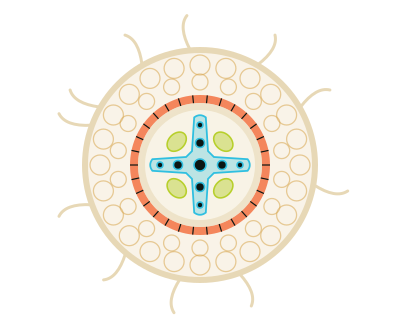
A root in transverse section, every tissue to name, in the Label lab.
The League's test
Pass the League's test
Six exam-style questions from the League. Get all six right to earn your stamp. Three wrong and you resit.

League test · Internal structure
You: ♥♥♥
Press Start when you're ready.
Remember it
Tap a card to flip it. Say the answer before you flip.
