15 wks to JAMB

L.O.E.P · BiologyNo. 15

Explainer · Excretion · about 15 min

After football in the harmattan sun you hardly wee at all, and it's dark. After a bottle of water it's clear. What decides?


Watch the lecture

Ash and Kay teach this lesson, start to finish.

⬇ Save for offline

Keeps it on this phone, so it plays with no signal and no data, at this same address.

In short

The key words in this lesson, in plain English:

Excretion:
The removal of waste made by the body's own chemical reactions, such as carbon(IV) oxide and urea. Passing out undigested food is egestion, not excretion.
Protein:
Large molecules made of chains of amino acids, used to build and repair the body. Beans, fish, eggs and meat are rich in them.
Urea:
The main nitrogen-containing waste in human urine, made in the liver from extra amino acids and removed by the kidneys.

Free this month: 1 of 1 lessons. A free account gives you 3 a month.

Every cell in your body makes waste as it works: carbon(IV) oxide from respiration, urea from spare protein, extra water and salt from what you ate and drank. Left in the blood, they poison you. Excretion is how the body gets them out, and your two kidneys, each the size of a fist, filter the whole of your blood plasma about every half hour.

Kay:On a hot harmattan afternoon, after football, I hardly wee at all and it's dark yellow. After I drink a big bottle of water it's almost clear. Who decides?
1

Play · quick rounds

Excretion or egestion? What leaves, and from where

Press Next

Five right to pass.

Right0 / 5

Excretory products and organs

Where you see it: a classroom with every window shut grows stuffy during a long lesson, partly because everyone's lungs are excreting carbon(IV) oxide and water vapour into the air. BiologyExcretionThe removal of waste made by the body's own chemical reactions, such as carbon(IV) oxide and urea. Passing out undigested food is egestion, not excretion.Breathing out and urinating are excretion; passing faeces is egestion.Science dictionary ▶ is removing the waste products of the body's own metabolism. It is not egestion: faeces are mostly food that was never absorbed, so passing them isn't excretion (though BiologyBileA greenish-yellow liquid made by the liver that helps break up fats during digestion.It is stored in the gall bladder.Science dictionary ▶ pigments in them are). The lungs excrete carbon(IV) oxide and water vapour. The kidneys excrete BiologyUreaThe main nitrogen-containing waste in human urine, made in the liver from extra amino acids and removed by the kidneys.Urea is also made in factories and sold as a nitrogen fertiliser.Science dictionary ▶, extra water and ChemistrySalt (in chemistry)The compound formed when the hydrogen of an acid is replaced by a metal or ammonium ion, as when an acid neutralises a base: sodium chloride, copper(II) sulfate.Science dictionary ▶ as urine. The skin excretes some water, salts and a little urea in sweat. The liver makes urea and breaks down old BiologyRed blood cellA biconcave disc with no nucleus, packed with haemoglobin, that carries oxygen round the body.Science dictionary ▶ into bile pigments, which leave in the faeces.
2

Work it out

Too much protein: the liver makes urea

You've eaten a big plate of beans and fish. Your body can't store the spare amino acids. Follow them through the liver.

Step 1

    Deamination and the liver

    Where you see it: fish farmers change pond water regularly, because fish release their nitrogen waste as ammonia straight into the water, while your liver turns yours into far less poisonous BiologyUreaThe main nitrogen-containing waste in human urine, made in the liver from extra amino acids and removed by the kidneys.Urea is also made in factories and sold as a nitrogen fertiliser.Science dictionary ▶. Spare amino ChemistryAcidA substance with a pH below 7 that releases hydrogen ions in water. Strong acids are corrosive; the stomach uses hydrochloric acid to digest food.Acids turn blue litmus paper red.Science dictionary ▶ can't be stored. In the liver they are BiologyDeaminationRemoval of the nitrogen-containing amino group from spare amino acids in the liver. It comes off as poisonous ammonia, which the liver turns into urea.The rest of the amino acid is used for energy or stored.Science dictionary ▶: the nitrogen-containing amino group is removed as ammonia, which is very poisonous, and quickly turned into urea, which is much less so. The rest of the molecule is used for energy or stored as BiologyGlycogenThe starch-like store of glucose in the liver and muscles, built up when insulin is released and broken down again by glucagon or adrenaline.Science dictionary ▶ or fat. Urea travels in the BiologyPlasmaThe yellowish liquid part of blood, which carries dissolved food, carbon dioxide, urea, hormones and heat.Science dictionary ▶ to the kidneys. The liver also detoxifies poisons such as ChemistryAlkanols (alcohols)Carbon compounds with the −OH (hydroxyl) group, CₙH₂ₙ₊₁OH: methanol, ethanol. Primary, secondary or tertiary by the number of carbons on the −OH carbon. They react with sodium to give hydrogen.Science dictionary ▶ and drugs, which is why heavy drinking scars it (cirrhosis).
    3

    Play · the nephron

    Follow the filtrate

    Tap the parts in the order the fluid passes through them, from the blood to the outside.

    Tap the first one

      The kidney and the nephron

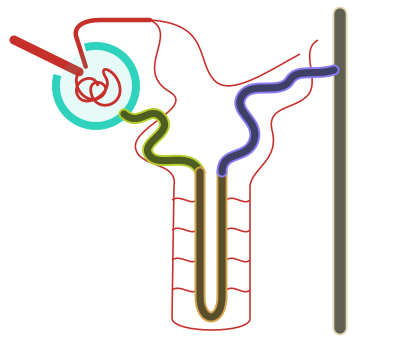
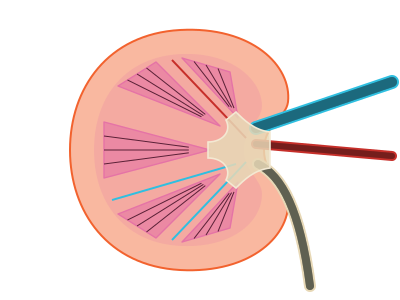
      Where you see it: biology teachers often buy a goat's kidney at the meat market and cut it lengthways, so students can see the cortex, the BiologyMedulla oblongataThe part of the brain joining the spinal cord that controls automatic actions: breathing, heartbeat, blood pressure.Science dictionary ▶ and the pelvis leading to the ureter. Each kidney has an outer cortex, an inner medulla and a pelvis that leads to the ureter. It is made of about a million BiologyNephronOne of about a million tiny tubules in each kidney that filter the blood and make urine: the kidney's working unit.Dialysis machines do the filtering job of nephrons when the kidneys fail.Science dictionary ▶, the kidney's functional units. Blood arrives in the renal BiologyArteries and veinsThe blood vessels of the heart's two directions. Arteries take blood out at high pressure (thick, elastic walls). Veins carry it back at low pressure (thinner walls and valves to stop backflow).Science dictionary ▶ and enters a knot of BiologyCapillaryThe tiniest blood vessels, with walls one cell thick, where food, oxygen and wastes pass between the blood and the body's cells.Your skin feels hot after running because more blood flows through its capillaries.Science dictionary ▶, the BiologyUltrafiltrationFiltering of the blood under high pressure in the kidney: small molecules (water, glucose, salts, urea) are squeezed out of the glomerulus into Bowman's capsule, while blood cells and plasma proteins stay in the blood.It happens because the vessel leaving the glomerulus is narrower than the one entering it.Science dictionary ▶, cupped in Bowman's capsule. The fluid filtered out flows along the proximal convoluted tubule, round the BiologySelective reabsorptionThe taking back of useful substances from the kidney tubules into the blood: all the glucose and amino acids, most of the water, and the salts the body needs. Urea is left behind.About 180 litres of filtrate a day become only about 1.5 litres of urine.Science dictionary ▶, along the distal tubule and into a collecting duct. Urine drains through the pelvis and the ureter to the bladder, and out through the urethra.
      4

      Play · arcade

      Filtered out, or kept in the blood?

      Press Start

      Swipe left if it passes into Bowman's capsule, right if it stays in the blood

      Score0Streak0Lives♥♥♥

      Ultrafiltration

      Where you see it: at antenatal clinics, nurses dip a test strip in a urine sample to check for BiologyProteinLarge molecules made of chains of amino acids, used to build and repair the body. Beans, fish, eggs and meat are rich in them.Science dictionary ▶, because protein in urine can mean the kidneys' filters are letting large molecules through. The vessel leaving the BiologyUltrafiltrationFiltering of the blood under high pressure in the kidney: small molecules (water, glucose, salts, urea) are squeezed out of the glomerulus into Bowman's capsule, while blood cells and plasma proteins stay in the blood.It happens because the vessel leaving the glomerulus is narrower than the one entering it.Science dictionary ▶ is narrower than the one entering it, so the blood there is under high PhysicsPressureHow hard a force presses on each square metre of a surface: pressure = force ÷ area, measured in pascals (Pa).A sharp knife cuts because its thin edge puts the force on a tiny area. Tractors and camels have wide tyres or feet so they don't sink.Science dictionary ▶. That squeezes small molecules out through the thin BiologyCapillaryThe tiniest blood vessels, with walls one cell thick, where food, oxygen and wastes pass between the blood and the body's cells.Your skin feels hot after running because more blood flows through its capillaries.Science dictionary ▶ walls into Bowman's capsule: ultrafiltration. Water, glucose, amino ChemistryAcidA substance with a pH below 7 that releases hydrogen ions in water. Strong acids are corrosive; the stomach uses hydrochloric acid to digest food.Acids turn blue litmus paper red.Science dictionary ▶, ChemistrySalt (in chemistry)The compound formed when the hydrogen of an acid is replaced by a metal or ammonium ion, as when an acid neutralises a base: sodium chloride, copper(II) sulfate.Science dictionary ▶ and BiologyUreaThe main nitrogen-containing waste in human urine, made in the liver from extra amino acids and removed by the kidneys.Urea is also made in factories and sold as a nitrogen fertiliser.Science dictionary ▶ pass through. Blood cells and large BiologyPlasmaThe yellowish liquid part of blood, which carries dissolved food, carbon dioxide, urea, hormones and heat.Science dictionary ▶ proteins are too big and stay in the blood. So protein or blood in the urine is a sign the filter is damaged.
      5

      Play · the tubule

      Take back what's useful: why urine has no glucose

      The filtrate now flows along the tubule. For each substance, decide: back into the blood, or leave it in the urine. Then Check.

      Decide for each one

        Glucose
        Amino acids
        Water
        Salts
        Urea

        Selective reabsorption

        Where you see it: a clinic urine test strip has a pad that changes colour if glucose is present; in a healthy person it stays unchanged, because the tubules take back all the glucose the filter let through. About 180 litres of ChemistryFiltrationSeparating an insoluble solid from a liquid by passing the mixture through a filter. The solid left behind is the residue; the liquid is the filtrate.Straining pap through a cloth is filtration.Science dictionary ▶ a day leave the BiologyUltrafiltrationFiltering of the blood under high pressure in the kidney: small molecules (water, glucose, salts, urea) are squeezed out of the glomerulus into Bowman's capsule, while blood cells and plasma proteins stay in the blood.It happens because the vessel leaving the glomerulus is narrower than the one entering it.Science dictionary ▶; only about 1.5 litres become urine. Along the tubules, useful substances are BiologySelective reabsorptionThe taking back of useful substances from the kidney tubules into the blood: all the glucose and amino acids, most of the water, and the salts the body needs. Urea is left behind.About 180 litres of filtrate a day become only about 1.5 litres of urine.Science dictionary ▶ into the BiologyCapillaryThe tiniest blood vessels, with walls one cell thick, where food, oxygen and wastes pass between the blood and the body's cells.Your skin feels hot after running because more blood flows through its capillaries.Science dictionary ▶ around them: all the glucose and amino ChemistryAcidA substance with a pH below 7 that releases hydrogen ions in water. Strong acids are corrosive; the stomach uses hydrochloric acid to digest food.Acids turn blue litmus paper red.Science dictionary ▶ (by active transport, in the proximal tubule), most of the water, and as much ChemistrySalt (in chemistry)The compound formed when the hydrogen of an acid is replaced by a metal or ammonium ion, as when an acid neutralises a base: sodium chloride, copper(II) sulfate.Science dictionary ▶ as the body needs. BiologyUreaThe main nitrogen-containing waste in human urine, made in the liver from extra amino acids and removed by the kidneys.Urea is also made in factories and sold as a nitrogen fertiliser.Science dictionary ▶ is mostly left behind, along with extra water and salts. Glucose in the urine is a sign of BiologyDiabetes mellitusA disease in which the pancreas makes too little insulin (or the body stops responding to it), so blood glucose stays high and sugar appears in the urine. Managed with diet, exercise and insulin.Science dictionary ▶: there's more in the blood than the tubules can take back.
        6

        Play · the hot day

        Who decides how much you wee?

        Try each of Kay's afternoons, and watch the hormone and the urine.

        Choose an afternoon

        pituitarykidney
        Blood–ADH–Urine–

        ADH and osmoregulation

        Where you see it: your first urine in the morning is usually darker than later in the day, because overnight you drink nothing and more BiologyADH (antidiuretic hormone)A hormone from the pituitary gland that makes the kidney's collecting ducts take back more water. More ADH means less, more concentrated urine.Sweating or salty food raises ADH; drinking lots of water lowers it.Science dictionary ▶ keeps more water in the blood. Keeping the body's water and ChemistrySalt (in chemistry)The compound formed when the hydrogen of an acid is replaced by a metal or ammonium ion, as when an acid neutralises a base: sodium chloride, copper(II) sulfate.Science dictionary ▶ in balance is osmoregulation. When your blood gets too concentrated (sweating, salty food, not drinking), the brain senses it and the BiologyPituitary glandThe pea-sized master gland under the brain. It makes growth hormone and hormones (such as TSH) that control the other endocrine glands, and is itself controlled by the hypothalamus.Science dictionary ▶ releases more ADH (antidiuretic hormone). ADH makes the walls of the collecting ducts more permeable, so more water is BiologySelective reabsorptionThe taking back of useful substances from the kidney tubules into the blood: all the glucose and amino acids, most of the water, and the salts the body needs. Urea is left behind.About 180 litres of filtrate a day become only about 1.5 litres of urine.Science dictionary ▶: a little, dark, concentrated urine. When the blood is too dilute, ADH falls, less water is taken back, and you pass lots of pale urine. Kay: it's your pituitary that decides, through ADH.
        7

        Play · quick rounds

        Excretion in other living things

        Press Next

        Five right to pass.

        Right0 / 5

        Other excretory systems

        Where you see it: rubber tappers on plantations in Edo and Delta States cut a thin strip of bark to collect latex, one of the substances textbooks list among a plant's stored waste products. BiologyProtistA single-celled organism with a nucleus, in the kingdom Protista: Amoeba (moves by pseudopodia), Paramecium (cilia) and Euglena (a flagellum and chloroplasts).Science dictionary ▶ loses CO₂ and ammonia by BiologyDiffusionThe spreading of particles from where they are more concentrated to where they are less concentrated, until evenly spread. It needs no energy.The smell of fried plantain fills the whole house by diffusion.Science dictionary ▶ through its membrane, and pumps out extra water with its BiologyMalpighian tubules, nephridia, flame cellsExcretory organs of other animals: Malpighian tubules in insects, nephridia in earthworms, flame cells in flatworms. Amoeba uses a contractile vacuole to pump out extra water.Plants have no special excretory organs.Science dictionary ▶. BiologyFlatwormsFlat, ribbon-like worms (Platyhelminthes). Many are parasites: the pork tapeworm grips the gut with the hooks and suckers on its scolex and grows new segments (proglottids) behind it.Science dictionary ▶ such as planaria use flame cells; earthworms use paired nephridia in each segment; BiologyInsectsArthropods with three body parts (head, thorax, abdomen), three pairs of legs on the thorax, one pair of antennae and usually wings: housefly, mosquito, cockroach, grasshopper.Science dictionary ▶ such as the grasshopper use Malpighian tubules that empty into the gut. Plants have no special BiologyExcretionThe removal of waste made by the body's own chemical reactions, such as carbon(IV) oxide and urea. Passing out undigested food is egestion, not excretion.Breathing out and urinating are excretion; passing faeces is egestion.Science dictionary ▶ organs: they make little waste, reuse much of it (CO₂ in BiologyPhotosynthesisHow green plants make food: chlorophyll traps light energy to turn carbon(IV) oxide and water into glucose, giving off oxygen.Every grain of rice and garri you eat began as sugar made by photosynthesis in a leaf.Science dictionary ▶, oxygen in BiologyRespirationThe breakdown of food (glucose) in every living cell to release energy. Aerobic respiration uses oxygen; anaerobic respiration does not.Breathing is not respiration: breathing brings in the oxygen that respiration in your cells uses.Science dictionary ▶), lose gases through BiologyStomataTiny pores, mostly on the underside of leaves, opened and closed by guard cells. Gases and water vapour pass through them.Many plants close their stomata in the midday heat to save water.Science dictionary ▶ and BiologyLenticelA small pore of loosely packed cells in the bark of a woody stem, through which gases are exchanged.Leaves use stomata; woody stems and roots use lenticels.Science dictionary ▶, and store other wastes (tannins, resins, latex, crystals) in old leaves and bark that are later shed.
        8

        Exam corner

        How the exam asks it

        A data question, every part of it. Tap each step to reveal it.

        In g per 100 cm³: plasma has glucose 0.1, protein 8.0, urea 0.03; the filtrate in Bowman's capsule has glucose 0.1, protein 0, urea 0.03; urine has glucose 0, protein 0, urea 2.0. Explain each difference.

        Now try the real ones

        Real JAMB, WAEC and NECO past questions on this lesson (the JAMB and WAEC ones in LOEP's words). Answer them one at a time: each is marked, with the worked answer.

        Start the 10 real questions ▶
        1. JAMB 2023Which organ mainly removes urea and excess water from the human body?
        2. WAEC 2017When excess amino acids are broken down in the liver, the main nitrogen-containing waste made is
        3. JAMB 2022Which part of the mammalian skin excretes waste such as urea and salts?
        4. WAEC 2020Birds pass out a semi-solid white paste in their droppings. Which nitrogenous waste in it helps them save water?
        5. JAMB 2021Which sequence shows the correct order in which fluid passes through a nephron?
        6. WAEC 2015Which of the following loses water but NO mineral salts from a healthy person?
        7. JAMB 2015Which of the following is a plant growth hormone rather than a waste product?
        8. WAEC 2020Inside the kidney, urine collects in a funnel-shaped space before it passes into the ureter. This space is the
        9. JAMB 2007Which plant product is used by tanneries to turn animal skins into leather?
        10. JAMB 2018Fresh-water Paramecium has a contractile vacuole that fills and empties repeatedly. What is the main job of this vacuole?

        Label it

        The kidney in section, and a single nephron from glomerulus to collecting duct, in the Label lab.
        9

        The League's test

        Pass the League's test

        Six exam-style questions from the League. Get all six right to earn your stamp. Three wrong and you resit.

        The League's badge

        League test · Excretion

        You: ♥♥♥

        Press Start when you're ready.

        Remember it

        Tap a card to flip it. Say the answer before you flip.

        Ash:And if the kidneys fail, a dialysis machine does the filtering instead, through a membrane, a few hours at a time, until a transplant can be found.
        Excretion: Biology explained, with games · L.O.E.P