15 wks to JAMB

L.O.E.P · BiologyNo. 04

Explainer · Digestion and animal nutrition · about 15 min

Where does your amala and ewedu actually go after you swallow it?

Watch the lecture

Ash and Kay teach this lesson, start to finish.

⬇ Save for offline

Keeps it on this phone, so it plays with no signal and no data, at this same address.

In short

The key words in this lesson, in plain English:

Digestion:
Breaking food down into small molecules the body can absorb, by chewing, churning and enzymes.
Ileum:
The long last part of the small intestine, where digestion finishes and the products are absorbed through its villi.
Vitamin:
A substance needed in tiny amounts to keep the body healthy. Lacking one causes a deficiency disease: no vitamin C, scurvy; no vitamin D, rickets.

Free this month: 1 of 1 lessons. A free account gives you 3 a month.

A plate of amala and ewedu with a piece of meat goes in at one end. Twelve hours or so later, the starch is in your blood as glucose, the meat is rebuilding your muscles as amino acids, and what's left leaves at the other end. In between is a 9-metre tube with its own teeth, acid, chemical scissors and millions of tiny fingers. That's digestion.

Kay:Nine metres. I've been carrying a nine-metre tube around this whole time and nobody told me.
1

Play · build a plate

What's on the plate?

A balanced diet has every class of food in the right amounts. Sort each item onto the class it gives you most of.

Drag each food to its class (or tap it, then tap the class)

Carbohydratesenergy
Proteinsgrowth and repair
Fats and oilsstored energy, warmth
Vitamins and mineralshealth, in small amounts

The classes of food

Where you see it: a pot of egusi soup brings several classes together: BiologyProteinLarge molecules made of chains of amino acids, used to build and repair the body. Beans, fish, eggs and meat are rich in them.Science dictionary ▶ from the melon seeds and fish, fat from the palm oil and the seeds, and BiologyVitaminA substance needed in tiny amounts to keep the body healthy. Lacking one causes a deficiency disease: no vitamin C, scurvy; no vitamin D, rickets.Science dictionary ▶ and minerals from the leafy vegetables. BiologyCarbohydrateSugars and starch: compounds of carbon, hydrogen and oxygen that are the body's main source of energy. Rice, yam, garri and bread are rich in them.Science dictionary ▶ (starch, sugars) give energy. Proteins build and repair the body. Fats and oils store energy and keep you warm. Vitamins and BiologyMineral saltsElements such as iron, calcium and iodine, needed in small amounts by animals (and nitrates, phosphates and magnesium by plants).Science dictionary ▶ are needed in small amounts to keep the body working. Water is the medium for every reaction, and BiologyRoughagePlant fibre, mostly cellulose, that we can't digest. It keeps food moving through the gut and prevents constipation.Science dictionary ▶ (fibre) keeps food moving through the gut. A BiologyBalanced dietA diet with all the classes of food (carbohydrates, proteins, fats and oils, vitamins, mineral salts, water and roughage) in the right amounts for a person's needs.Science dictionary ▶ has them all in the right proportions; too little protein in a young child's diet causes BiologyKwashiorkorA disease of young children caused by too little protein in the diet, with a swollen belly, thin hair and weak muscles.Adding crayfish, soya or beans to a baby's pap helps prevent kwashiorkor.Science dictionary ▶.
2

Ash's lab

Food tests

Four mystery samples. Pick a sample, then a test, and watch the tube. Find out what each one contains.

Pick a sample, then a test

    Identified0 / 4

    The food tests

    Starch: iodine solution turns from brown to blue-black. BiologyReducing sugarA sugar, such as glucose, that turns blue Benedict's solution green, orange or brick-red when heated with it.Science dictionary ▶ (glucose): heat with Benedict's solution and blue turns brick-red (through green and orange for less sugar). BiologyProteinLarge molecules made of chains of amino acids, used to build and repair the body. Beans, fish, eggs and meat are rich in them.Science dictionary ▶: ChemistryBiuret testThe test for protein: add sodium hydroxide solution and a few drops of copper(II) sulphate solution; a violet (purple) colour shows protein. Starch is tested with iodine, which turns blue-black.Glucose is tested with Fehling's or Benedict's solution: a brick-red precipitate.Science dictionary ▶ solution turns blue to violet (Millon's reagent instead gives a white ChemistryPrecipitateAn insoluble solid that forms when two solutions are mixed, such as white silver chloride from silver trioxonitrate(V) and a chloride.Science dictionary ▶ that turns red on warming). Fats and oils: rub on paper and a translucent greasy spot is left; or the emulsion test with ChemistryEthanolThe alcohol in alcoholic drinks (C₂H₅OH). It is also used as a fuel and a solvent.The liver breaks it down in steps.Science dictionary ▶ gives a cloudy white layer.
    3

    Play · bite it

    The right tooth for the job

    This is your lower jaw. For each bite, tap the kind of tooth that does the work. Get 5 right.

    Press Start

    Right0 / 5

    Teeth

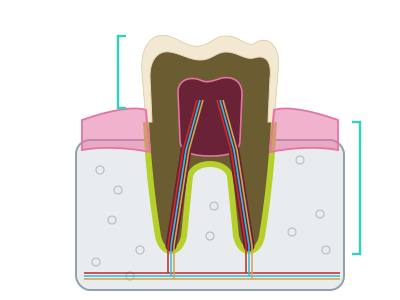
    Where you see it: with roasted corn bought by the roadside, your BiologyIncisorA chisel-shaped front tooth for cutting and biting.Science dictionary ▶ at the front bite the grains off the cob, then the broad BiologyPremolars and molarsThe broad cheek teeth with ridges (cusps), for crushing and grinding food.Science dictionary ▶ at the back grind them. Incisors (chisel-shaped, at the front) cut and bite. BiologyCanine (tooth)A pointed tooth beside the incisors, for gripping and tearing. Dogs and lions have very long ones.Science dictionary ▶ (pointed) grip and tear. Premolars and molars (broad, with cusps) crush and grind. An adult has 32: in each half-jaw, 2 incisors, 1 canine, 2 premolars, 3 molars. Each tooth is covered in BiologyEnamelThe hard, white outer layer of a tooth's crown: the hardest substance in the body. Acid from bacteria feeding on sugar dissolves it.Science dictionary ▶, over dentine, round a pulp cavity of nerves and BiologyArteries and veinsThe blood vessels of the heart's two directions. Arteries take blood out at high pressure (thick, elastic walls). Veins carry it back at low pressure (thinner walls and valves to stop backflow).Science dictionary ▶. Sugar feeds mouth BiologyBacteriumA tiny single-celled organism with no true nucleus. Some cause disease (cholera, typhoid); many are useful, making yoghurt, fixing nitrogen and rotting dead matter.Science dictionary ▶ whose ChemistryAcidA substance with a pH below 7 that releases hydrogen ions in water. Strong acids are corrosive; the stomach uses hydrochloric acid to digest food.Acids turn blue litmus paper red.Science dictionary ▶ dissolves enamel: tooth decay. A goat has no upper incisors or canines, but a gap and big grinding cheek teeth; a dog has huge canines for tearing.
    4

    Play · the journey

    Down the tube

    A mouthful of food sets off. Tap where it goes next, all the way through.

    Where does food go first?

      The alimentary canal

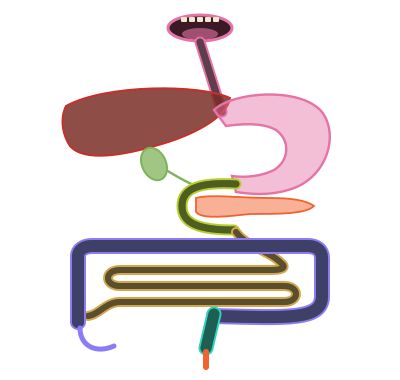
      Where you see it: you can still swallow water while bending over or lying down, because BiologyPeristalsisWaves of muscle squeezing that push food along the gut, from the throat to the intestines.It works even if you're upside down.Science dictionary ▶, not PhysicsGravityThe force that pulls masses towards each other. On Earth it pulls objects down at about 9.8 m/s².The Moon's gravity causes the tides.Science dictionary ▶, pushes food and drink down the BiologyOesophagusThe muscular tube that carries food from the mouth to the stomach by peristalsis.Science dictionary ▶. Food is moved along the gut by peristalsis: waves of muscle contraction behind it. The mouth chews it and starts BiologyDigestionBreaking food down into small molecules the body can absorb, by chewing, churning and enzymes.It starts in the mouth with saliva.Science dictionary ▶ starch; the oesophagus carries it down; the stomach churns it with ChemistryAcidA substance with a pH below 7 that releases hydrogen ions in water. Strong acids are corrosive; the stomach uses hydrochloric acid to digest food.Acids turn blue litmus paper red.Science dictionary ▶ and BiologyPepsinThe stomach enzyme that breaks proteins into peptides. It works in the stomach's acid conditions.Science dictionary ▶; in the BiologyDuodenumThe first part of the small intestine, where bile and pancreatic juice join the food.Science dictionary ▶ BiologyBileA greenish-yellow liquid made by the liver that helps break up fats during digestion.It is stored in the gall bladder.Science dictionary ▶ and pancreatic juice join it; the BiologyIleumThe long last part of the small intestine, where digestion finishes and the products are absorbed through its villi.Science dictionary ▶ finishes digestion and absorbs the products; the BiologyColonThe first, wide part of the large intestine, where most of the remaining water is absorbed from undigested food.Science dictionary ▶ takes back water; the rectum stores the faeces until they leave through the anus (egestion). The liver, gall bladder and pancreas are not part of the tube, but pour their juices into it.
      5

      Play · pick the scissors

      Chemical scissors

      Big food molecules are chains, too big to pass into the blood. Choose the right enzyme to cut each one, in the order the meal meets them.

      Press Start

      Step0 / 6

      Digestive enzymes

      Where you see it: cooks soften tough meat by wrapping it in pawpaw leaves or adding unripe pawpaw, because pawpaw contains papain, an BiologyEnzymeA protein that speeds up a chemical reaction in living things without being used up, like the enzymes that break down food.Most enzymes stop working if they get too hot.Science dictionary ▶ that breaks down BiologyProteinLarge molecules made of chains of amino acids, used to build and repair the body. Beans, fish, eggs and meat are rich in them.Science dictionary ▶. Enzymes are protein ChemistryCatalystA substance that speeds up a reaction by giving it an easier route (lower activation energy), and is unchanged at the end.Car exhausts contain catalytic converters; your saliva contains enzyme catalysts.Science dictionary ▶: each works on one kind of food, at its own best temperature (body temperature) and ChemistrypHA scale from 0 to 14 for how acidic or alkaline a solution is: below 7 acidic, 7 neutral, above 7 alkaline.Farmers test soil pH before adding lime to acidic soil.Science dictionary ▶. BiologyAmylaseThe enzyme in saliva and pancreatic juice that breaks starch down into maltose.Science dictionary ▶ (BiologySalivaThe liquid in the mouth. It wets food and contains an enzyme (amylase) that starts digesting starch.A cow makes over 100 litres of it a day.Science dictionary ▶, pancreas) turns starch into maltose; BiologyMaltaseThe enzyme that splits maltose into glucose in the small intestine.Science dictionary ▶ turns maltose into glucose. BiologyPepsinThe stomach enzyme that breaks proteins into peptides. It works in the stomach's acid conditions.Science dictionary ▶ (stomach, ChemistryAcidA substance with a pH below 7 that releases hydrogen ions in water. Strong acids are corrosive; the stomach uses hydrochloric acid to digest food.Acids turn blue litmus paper red.Science dictionary ▶) and BiologyTrypsinAn enzyme from the pancreas that breaks proteins into peptides in the small intestine.Science dictionary ▶ (pancreas) break proteins into peptides; peptidases finish them into amino acids. BiologyLipaseThe enzyme that breaks fats and oils into fatty acids and glycerol, after bile has emulsified them.Science dictionary ▶ (pancreas) turns fats into fatty acids and glycerol, after BiologyBileA greenish-yellow liquid made by the liver that helps break up fats during digestion.It is stored in the gall bladder.Science dictionary ▶, which is not an enzyme, has broken the fat into tiny droplets (emulsification) and ChemistryNeutralisationThe reaction between an acid and a base that produces a salt and water, cancelling out the acid.Acid + base → salt + water.Science dictionary ▶ the stomach acid.
      6

      Play · absorb it

      Why the ileum has fingers

      Digested food has to get out of the gut and into the body. Run the same food past a flat wall, then a wall covered in villi, and count what gets absorbed.

      Pick a wall, then run

      blood capillaries: glucose, amino acidslacteals: fatty acids and glycerol
      Absorbed–

      Absorption

      Where you see it: clinics give oral rehydration solution to children with diarrhoea; the glucose in it helps the lining of the small intestine absorb ChemistrySalt (in chemistry)The compound formed when the hydrogen of an acid is replaced by a metal or ammonium ion, as when an acid neutralises a base: sodium chloride, copper(II) sulfate.Science dictionary ▶ and water into the blood. The BiologyIleumThe long last part of the small intestine, where digestion finishes and the products are absorbed through its villi.Science dictionary ▶ is long, and its lining is folded into millions of BiologyVillusOne of millions of tiny finger-like folds lining the ileum, giving a huge surface for absorbing digested food. Each has blood capillaries and a lacteal.Science dictionary ▶, each covered in microvilli: a huge surface area. Each villus has a wall one cell thick, a dense network of BiologyCapillaryThe tiniest blood vessels, with walls one cell thick, where food, oxygen and wastes pass between the blood and the body's cells.Your skin feels hot after running because more blood flows through its capillaries.Science dictionary ▶ that take glucose and amino ChemistryAcidA substance with a pH below 7 that releases hydrogen ions in water. Strong acids are corrosive; the stomach uses hydrochloric acid to digest food.Acids turn blue litmus paper red.Science dictionary ▶ to the liver (by the hepatic portal vein), and a BiologyLactealThe small lymph vessel in each villus that absorbs fatty acids and glycerol.Science dictionary ▶ that takes fatty acids and glycerol into the BiologyLymphTissue fluid that has leaked from capillaries to bathe the cells, drained back towards the blood in lymph vessels.Science dictionary ▶. Water is absorbed mostly in the ileum, and the rest in the BiologyColonThe first, wide part of the large intestine, where most of the remaining water is absorbed from undigested food.Science dictionary ▶.
      7

      Play · arcade

      Vitamin or mineral?

      Press Start

      Swipe left if it comes from lacking a vitamin, right for a mineral

      Score0Streak0Lives♥♥♥
      Ash:Night blindness is lack of vitamin A, which is why mama says eat your carrots and your red palm oil. She was doing biology the whole time.
      8

      Exam corner

      How the exam asks it

      The classic long answer. Tap each step to reveal it.

      Describe what happens to a slice of buttered bread (starch and fat) from the mouth until its products are absorbed.

      Now try the real ones

      Real JAMB, WAEC and NECO past questions on this lesson (the JAMB and WAEC ones in LOEP's words). Answer them one at a time: each is marked, with the worked answer.

      Start the 10 real questions ▶
      1. JAMB 2023Which of the following is NOT part of the alimentary canal?
      2. WAEC 2019Eating sweets often without brushing the teeth leads to tooth decay mainly because
      3. JAMB 2022A mould grows on stale bread and feeds on it. This feeding relationship is called
      4. NECO 2008The dental formula i 3/3, c 1/1, pm 4/4, m 2/3 represents that of a ____________
      5. JAMB 2018A molecule of maltose is formed when two molecules of which sugar join?
      6. WAEC 2004In a dog, which teeth form the large carnassial pair used to shear flesh?
      7. JAMB 2023Digestive enzymes help the body by
      8. WAEC 2017The complex, energy-rich organic matter that organisms take in to supply energy and materials for growth is called
      9. JAMB 2019A tapeworm has a very thin body covering. This allows it to
      10. JAMB 2018A man who rarely eats fruits and vegetables develops bleeding, swollen gums. He is lacking

      Label it

      The alimentary canal and the inside of a tooth, in the Label lab.
      9

      The League's test

      Pass the League's test

      Six exam-style questions from the League. Get all six right to earn your stamp. Three wrong and you resit.

      The League's badge

      League test · Digestion and nutrition

      You: ♥♥♥

      Press Start when you're ready.

      Remember it

      Tap a card to flip it. Say the answer before you flip.

      Kay:That's digestion. Next time someone asks if you've eaten, tell them it's still in your duodenum. Watch their face.
      Digestion and animal nutrition: Biology explained, with games